
The APRU Global Health Program successfully launched its inaugural Mini Certificate in Global Aging, a free virtual training delivered over three sessions from late February to mid-March 2026. Open for students across APRU member universities, the program attracted 683 registrants, with some 159 participants earning certificates upon successful completion. Participants are from 21 economies and across at least 65 academic disciplines.
Co-developed by the Global Health Program Director Professor Mellissa Withers (Keck School of Medicine, University of Southern California) and Professor Jonathan Guillemot (School of Medicine, Universidad San Francisco de Quito), the course builds on the successful model of the APRU Mini Certificate in Health Research Ethics, also established by Professor Withers since 2021. Designed for undergraduate and graduate students with limited prior exposure to the subject, the new Mini Certificate introduces foundational knowledge and global perspectives on demographic aging.
The world is undergoing a profound demographic transformation as populations age at an unprecedented rate. Advances in healthcare, nutrition, and living standards have extended life expectancy, while declining birth rates are reshaping the age structure of societies. Against this backdrop, the Mini Certificate in Global Aging offers three two-hour online sessions combining expert lectures with interactive breakout discussions. Participants also complete online homework via a shared course website and, upon successful completion of all components, receive a certificate of participation.
The program features six speakers: Angelique Chan (National University of Singapore), Laurence Lloyd Parial (University of the Philippines Manila), Hiroki Nakatani (Keio University), Andrew Sixsmith (Simon Fraser University), Zhaoli Joy Dai-Keller (The University of Sydney), and Po-Ju Chang (National Taiwan University). Together, they introduce key topics including global and regional demographic trends; the impacts of aging on health systems, labor markets and social policy; the foundations and consequences of ageism; and pathways to healthy and active aging, including age-friendly urban design and innovation.
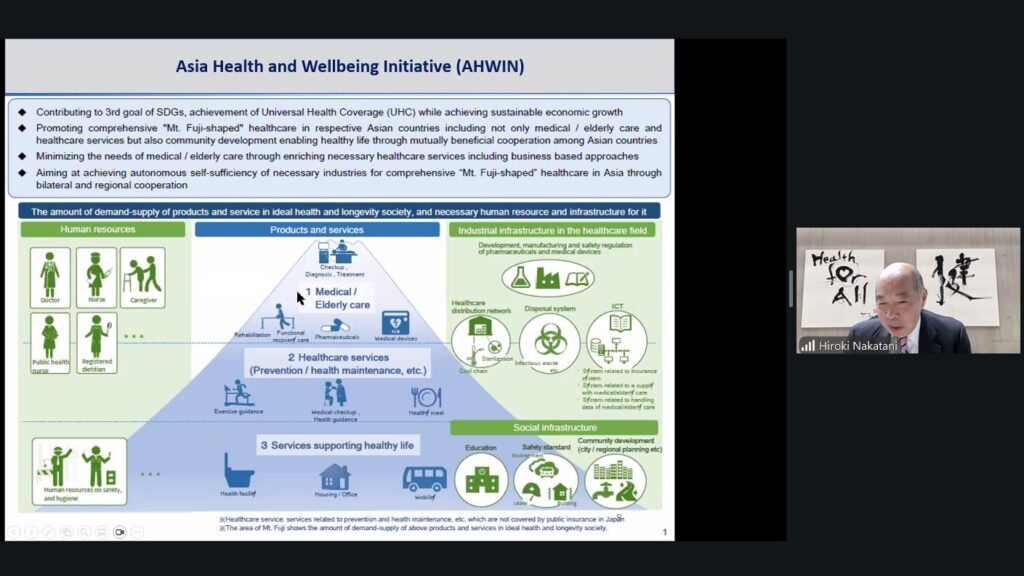
Dr. Hiroki Nakatani from Keio University is presenting the lecture “Implication of demographic aging: a world-changing transition”
Emphasizing both Global North and Global South perspectives, the course enables students to connect global frameworks with local contexts. Through case studies and small-group discussions facilitated by 40 experts from across the APRU network, participants learn to analyze local examples of demographic aging, describe the UN Decade of Healthy Ageing’s key action areas, and identify principles for building more age-inclusive communities.
“This course has changed my view of global aging, helping me see it not only as a challenge for health systems and economies, but also as an opportunity to rethink how societies support active, meaningful aging,” said Charlotte Gai, a student from The University of Auckland. “My key takeaway is that aging should be approached from a multidisciplinary perspective, combining health, social policy, and community support.”