Key Partners
About APEC University Leaders’ Forum (AULF)
About AULF 2026
About Shenzhen City
Conference Venue
Registration
About the Host
Travel Tips to Shenzhen
Places to visit in Shenzhen

Since 2017, the Association of Pacific Rim Universities (APRU) has hosted the APEC University Leaders’ Forum (AULF). The Forum convenes presidents of the leading Asia-Pacific research universities together with leaders from major global corporations and government to share insights and discuss the critical issues of the region as an official side event of the APEC CEO Summit. ​

APEC governments and business wish to relate more closely to research universities on issues of importance to APEC economies including innovation, labour mobility, disaster risk reduction, sustainability and growth, and gender equity and human resource development.

Universities offer insights on the key challenges of the region and contribute to the social and economic well-being of citizens, on the basis of their research expertise in science and engineering, social sciences and humanities, and their leading role in technology, innovation, and entrepreneurship.

This Forum with a focus on the issues of the Asia-Pacific region has enabled thought leaders in academia, business and industry, and government, to have a high-level dialogue on partnering for knowledge creation in solving current challenges.

Past AULF

To align with APEC 2026 theme, “Building an Asia-Pacific Community to Prosper Together “, this the AULF 2026 is a forum to provide a centralized academic voice from APRU universities leaders to provide knowledge on achieving APEC priorities

Theme:
“Open, Innovative, Collaborative: Universities as Catalysts for Asia-Pacific’s Prosperous Future”


Join global university leaders, policymakers and industry innovators at the APRU APEC University Leaders’ Forum to redefine the role of higher education in the 21st-century economy. As the Asia-Pacific region navigates rapid technological shifts and sustainability challenges, universities are stepping up as the primary architects of regional innovation. Under the theme “Universities as Catalysts for Asia‑Pacific’s Prosperous Future”, this high-level forum convenes thought leaders to explore how higher education drives inclusive growth, innovation, and entrepreneurship across the region.

Topics:

  • Higher Education as a Driver of Inclusive Growth: Expanding Education Access, Equity, and Collaboration Across the Asia-Pacific
  • From Knowledge to Impact – Universities at the Core of Innovation
  • Building Resilient Entrepreneurial Ecosystems in the GBA and Across the Asia‑Pacific


Discussions will highlight universities’ pivotal role and explore the way forward in expanding education access, fostering regional collaboration, developing talent and building ecosystems that facilitate entrepreneurship to translate knowledge and innovation into societal and economic impact – ensuring knowledge advancements benefit all sectors of society. Delegates will gain fresh insights into how academia, industry, and policy can align to shape a more equitable, sustainable, and prosperous Asia‑Pacific future. 

Event Date: 

  • November 16, 2026 (Forum day) 
  • November 15, 2026 (welcome reception, campus tour and firms visit to technology company in Shenzhen)


This event is by invitation-only.


Shenzhen owes its development to China’s Reform and Opening-up. Established as a city in March 1979, it became the country’s first Special Economic Zone in August 1980.

Known as the “the City of Peng”, Shenzhen is a coastal city in southern China, adjacent to Hong Kong, China. Shenzhen administers nine districts—Futian, Luohu, Yantian, Nanshan, Bao’an, Longgang, Longhua, Pingshan, and Guangming—as well as Dapeng New District and the Shenzhen-Shanwei Special Cooperation Zone.

Over the past four decades, Shenzhen has transformed from a small fishing village into a modern international metropolis—a miracle in the history of global development achieved by the Chinese people. In 2025, Shenzhen, s GDP reached 3.87318 trillion yuan, ranking third nationwide. The city, s total output value and value-added of industrial enterprises above designated size have maintained the top position among Chinese cities for four consecutive years. Its total import and export volume has led all Chinese cities for two consecutive years.

Known as China’ s “Silicon Valley” and the “Southern Center of Technology”, Shenzhen is a major hub for high-tech industries and advanced manufacturing. It is home to world-renowned technology companies such as Huawei, BYD, Tencent, and DJI. It is also the first Chinese city to be designated a “City of Design” by UNESCO. In 2025, the Shenzhen-Hong Kong-Guangzhou innovation cluster topped the Global Innovation Index rankings. Shenzhen’s R&D investment intensity ranked first among Chinese cities, while its PCT international patent applications maintained the leading position nationwide.

Shenzhen is striving to build itself into an economic center of greater global influence and a modern, international metropolis, aiming to lead the way and serve as a pioneering force in advancing Chinese modernization.

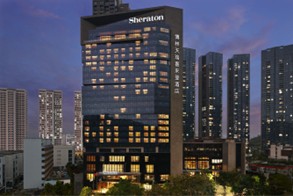
Sheraton Shenzhen Nanshan 

深圳博林天瑞喜来登酒店

Website: https://www.marriott.com/en-us/hotels/szxsn-sheraton-shenzhen-nanshan/overview/

The pleasant 5-star Sheraton Shenzhen Nanshan hotel, located approximately 900 metres from the Shenzhen Wildlife Zoo, offers an indoor swimming pool and Wi-Fi in public areas. The smoke-free hotel offers a banquet hall, about a 10-minute ride from the massive Happy Valley of Shenzhen Water Park, making it an attractive choice.

There is a shared lounge and a golf course provided on site. As part of its commitment to guest wellness, the Sheraton Shenzhen Nanshan includes a fitness studio featuring fitness classes.

This Shenzhen hotel is nestled in the Nanshan district, just a few steps from the restaurant Xili Kitchen. The open-air zoo “Shenzhen Safari Park” in Shenzhen is 2.4 km from the Sheraton Shenzhen Nanshan. Guests might as well visit Eco Park of University Town, which is just 600 metres away. Entertainment in the area includes the Shenzhen Noble Merchant Golf Club around a 15-minute drive from the accommodation. The nearest bus stop is Gate of University Town, located only 0.8 km away, and Shenzhen Luohu train station is 24 km away.

The event is by invitation only. Please only register when you received an invitation from us only. 

The registration will start in May.

Please contact [email protected] if you wish to receive an invitation.

Host


As a network of leading universities linking the Americas, Asia, and Australasia, APRU (the Association of Pacific Rim Universities) brings together thought leaders, researchers, and policy-makers to exchange ideas and collaborate on practical solutions to the challenges of the 21st century.

We leverage our members’ collective education and research capabilities into the international public policy process. In the post-pandemic era, our strategic priorities focus on:

1. providing a neutral platform for high-level policy dialogue;

2. exploring innovative solutions for a sustainable future; and

3. supporting diversity, inclusion, and minorities.

APRU’s primary activities support these strategic priorities, focusing on critical areas such as disaster risk reduction, women in leadership, indigenous knowledge, virtual student exchange, e-sports, population aging, global health, sustainable cities, artificial intelligence, waste management, and more. 

The campus of Tsinghua University is situated in northwest Beijing on the site of the former imperial gardens of the Qing Dynasty, and surrounded by a number of historical sites.

Tsinghua University was established in 1911, originally under the name “Tsing Hua Imperial College”. The school was renamed “Tsing Hua College” in 1912. The university section was founded in 1925. The name “National Tsing Hua University” was adopted in 1928.

The faculty greatly valued the interaction between Chinese and Western cultures, the sciences and humanities, the ancient and modern. Tsinghua scholars Wang Guowei, Liang Qichao, Chen Yinque and Zhao Yuanren, renowned as the “Four Tutors” in the Institute of Chinese Classics, advocated this belief and had a profound impact on Tsinghua’s later development.

Following the outbreak of the War of Resistance against Japanese Aggression in 1937, National Tsing Hua University, National Peking University and Nankai University merged to form Lin-shih-ta-hsueh, which was renamed the National South-West Associated University in 1938 after moving to Kunming. In 1946 The University was moved back to its original location in Beijing after the war.

After the founding of the People’s Republic of China, the University was molded into a polytechnic institute focusing on engineering in the nationwide restructuring of universities and colleges undertaken in 1952. In November 1952, Mr. Jiang Nanxiang became the President of the University. He made significant contributions in leading Tsinghua to become the national center for training engineers and scientists with both professional proficiency and personal integrity.

Since China opened up to the world in 1978, Tsinghua University has developed at a breathtaking pace into a comprehensive research university. At present, the university has 22 schools and 59 departments with faculties in science, engineering, humanities, law, medicine, history, philosophy, economics, management, education and art.

With the motto of “Self-discipline and Social Commitment” and the spirit of “Actions Speak Louder Than Words”, Tsinghua University is dedicated to the well-being of Chinese society and to world development. As one of China’s most prestigious and influential universities, Tsinghua is committed to cultivating global citizens who will thrive in today’s world and become tomorrow’s leaders. Through the pursuit of education and research at the highest level of excellence, Tsinghua is developing innovative solutions that will help solve pressing problems in China and the world.

Tsinghua University launched its global strategy in 2016. Guided by this strategy, Tsinghua aims to foster innovative talents with global competence, serve China and the world through research, and strengthen its institutional competitiveness and global impact.

Since the formation of the global strategy, Tsinghua has established new global institutions dedicated to promoting international collaboration and providing students, faculty and staff with overseas opportunities to study, research and undertake internships.

Tsinghua University also initiated four University alliances, including the China-UK Humanities Alliance for Higher Education, Asian Universities Alliance (AUA), Global Alliance of Universities on Climate (GAUC), and Global MOOC and Online Education Alliance.

In 2021, Tsinghua University formulated its Global Strategy 2030, in order to enhance its level of international exchange and cooperation to higher standards, and contribute to building a community with a shared future for mankind.

About CUHK- Shenzhen

The Chinese University of Hong Kong, Shenzhen (CUHK-Shenzhen) was founded with the approval of the Ministry of Education to explore a new path in higher education bridging China and the world. Integrating the best of East and West, the University is committed to providing top-tier education and fostering an enriching research environment. Our mission is to cultivate innovative talent equipped with a global perspective, an understanding of Chinese cultural traditions, and a strong sense of social responsibility.

Currently, approximately 13,000 students from more than 50 countries and regions study at CUHK-Shenzhen.

Over the past decade, the University has established eight schools: Management and Economics, Science and Engineering, Humanities and Social Sciences, Data Science, Music, Medicine, Public Policy, and Artificial Intelligence. Alongside the Graduate School, they offer 30 undergraduate and 62 postgraduate programmes.

CUHK-Shenzhen adopts a unique collegiate system comprising eight colleges: Shaw, Diligentia, Muse, Harmonia, Ling, Minerva, Duan Family, and the Eighth College. This system breaks down barriers between majors, grades, and backgrounds, providing an immersive platform for holistic, whole-person education.

Emphasizing global awareness, CUHK-Shenzhen has partnered with over 160 renowned universities across 30 countries to offer nearly 290 international programmes. Consequently, over 60% of our students graduate with credit-bearing overseas experience.

The University’s global recruitment has gathered the world’s leading scholars and scientists here at CUHK-Shenzhen. By now, around 700 distinguished scholars have joined our faculty team, each of whom has had teaching or research experience overseas, including 5 Nobel laureates, and over 50 fellow members of science academies around the world. Together with their knowledge and expertise, they bring to CUHK-Shenzhen their vision, creativity, passion and dedication for education.

Aligning with the strategic development of the Greater Bay Area, the University is rapidly advancing research in cutting-edge fields, including big data, intelligent networks, bioinformatics, advanced materials, finance, robotics, and precision medicine, striving to evolve into a premier world-class university. 


Average Weather

  • High of 79°F / 26°C
  • Low of 64°F / 18°C
  • Fresh mornings with light mist and gentle breezes
  • Bright and vibrant sunny afternoons with clear skies
  • Warm, pleasant evenings ideal for outdoor walks


What to Pack

  • Comfortable walking shoes
  • China uses a 220V, 50Hz power supply. The main plug types are Type C and Type I.
  • Business casual attire
  • A light jacket or thin sweater


Payment

Cashless payment is prevalent in Shenzhen. Still, it is advisable to carry a small amount of Chinese Yuan (CNY) cash for small local vendors.

  • Mobile payments (WeChat Pay & Alipay) are the most popular and accepted nearly everywhere.
  • Visa and Mastercard are widely accepted at major hotels, restaurants and large shopping malls.
  • American Express and other international cards have limited coverage; a backup payment method is recommended.
Contact
Us
×
Speaker