

This article was featured on University World News on May 21, 2025 and written by Jae Weon Choi, President of the Pusan National University.
There’s something delightfully ironic about gathering university leaders, tech innovators and policymakers on an island well-known for vacationing and the art of slowing down to talk about accelerating the future with artificial intelligence.
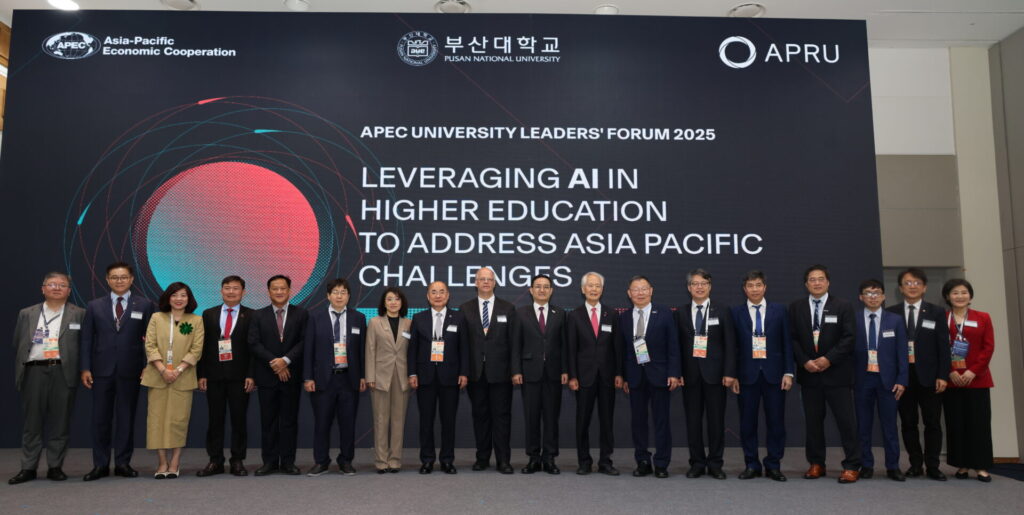
Yet for two days in Jeju, South Korea, under the banner of the 2025 Asia-Pacific Economic Cooperation (APEC) University Leaders’ Forum, co-hosted by Pusan National University and the Association of Pacific Rim Universities (APRU), that’s exactly what happened.
And what emerged was more than just a conference. It was a collaborative call to action – a recognition that if AI is to serve humanity, then humanity must first decide what kind of intelligence we value most.
| This article is part of a series on Pacific Rim higher education and research issues published by University World News and supported by the Association of Pacific Rim Universities. University World News is solely responsible for the editorial content. |
The conversations were urgent, bold and refreshingly honest. How do we ensure that AI doesn’t widen the digital divide but instead becomes a bridge?
How do universities, industries and governments co-design systems that are not only intelligent but also just? And, perhaps most importantly, how do we teach our students to be better humans in a world increasingly shaped by machines?
Fairness: A recurring theme
Fairness was a recurring theme throughout the forum – fair access to AI tools, fair representation in data, and fair chances for regions with fewer resources.
As I listened, it struck me that the conversation wasn’t just about machines or data but about how institutions like ours make decisions that shape people’s lives.
Whether it’s university admissions, scholarship awards or job hiring, we like to believe that we’re choosing the “best” candidate. Enter the trusted principle of merit. What could be more fair than that?
But merit, as it turns out, is a bit like an AI algorithm: it looks objective until you peek under the hood.
Because merit, in practice, is often a proxy for privilege. It’s shaped by those who had access to a stable internet connection in 7th grade, who went to better-funded schools and who had the luxury of time for extracurriculars instead of part-time work. And those things are often closely tied to race, nationality, zip code and family wealth – none of which is earned.
So when we say we’re selecting “the best”, we may actually be rewarding the luckiest. If that’s fairness, it needs a reboot.
If fairness is a system, then education is its foundation – and right now, that foundation is uneven. No algorithm can fix the fact that a child born into poverty has fewer chances long before a résumé ever hits a desk. That’s why our work doesn’t end at identifying bias in AI models; it begins with confronting the structural inequities that feed them.
This means continuing to educate – not just with more degrees, but with deeper awareness.
Awareness of how socioeconomic status, race, gender and geography quietly gate-keep opportunities. Awareness that data reflects the world as it is, not as it should be. And awareness that fairness isn’t a setting you can toggle on.
Tackling these issues requires more than good intentions. It requires action and cooperation.
Universities can’t do this alone. Neither can industry nor government. But together – through communities like APEC – we can begin building systems that don’t just admire fairness as a value but embed it in practice.
Regional platform
One way forward could be the launch of a joint initiative with real reach and impact – “Campus APEC” – a regional platform for education, research and innovation, led by APRU universities and supported by governments and industry partners. The goal: to develop the next generation of AI experts while closing the AI literacy gap and advancing fairness.
The idea is that member universities could jointly offer free, open access online courses covering everything from AI development and machine learning to ethics, governance and inclusive design. These courses could be translated into multiple languages and tailored for learners across socioeconomic contexts.
Beyond education, Campus APEC could fund research on algorithmic bias, equitable AI deployment in public services and culturally sensitive data practices, with grants co-sponsored by governments and private-sector partners.
In addition to offering open-access online courses in AI, Campus APEC could also support student exchange programmes that place students in short-term, AI-focused immersion experiences across the region – pairing technical training with exposure to diverse cultural and policy contexts.
Faculty collaborations could be deepened through joint research labs, co-taught virtual courses and visiting scholar residences focused on interdisciplinary approaches to AI governance, fairness and application.
Collaborative faculty working groups could also be tasked with producing open-access policy briefs and educational toolkits to guide ethical AI use in education, labour markets and public administration.
And to keep the dialogue ongoing and inclusive, Campus APEC could host regular AI-for-Good hackathons, regional policy roundtables and student-led innovation forums, bringing together students, researchers, policymakers and civil society leaders from across the Pacific Rim.
Campus APEC is just one example of how we can move from abstract ideals to concrete action. Through initiatives like this, we can begin addressing a deeper challenge: ensuring that AI innovation remains anchored in human values. We built AI. To make it work, we need to build a society that is human.
Jae Weon Choi is president of Pusan National University, South Korea. PNU co-hosted the 2025 APEC University Leaders’ Forum (AULF) that took place from 12 to 13 May in Jeju, South Korea.
This article is a commentary. Commentary articles are the opinion of the authors only and not their employer and do not necessarily reflect the views of University World News.