
This article was featured on University World News on May 14, 2025 and written by Yojana Sharma.
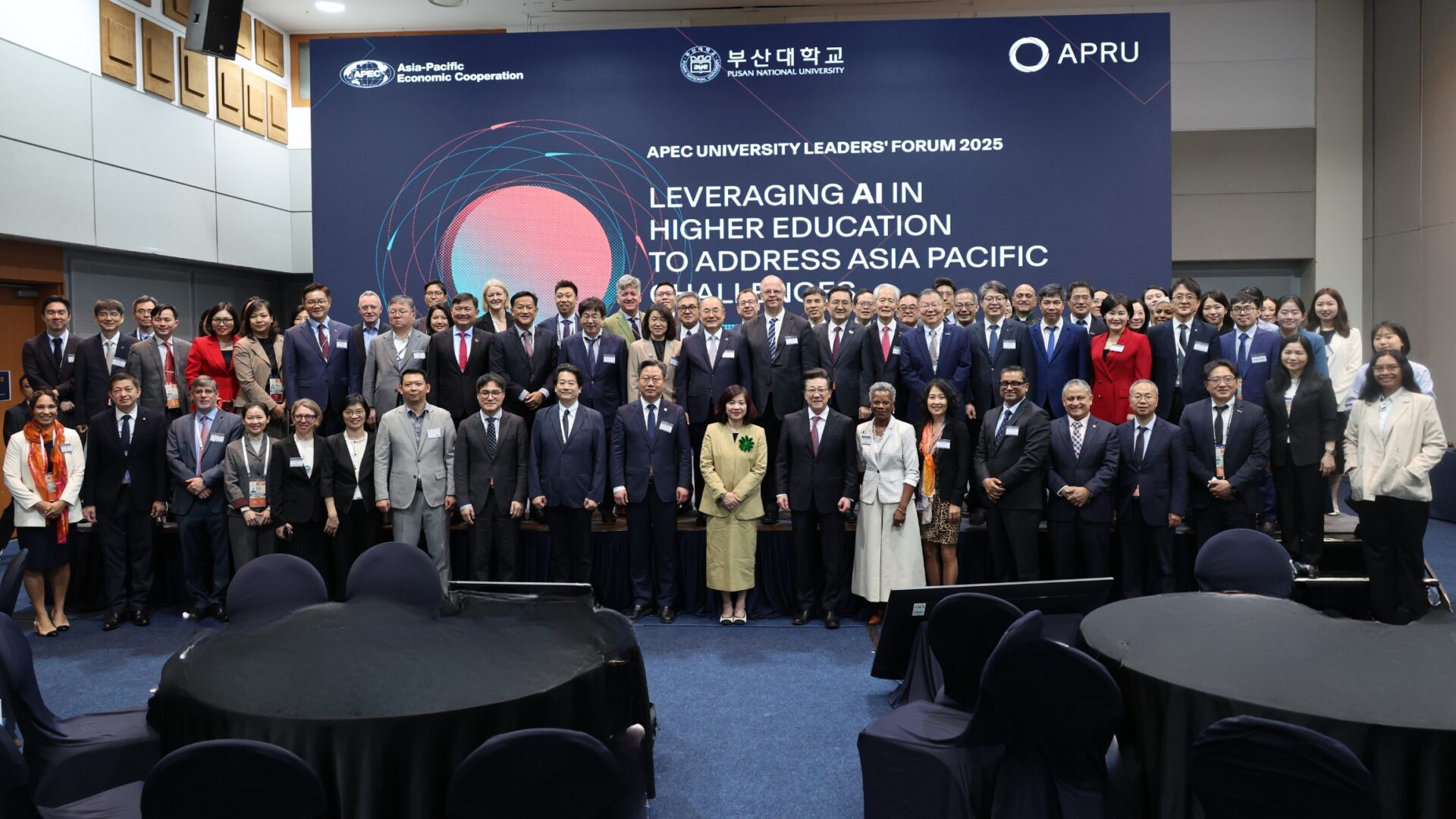
Pacific Rim university leaders meeting on the sidelines of the Asia-Pacific Economic Cooperation (APEC) gathering of education ministers in Jeju, South Korea, this week focused on “leveraging artificial intelligence in higher education to address Asia-Pacific challenges”, stressing the need for collaboration between universities, public bodies and communities over the use of AI for public good.
The APEC University Leaders Forum (AULF), made up of university heads from Asia, Australia and New Zealand, and North and South America, was jointly hosted by South Korea’s Pusan National University (PNU) and the Association of Pacific Rim Universities (APRU) in partnership with the South Korean Ministry of Education. It took place from 12 to 13 May.
Park Sung-min, deputy minister for planning and coordination at the ministry, said on 13 May: “Solving challenges in the Asia-Pacific region through the use of AI goes beyond mere technical issues and allows us to reflect on the essence of education and the importance of global cooperation”.
| This article is part of a series on Pacific Rim higher education and research issues published by University World News and supported by the Association of Pacific Rim Universities. University World News is solely responsible for the editorial content. |
Pointing to the “huge wave of digital transformation”, in particular, the emergence of generative AI and the role of universities in “an era where the boundaries between academia and technology are blurring”, Park said: “AI technology is clearly a powerful tool for innovation in higher education. However, at the same time, we must find a direction for educational innovation that can achieve sustainable growth and inclusive prosperity.”
AI: No longer a theory
PNU President Jae Weon Choi told the forum AI was no longer confined to theory or the laboratory.
“It is reshaping the way we think, learn, live and govern, while also raising pressing ethical and social questions. In this context, the role of universities must go beyond research and education. We must also take responsibility for helping students develop ethical reasoning, a sense of community and global citizenship.
“The future of higher education we shape together must be global, ethical and human-centred,” he stressed.
APEC Secretariat Executive Director Eduardo Pedrosa said that AI in higher education aimed at addressing Asia Pacific challenges resonates with the core priorities of APEC and its 21 members.
“There is a clear consensus among APEC member economies, stakeholders and working groups that digital transformation with AI at its heart is a pivotal force reshaping our region’s economic and social landscape.
“APEC leaders and ministers in recent years have consistently highlighted the urgency of seizing AI’s transformative potential to achieve shared prosperity for all walks of life during this uncertain global environment.
“AI offers immense opportunities, driving productivity and innovation, streamlining trade and investment, enhancing public services and delivering data driven sustainability solutions,” he noted.
Pedrosa stressed the importance of balancing AI’s benefits – such as productivity, innovation, and sustainability – with addressing associated risks, including job displacement, algorithmic bias, and the digital divide.
“This is where the pivotal role of education becomes paramount,” he said, affirming APEC’s support for university-industry-government collaboration to ensure inclusive AI-driven growth.
“APEC strongly believes in the power of collaboration,” he said, adding APEC would support APRU and universities “in their efforts to forge impactful partnerships with governments and business, ensuring that AI is harnessed for inclusive and sustainable growth across our diverse economies.”
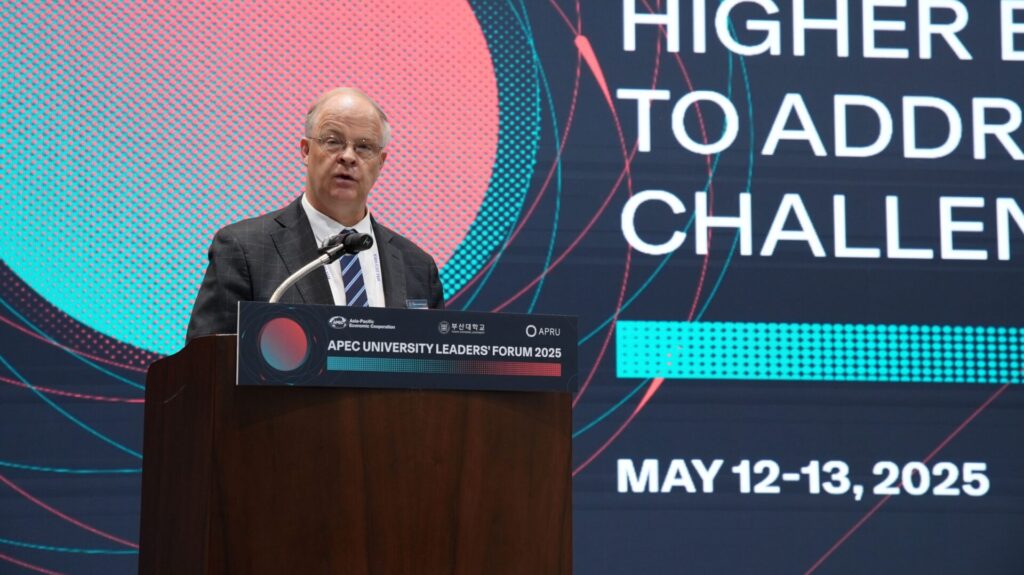
APRU Chief Executive Thomas Schneider said navigating the new higher education reality was complex and required institutions to rethink basic assumptions that have underpinned their value proposition as education providers and their institutional operations.
Faced with an emerging technology “that still displays many uncertainties in terms of development, standardisation, regulations [and] usability, universities have not yet found common ground in how to balance opportunities and risks”, he said.
“AI has a promise to contribute to the solving of global problems and to accelerate scientific discovery … At the same time, an increasing proportion of the world population is cognisant of the rising impact of AI on their lives. To many, it is a cause of increasing anxiety and concern,” Schneider acknowledged.
“Many studies contemplate societal benefits and risks to society, uncharted territory in most respects, and this is what brings us together here at the APEC University Leaders Forum: the opportunity to offer stakeholders from higher education, industry and politics a platform to discuss the implications of AI and to enhance cross-sector understanding, to define frameworks for the use of AI and to chart ways in uncharted territory.”
Radical collaboration
Keynote speaker Padmanabhan Anandan, former CEO of the non-profit Wadhwani Institute for Artificial Intelligence, which focuses on developing AI applications for social good, a former director of Microsoft Research and current founder of the AI Matters for Development (AIM4DEV) consultancy, showcased the capacity of AI to calculate a baby’s weight in real time, based on the baby’s torso length, head circumference and other measures gleaned from a digital photograph.
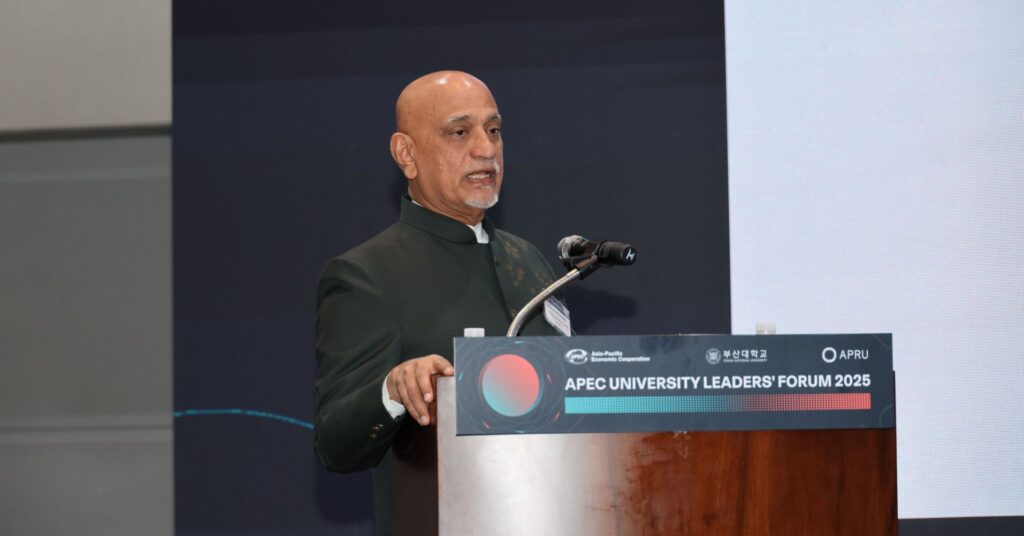
“This is the miracle of computer vision,” said Anandan, “but the fact that it can be done in a setting like … a village by a person who does not require any training is a very, very important thing. It doesn’t require spring balances [to weigh the baby]. It doesn’t require hardware.”
He also highlighted an AI solution being used in India to limit pesticide overuse that is part of a national pest surveillance system launched last year. Based on pictures of crop leaves and insect traps, AI can guide optimal insect control measures.
However, when it came to AI solutions for the public good, he said, no single organisation was capable of designing and delivering the full range of services required.
“It requires technologists and scientists who develop the solution; professionals such as health or agriculture professionals; implementers – organisations on the ground that can work with the communities and with officials; and the officials themselves.
“We need the ministers; we need the health secretaries; we need the administrators – both at the state and the central levels.
“It really takes close collaboration between all four kinds of groups in order to get it done,” Anandan told the forum. “I call this ‘radical collaboration’, because …. [it is] a continuous co-creation process.”
Anandan told University World News universities can play an important role in this collaboration. “If there is one place that we all consider to be a neutral place where all the different stakeholders will comfortably come and work, it’s a university,” he noted.
“Governments will talk to universities. Technologists come from the university, so they will talk to universities. NGOs often work with universities, and domain specialists are also trained in universities. So the university can be a moderating voice and capable of creating these collaborative frameworks.”
Technology as an ‘engine for progress’
Anandan argued that for poor and underserved communities, the risk of ‘bad AI’ is low. “It’s not technology that’s coming in the way of their livelihoods or problems, but social structures and so it’s socio-economic models, and those are not going to be influenced by AI,” he said.
“The biggest factor that’s making lives difficult for poor communities is the lack of expertise in the medical domain or any other technological domain, even in agriculture. It may be possible that AI can fill some of that expertise gap.
“Typically, one may be worried about AI potentially taking jobs, but in this case we’re talking about situations where there are simply not enough humans out there able to solve the problems.”
Panel member Dr Cormekki Whitley, chief operating officer of data.org, which is collaborating with universities in training AI professionals to work in the public good domain, told University World News: “When we think about social impact, there is a need for a cross-sector approach. You need academia for the rigour, to test some of these assumptions. But we also need to make sure universities also have a social impact lens.”
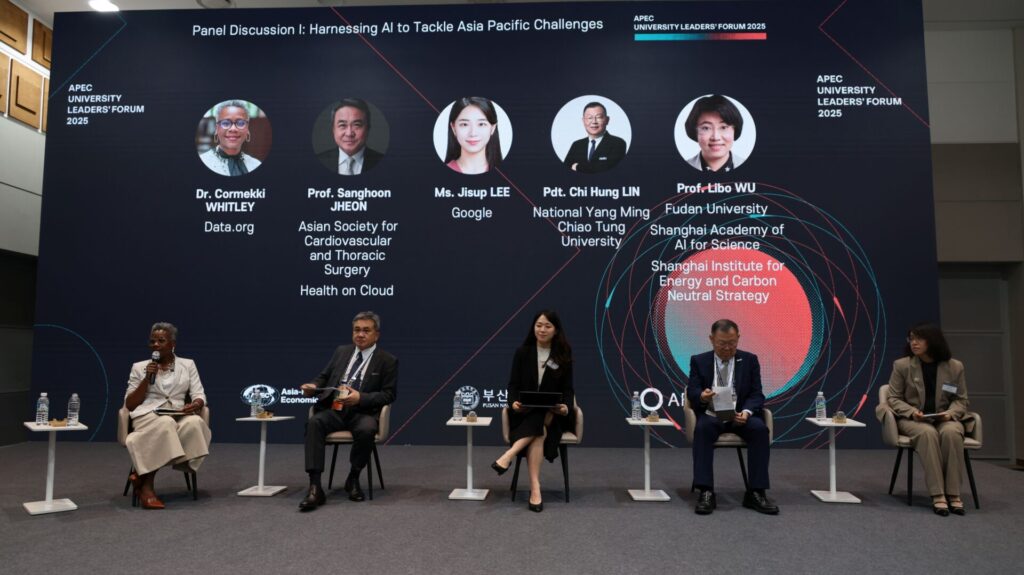
Jisup Lee, Google’s head of government affairs and public policy in Korea (focused on platforms and devices), told the forum that technology had always been a powerful engine of progress. “Just as the internet and mobile devices expanded opportunities worldwide, AI is expected to accelerate that progress … and I believe that we do have a once-in-a-lifetime opportunity to really unlock this human potential on a global scale.”
She said the Google mission was to “organise the world’s information and make it universally accessible and useful” and described AI as “more than just a technological advancement”.
“It is a transformative force with the potential to address some of humanity’s most pressing and difficult challenges. We believe that it should be a collaborative process … We make tools that empower others to harness AI for individual and collective benefits,” she noted.
Starting locally
Highlighting the capacity of AI to assist universities locally, keynote speaker Dr Ravi Pendse, vice-president for information technology and chief information officer at the University of Michigan, introduced the university’s MAISIE AI assistant, and its related mobile app for students, ‘Go Blue’.
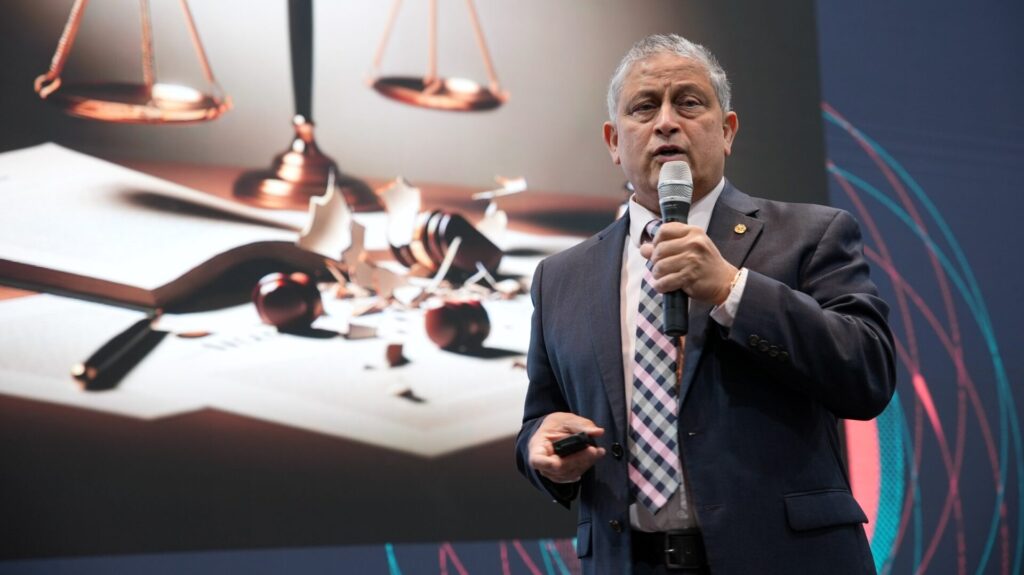
“What’s most interesting is that it is helping us find gaps in our information … and we are able to then react to that.”
Pointing to the issue of food insecurity, he said: “There are poor students on campuses who struggle to make ends meet. So, when we saw a lot of questions being asked about where free food is available on campus … we partnered with some of our benefactors and donors and made sure the facility that provides free food to our students had more resources.”
Pendse said some 4,000 AI applications were in use across the university. However, Pendse cautioned: “We do need to have humans in the loop. We do need to have human supervision because that human empathy, that human touch … AI will never replace it.”
Development assistance
PNU’s Choi told University World News the forum’s focus was on “using AI to revolutionise or revitalise education and higher education, as well as addressing socio-economic issues in the Asia-Pacific region”.
“Specific topics we’re interested in examining are things like climate change, poverty and medical services — issues that are prevalent in many of APEC’s societies,” he said, adding that the university’s own focus was AI applications.
He said PNU was engaging with official development aid (ODA) to transfer the scientific capacities of Korea and the Pusan National University to societies around the APEC region.
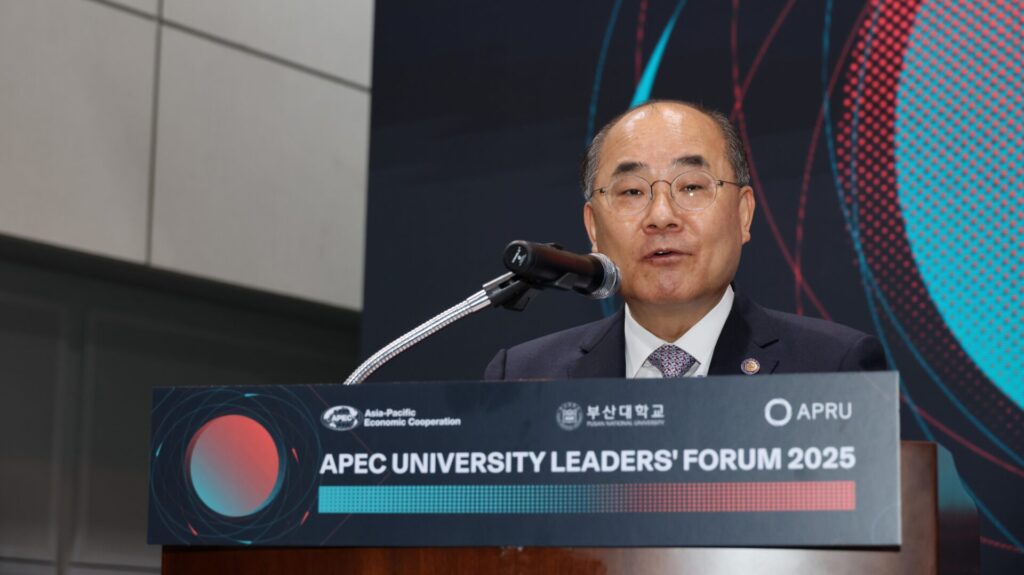
“We have ODA programmes related to Korean medicine, farming and engineering and some of our ODA partners include Mongolia, Kazakhstan and various countries in Southeast Asia.”
He pointed to South Korea’s particular strengths in industry-university cooperation. “In engineering we are very much involved in transferring knowledge about how universities can facilitate industry-academic collaboration in ODA projects.”
PNU, situated on the Korean coast, opened the APEC-APRU Marine Climate Tech Centre last year.
“It provided us with a basis to conduct leading climate change research and protect marine environments. We’re hoping we can use APRU as a platform to engage in closer collaboration in research in ODA, with universities and in countries across the region.”
Choi said the hope was that the AULF event would “open up a channel” to enable APEC universities and leaders in the APEC region to come together to talk about AI and what it can do. It could also be an opportunity for the region’s leaders to improve the application and use of AI in their respective countries.