

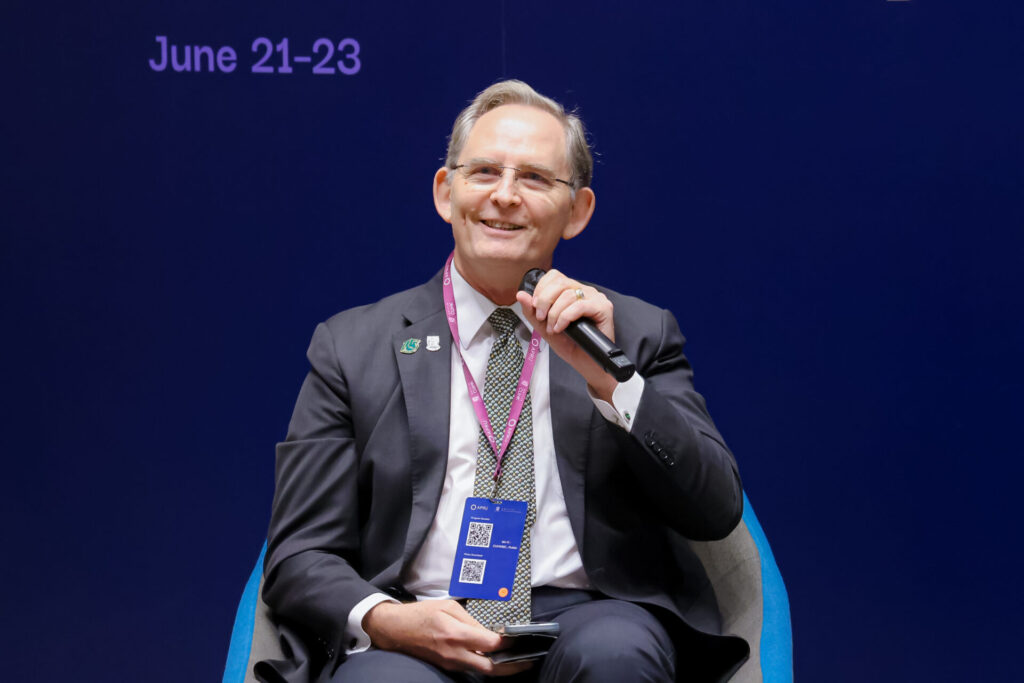
The central questions that Jay Siegel, vice-president and pro-vice chancellor of Teaching and Learning at The University of Hong Kong, asked the four presidents at the “Sustainable higher education systems: Building integrational partnerships for resilience and inclusive higher education” session of the 30th Annual Presidents’ Meeting of the Association of Pacific Rim Universities (APRU) to answer had less to do with the mechanics of partnerships than with the ethics inherent in them.
“We’re talking about situations in which the university sees itself as a nexus of various sectors of society, be it industry, government, military or NGOs,” he explained before continuing by interrogating the concept of sustainability used in the session’s title. “We want to look at the financial aspect, but of late we’ve heard there’s a trust sustainability, there is a social relevance sustainability, and there is a fiduciary responsibility with AI being present.
“Are these partnerships really beneficial [to the students], and do they really serve the mission of the university, or do they perturb the university?” asked Siegel, who is also a world-renowned chemist.
| This article is part of a series on Pacific Rim higher education and research issues published by University World News and supported by the Association of Pacific Rim Universities. University World News is solely responsible for the editorial content. |
Naoshi Sugiyama, president of Nagoya University (NU, Japan), kicked off the discussion by giving a capsule history of how NU went from a limited number of research collaborations with industry to a deep relationship with a company owned by Toyota that produced blue LED lights that destroy acne-causing bacteria and reduce skin oil production; the three professors involved in the project received the 2014 Nobel Prize for Physics.
Chancellor of the University of Hawai’i, Manoa (UHM), Vassilis Syrmos, also spoke from a position of institutional strength. The 14 telescopes at Mauna Kea, a US$10 billion installation, draw international and governmental cooperation and can observe the entirety of the northern night sky and a large portion of the southern night sky – the portion which cannot be observed by a telescope in Chile.
And UWM is working with the University of Washington and University of California on “ocean sciences, ocean acidification [and] coastal sciences” with the need to improve resilience to the impacts of climate change an issue of grave concern.
“These oceans are actually boiling, and that affects how we’re going to leave this earth to our next generation,” he said, before explaining that sea level rises will “affect billions of dollars in investment in coastal communities”, and they are also going to leave some Pacific islands under water in 25-30 years – including Waikiki Beach, a 15-minute bicycle ride from Syrmos’ campus.
National Taiwan University (NTU) has recently established an advanced technology school, said the university’s executive vice-president, Shih-Torng Ding, who holds a PhD in poultry science. Ten different companies collectively donated half the money for the school and the government donated the rest.
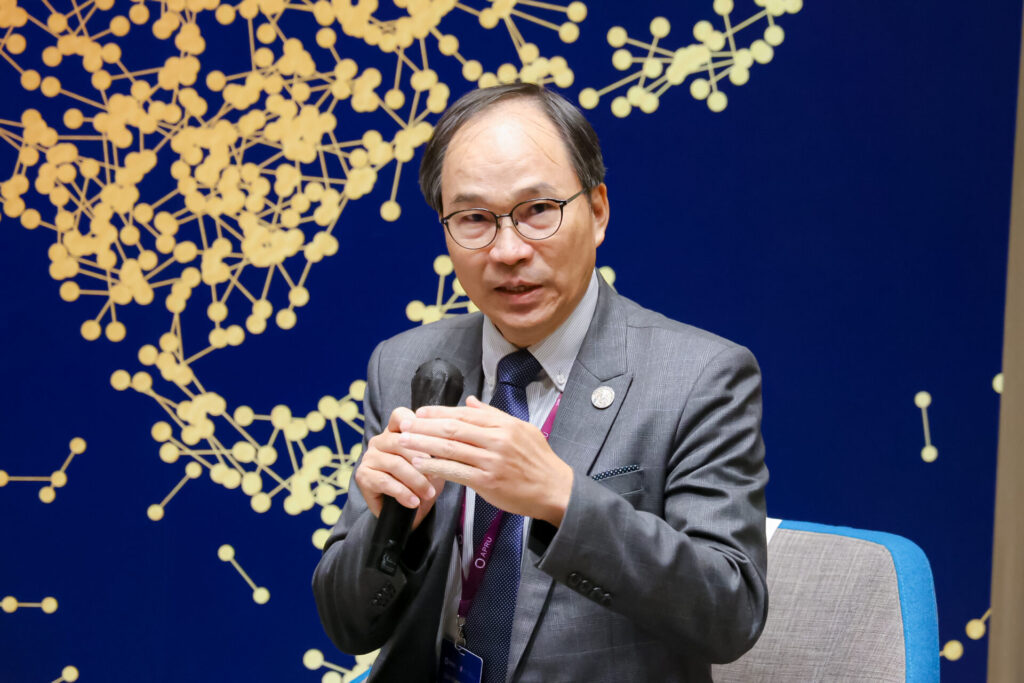
The resources allowed NTU to set up a school to tackle oceanic and other climate change problems, as well as to fund poor students. Another partnership Ding pointed to was one that allowed NTU to send students to Kew Gardens in London.
VinUniversity in Hanoi, Vietnam, is in a different situation. It was established as a private non-profit university by the Vingroup, which contributes 2.6% of the country’s GDP. According to President Lê Mai Lan, who is both the president of the university and vice chair of the Vingroup, VinUniversity sees its mission as nation-building.
This process includes creating an indigenous university that will attract and keep Vietnamese talent in Vietnam.
Despite the Vietnamese dong being weak against the US dollar, Vietnamese parents spend US$4 billion sending their children overseas. “Many kids don’t go back when they graduate,” said Mai Lan. And, if they do go back, they have trouble reintegrating into the country, she said.
Academic freedom or constraints?
Siegel’s question about academic freedom led Ding to emphasise that at his university, professors have research autonomy. “They don’t know, they don’t care what we say as administrators. They do their own thing. We are the land of the free. We don’t have any regulation of them.”
Syrmos answered the question by referring to a successful US$200 million partnership with both the US federal and Hawai’i state governments that pairs specialist doctors on O’ahu, the state’s “Big Island”, with healthcare providers on the outer islands in order to lessen the need for residents to travel to Honolulu.
As well, he told of a US$100 million initiative by the Sockenberg Foundation to further rural healthcare that could, he said, run into academic freedom issues.
Mai Lan’s university in Vietnam and Sugiyama’s in Japan exist in similar “top-down” ecosystems, despite Vietnam being a socialist country and Japan being capitalist. In both cases, the universities do not have the type of autonomy that the other panellists appeared to take for granted.
Institutional resilience and social equity
The panel discussion on sustainability framed it as extending beyond environmental goals to include institutional resilience and social equity. Several of the panel speakers spoke to University World News about how they are innovating through collaborations and partnerships to address these issues.
The University of Hawai’i system, or UH, for example, has long-term programmes to build resilience that tap into the unique strengths of the territory where its sprawling campus is situated, the island state of Hawai’i which is home to a diverse native population.
This gives the university a distinctiveness in its ongoing global research into climate change-related collapse of ecosystems that is threatening food and health security.

“UH research programmes are founded on the ecosystem of Hawai’i’s indigenous practices, and UH aims to build resilience to address local and global challenges. The distinctiveness of its environment is attracting private and institutional funding,” said Syrmos, who has recently been approved the provost of UH Manoa, the university’s flagship campus.
A case in point is ongoing healthcare initiatives. Given the diverse populations in Hawai’i, the UH Cancer Center conducts a Multiethnic Cohort Study, the largest epidemiologic study of cancers that stresses personalised treatment for different types of cancer.
The Center offers training and other initiatives, including sharing findings globally to make recommendations on treatments and nutrition. Its partners include the Hawai’i government.
Another example is the Office of Indigenous Knowledge and Innovation-led collaboration between UH campuses and community colleges to facilitate place-based research initiatives or practices that have sustained people and the land in the past.
For instance, the circular economy and justice programme at Po‘ai ke Aloha ‘Aina Center combines research and advocacy in sustainable development research by incorporating the give, take and regenerate model that has been practised by Hawaii’s isolated communities for centuries and modern circular economy guidelines.
There is also research on holistic indigenous food practices at Ke O Mau Center for Sustainable Island Food Systems. One area of focus is expanding the ancient practice of agroforestry that was based on diverse forest nutrient recycling to preserve ecosystems and maximise production.
It is funded by the US government. The programme also deals with the challenge of funding largely by working in partnership with the Hawaii Ulu Cooperative involved with reviving and protecting traditional crops.
New interdisciplinary curricula

At VinUniversity, President Mai Lan is implementing new curricula, research and partnerships that support the country’s economic growth, which are transforming it into an emerging world power.
The Vietnamese university provides financial support for students following doctoral courses and study abroad programmes.
“Vietnam higher education, once steeped in traditional curricula that focused on creating graduates in specialised fields such as engineers or doctors, is now moving into interdisciplinary curricula such as becoming engineers or doctors,” she told University World News.
Such changes are undertaken during a time when urbanisation is growing rapidly in the country and the aggressive use of AI by students. The university has collaborations with Cornell University in the United States and other foreign partnerships aimed at fostering rapid development of data science.
The AI technology is viewed by higher education experts as a critical co-working peer and is encouraged in curriculums and research, as seen in public and private investment into driverless taxis, robot surgery and humanoid robots.
“We are so optimistic. First of all, again, we come from a still very poor country and we still have a lot of things to catch up with the world. So we have nothing to lose. We just have to move forwards,” said Mai Lan.
Indeed, she explains that government spending on R&D research remains high to support universities playing an essential role in contributing to impactful and effective national and international policies.
Vietnam’s green growth strategy has a net-zero commitment by 2050, a goal based on fostering sustainable cross-sector collaboration, as reflected in ongoing projects between VinUniversity and the Duke Center for International Development at Duke University, North Carolina, in the US.
The objective of the partnership is developing Vietnam’s first integrated data framework for tracking innovation and green growth and combining sector-based and province-based perspectives.
GREEN-X, a transformation to green technology project, focuses on five research areas: carbon monitoring; smart marine systems; circular urban waste systems; green policy design; and innovation and green transformation.
Industry partnerships grow
Expanding collaborations with industry is also a pillar in the transformation goals of Nagoya University, a national institute located in the heart of Japan’s manufacturing base, located in the central region.
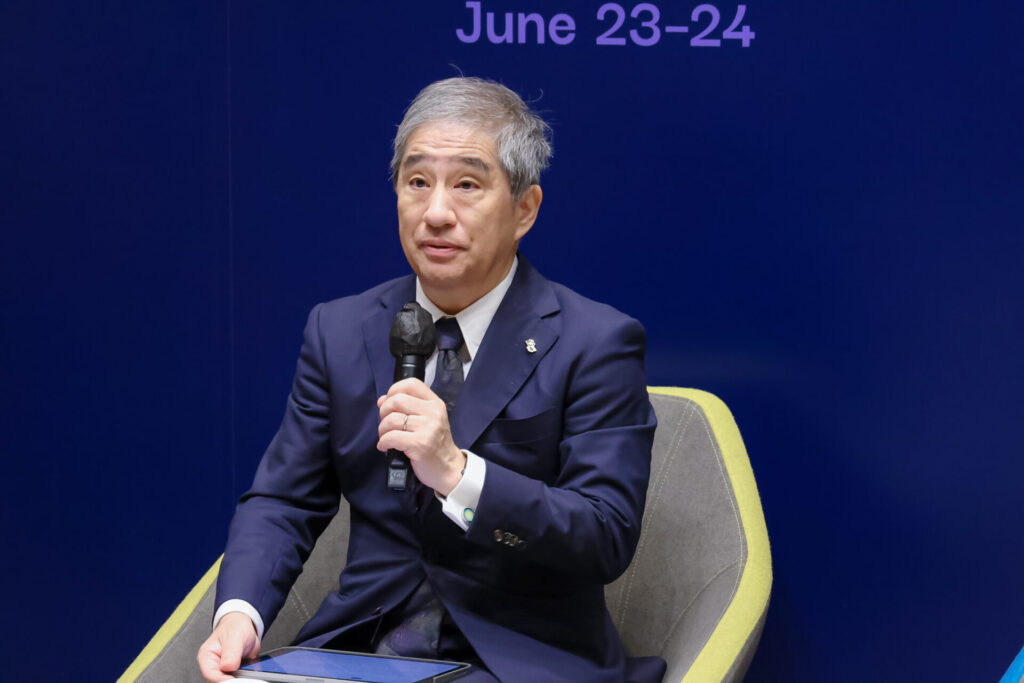
Nagoya University President Dr Naoshi Sugiyama told University World News of the appeal of jointly tackling research that benefits both academic and industrial sectors against a backdrop of businesses racing to employ skilled youth to boost their company’s global competitiveness.
“Initiatives are being implemented in the university that will strengthen the human resources,” said Sugiyama. Nagoya University, a national institution, boasts a reputation as a leader in science and technology research.
This May, Nagoya University and Toyota Systems Corporation launched an AI research centre to tackle social challenges by using an AI- and data-driven approach.
The project is seen as contributing to the critical competitiveness in the Toyota Group, the world’s leading automotive company. Toyota Systems is a subsidiary of Toyota Motor Corporation that is developing systems for the company.
A key point in the partnership is setting up a joint laboratory system housed on campus later this year. Toyota will leverage Nagoya University’s proven research on AI.
On the other hand, doctoral students will be able to work beside real-world corporate researchers and be paid for their research.
“This collaboration will break down the walls between academia and industry,” said Sugiyama.
The new collaboration will last three years with a possibility of extension and will bring the two parties together to support business transformation in Toyota Group.
Joint research will use 3D data and business applications such as image recognition and language processing. Various research themes will be pursued with the expectation of the collaborations gaining an edge in global markets.
Driverless taxis are already on the road in China and the United States. Development of the autonomous vehicle industry is getting increasing attention in Japan and seen as a means of addressing the country’s labour shortages.
The new collaboration is similar to many others undertaken with industry. For example, when the giant Nagoya Railways system in Nagoya, including the Nagoya railway hub, was given a major upgrade in 2025, it involved two sectors working together on joint research on regional public transportation systems and community development.
The upgrade is contributing to the development of Nagoya and the Chubu region. The terminal station, for instance, is a gateway to Chebu Centrair International Airport.
Sugiyama refers to ongoing discussions around developing clearer guidelines and sharing of companies’ profits as the business depends on university campuses and academic contributions.
Sugiyama also referred to the discussion on the expansion of academic-industrial partnerships against the long-held assumption that university research focuses on contributing to social good.
“Expanding that role to an approach that will also capture the financial wealth of collaborating companies underlines the broader nuances,” he said.