
This article was featured on University World News on June 26, 2025 and written by Nathan M Greenfield.
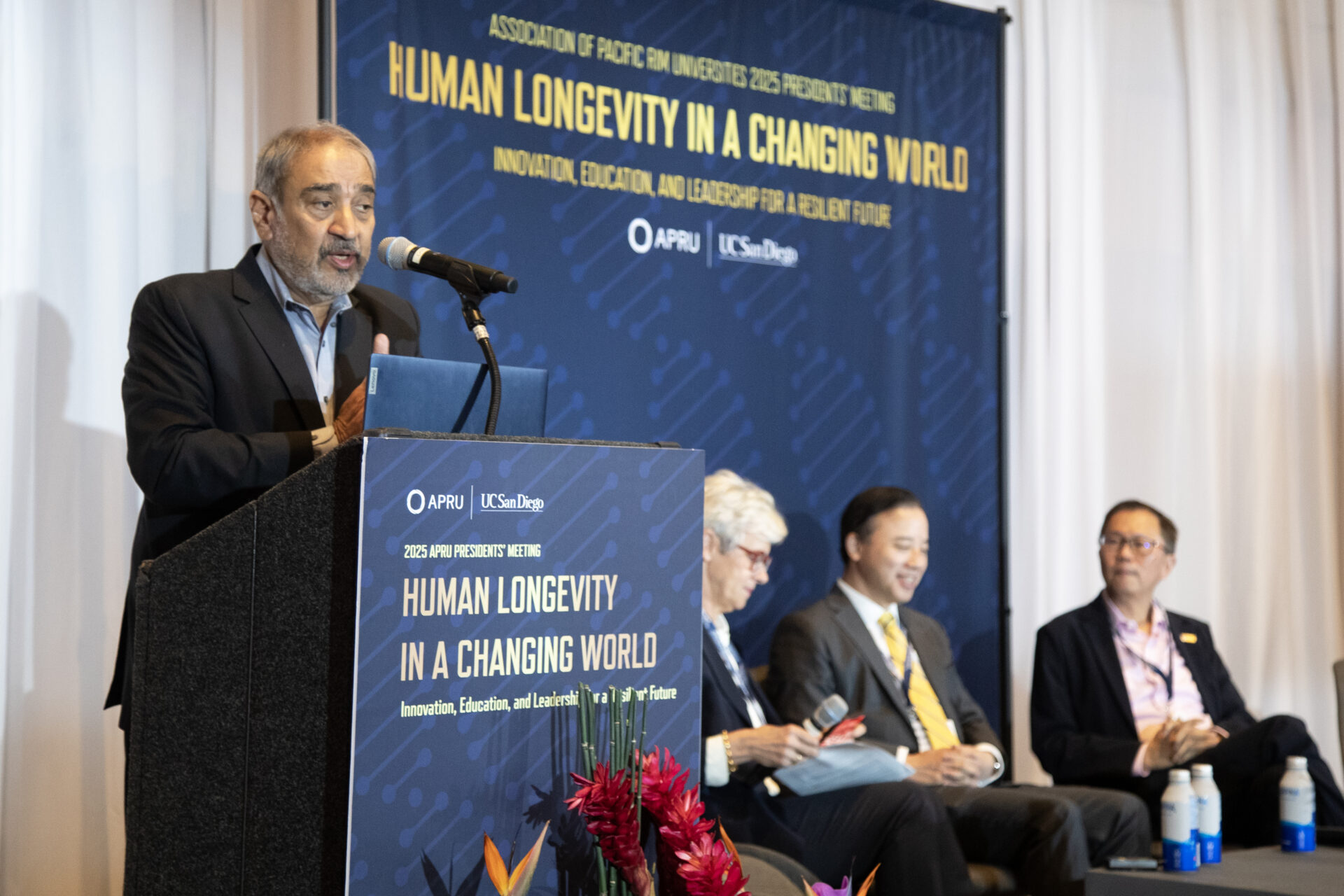
“Our DNA is not our destiny,” according to Dr Kiana Aran, who spoke at a session of the Association of Pacific Rim Universities (APRU) presidents’ annual meeting held at the University of California (UC) San Diego this week, which addressed innovation and education on the topic of “human longevity in a changing world”.
Had she been speaking in 1900, noted Aran, an associate professor of bioengineering and medicine and co-director of the Center for Technologies for Healthy Aging at the Institute of Engineering in Medicine at UC San Diego, her audience would have been a lot younger: at that time the average human lifespan was just 37 years.
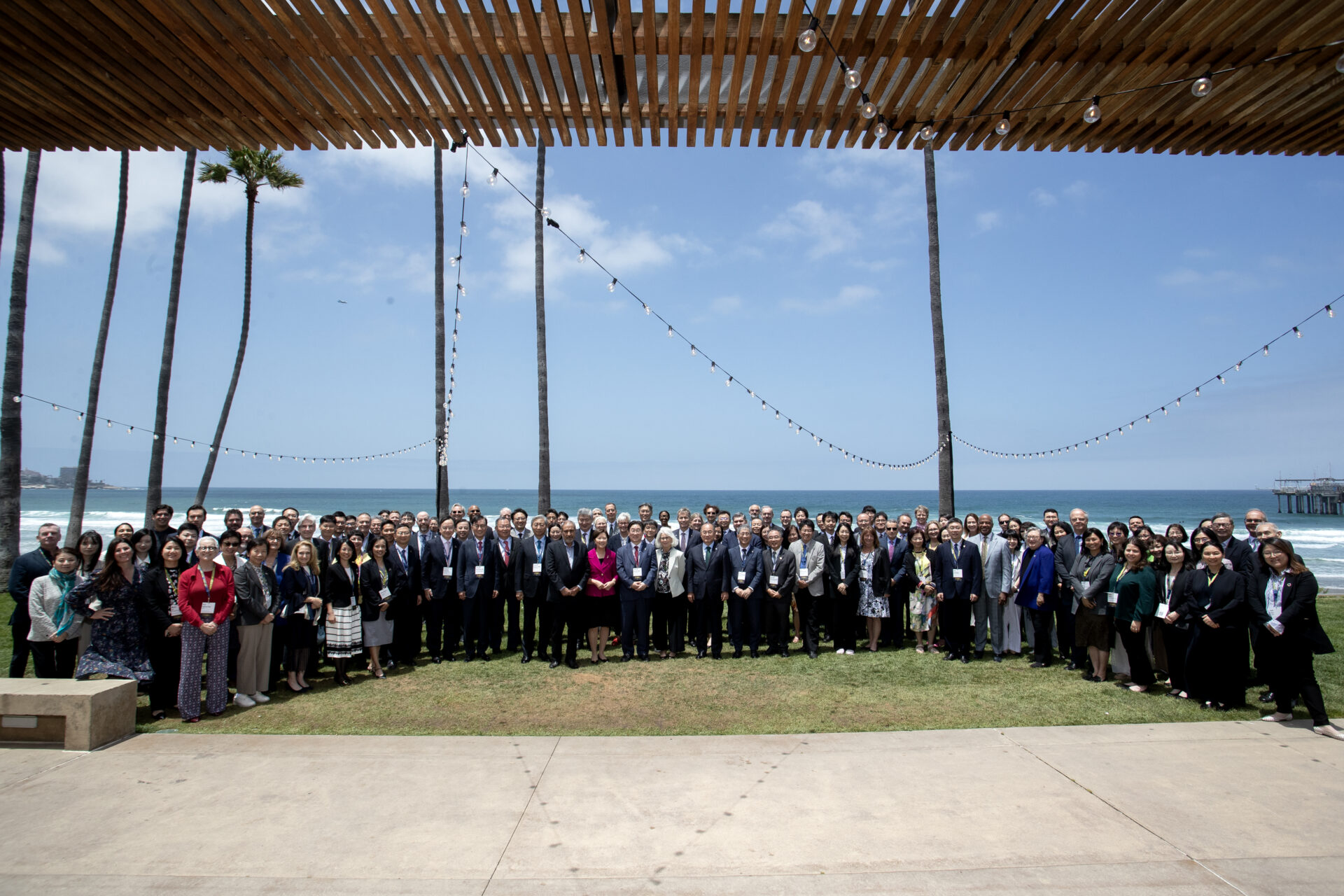
The three-day conference, held from 22 to 24 June, brought together 28 university presidents and 110 delegates from 46 universities from across the Pacific Rim, including Asia and the Pacific, North America and Latin America, to look at global challenges related to human longevity – such as healthcare innovation, socio-economic inequality, and the impact of geopolitical tensions on trust, which is crucial to AI research and development.
|
This article is part of a series on Pacific Rim higher education and research issues published by University World News and supported by the Association of Pacific Rim Universities. University World News is solely responsible for the editorial content. |
Shifting gears, Aran told university leaders at the session titled “AI and Longevity: Global Challenges and International Research Collaboration” that had the US Food and Drug Administration not banned the sale of young human blood plasma, “we all would have become vampires”.
The two points – about increased human lifespan and the possibilities for human blood plasma – are related, Aran added, as manifestations of science and of applications of technology that have increased longevity.
For example, birthing mothers’ mortality has been drastically reduced by sterilisation and scientific birth control measures, while vaccinations and other measures combatting disease reduced childhood mortality.
An example of technology to enhance longevity involves the use of plasma bags – each fetching US$8,000. As part of the new science of rejuvenation, experiments started at UC Berkeley a decade ago.
Young blood injected into older animals had a significant impact, rejuvenating older animals’ hearts, muscles and cognitive responses, Aran explained. Certain molecules filtered from human blood have shown promise in this regard.
Today, some believe gene editing techniques may make it possible to switch off the creation of the inhibitory molecule in bone marrow (where blood is made) and switch on the gene that makes the rejuvenated molecule, Aran said.
Huge amounts of data
But she noted that any project that hopes to “intervene in ageing” by rewiring genes requires a huge amount of data from large longitudinal studies, including genomic, RNA, protein and imaging data, to see how the human anatomy is changing.
In addition: “We need to monitor our behaviour and our cognitive responses, our muscle and bone density,” she said.
The amount and variations in types of data are so large and would include real-time data from smartwatches and glucose metres that no human could make the necessary correlations. Only AI has the power to do the calculations and make the necessary predictions, explained Aran.
In fact, “human involvement creates a lot of false data that could impact the AI predictive analysis”, she said. And scientists will have to gather the data from many sources, including geographically, as well as from different institutions and agencies.
But data sharing – particularly of biomedical and genetic data and the use of AI – requires considerable trust, which may be eroded by non-ethical uses of AI, IP problems and geopolitical tensions, the conference heard.
Quality of life for all
Dr Nancy Ip, president of the Hong Kong University of Science and Technology (HKUST) and an expert on neurodegenerative diseases, pointed to wearable sensors that detect falls and the technology (that now exists) to allow a smartphone “to detect the atrial fibrillation” associated with strokes.
AI and the biological sciences must be accessible to underserved communities, she told the conference, noting the great expense of, for example, wearable technologies.
“We have to ensure that in using AI we are not expanding the inequities [or] exacerbating them,” Ip said. “We have to ensure that going forward with AI-driven longevity solutions, we’re actually providing or enhancing the quality of life for all,” she said.
Current geopolitical tensions were a complicating factor, she said, without specifying the international actors involved. But she pointed to the “complexities of intellectual property arrangements”, leaving no doubt she was referring to geopolitical-intellectual property tensions between the United States and China.
Ip nonetheless believes that “we can work to overcome” the challenges. “We built this environment, full of trust and openness and a shared goal” of leveraging AI “not just to extend our lifespan, but also to enhance the quality of life for all,” she said.
Resource disparities
Ip challenged her fellow university presidents to “address the resource disparity” between regions, which results in universities not having access to resources.
“We can go further to set up capacity-building programmes to help train the researchers from these underserved communities.”
Lin Chi-Hung, president of National Yang Ming Chiao Tung University, Hsinchu, Taiwan, told University World News a few weeks before attending the conference that current China-US relations and issues around licensing of intellectual property impact Taiwan mostly in increased licence costs.
He sketched out two distinct directions for data sharing. The first, more restrictive, is spurred by fears that if a researcher puts all their data into the public domain, a company may scoop it up and make a profit from it before the researcher and their university can monetise it.
This could have a serious knock-on effect of degrading data sets that are in the public domain. “We know that there is a lot of misinformation in databases.
“If authentic data suppliers are holding back, what you will have, probably, is more or a higher percentage of data that is contaminated or biased. You can imagine what kind of analysis you can draw from that set of data,” said Lin.
The second direction, which he associated with tech companies like Nvidia, Google and Amazon, is to have large databases but with the analysis of such data geared towards the needs of the companies, rather than the common good.
Data for public health
Because Taiwan, like other places in East Asia, is transitioning to a “super-aged” society, Lin said Taiwan is especially interested in using AI for public health.
In addition to collecting data about the human genome and diseases, data must be collected and fed into AI systems about the environment people live in and other aspects. As much as 50% of diseases may be due to environmental and other conditions and behaviours such as overeating.
“You need to collect all this data from all these different perspectives,” he said. In Taiwan, as is the case elsewhere, this is not easy because data is not only stored in hospital records. It can be in the department of health records, local or central government records, insurance companies and other health care providers.
Lin is also concerned about the overall representativeness of data being fed into public health AI in Taiwan.
Though 95% of Taiwanese claim to be descendants of the Han Chinese people, that still leaves 1.6 million people who are Aboriginal people from the island of Taiwan.
Public health data does not accurately include these people. Nor does it include an accurate ratio of the demographics of older people, who make up a disproportionate percentage of Taiwanese, he said.
Like Ip and Aran, Lin is especially hopeful about AI providing a way to individualise healthcare by providing individuals with guidance on what to eat and about exercise, for example. AI monitoring can, he says, serve as a way of curbing mistreatment of the elderly by carers.
Broader perspectives in gathering data
Most of the discussion by university leaders at the conference focused on research and practices that can improve public health or healthcare delivery and what to expect in the near future.
But with education central to university presidents’ remit, Ip discussed how HKUST is using AI to assist the learning process.
“When ChatGPT first came out, our university was the first university in Hong Kong to embrace it. We helped our students and our faculty to learn about the power of AI. We launched workshops. We have a centre for education and innovation that has a very important role to play because AI will stay with us,” Ip said.
APRU, with some 61 research-orientated universities across the Pacific Rim, has an important role to play in dealing with the problems engendered by different regulatory guidelines in the US and European Union, and as a higher education organisation can help establish “a set of standardised agreements … in line with the different regulatory requirements in different countries”, Ip noted.
Ip also called for a new AI Longevity hub within APRU.
“By forming the AI longevity hub under APRU, I think we can share resources, share our data sets cross borders… and push forward to have this future where, in terms of longevity, we are not just adding years to our lives, but we are adding life to our years,” she stated.