
APRU at APAIE 2026
APRU was delighted to contribute to APAIE 2026 with a series of panel sessions showcasing how our network’s collective expertise is shaping the future of international higher education across the Asia Pacific. This article is one of four in a special APRU series sharing insights from our conversations at APAIE 2026. APAIE 2026—the premier gathering of international higher‑education leaders, policy makers, and industry professionals—convened in Hong Kong from February 23–27 under the theme Asia‑Pacific Partnerships for the Global Good. This year’s conference brought together 3,592 participants from 72 regions, featured 600+ organisations, welcomed 570 delegates to pre‑conference workshops, and delivered 120 presentations and 3 plenaries.
Session Report
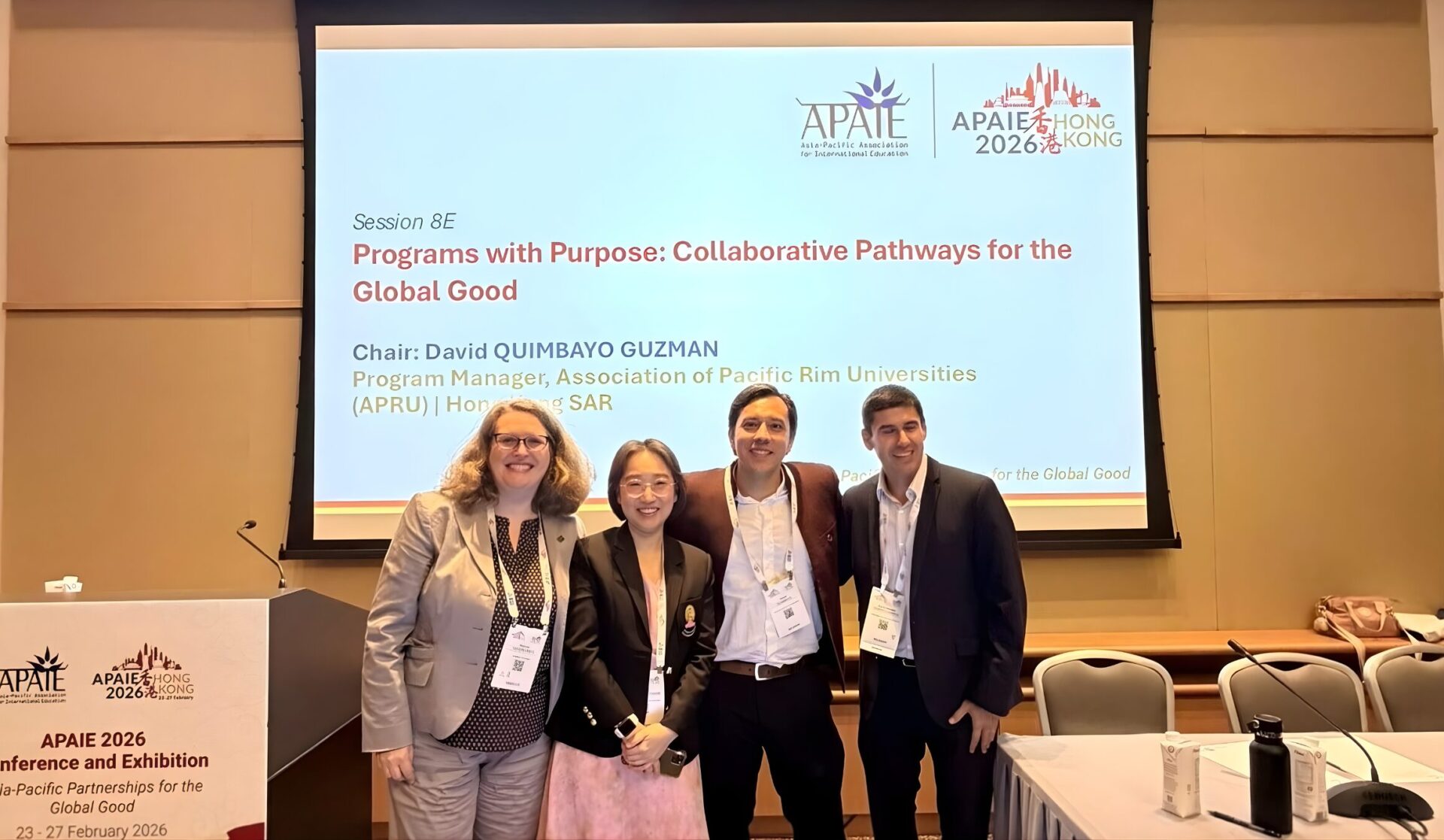
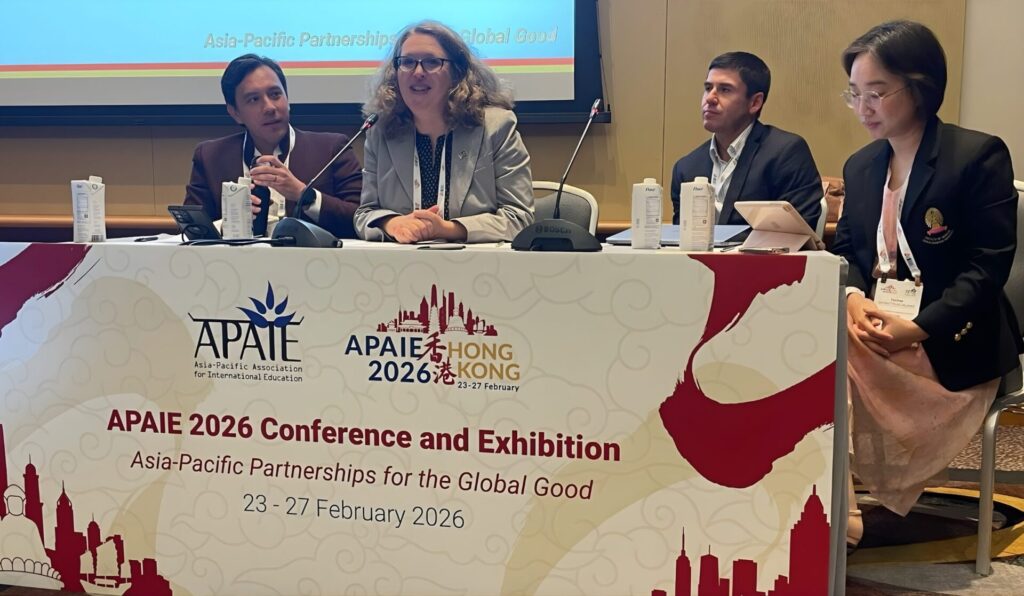
Chaired by David Quimbayo, Program Manager, APRU, this panel explored three student‑centered models that blend virtual exchange, facilitated dialogue, and on‑site immersion to develop diplomacy, empathy, and problem‑solving at scale: Tecnológico de Monterrey’s Asia Pacific Open Dialogues, the University of Oregon/USC Certificate in Global Climate Change Leadership, and Chulalongkorn University’s SDG Education for Global Citizenship (SDG4GC).
Facilitated Dialogue as a Design Principle
Dr. David Huerta, International Experiences and Models Director, Tecnológico de Monterrey outlined Asia Pacific Open Dialogues, a COIL‑style initiative structured around intentional, professionally facilitated small‑group conversations. The design sequence: asynchronous preparation → synchronous dialogue → guided reflection, ensures that every student’s voice is heard. Cohorts now run in English and Spanish, with students co‑selecting timely topics (e.g., AI ethics, mental health). Early outcomes point to stronger active listening, empathy, and leadership readiness; staff facilitators also build internationalization capacity. “Dialogue must be intentional and facilitated so every student has a voice.”
Climate Diplomacy in Practice
Eleanor Vandegrift, Director Global Studies Institute and Assistant Vice Provost for Global Partnerships, University of Oregon presented the Certificate in Global Climate Change Leadership (with USC/APRU), a month‑long, UN‑style negotiation using the MIT‑developed C‑ROADS model. Multidisciplinary, multi‑university delegations engage with 30+ global speakers; fee differentials and targeted outreach widen access. The team now uses pre/post instruments to track growth in diplomacy, cross‑cultural awareness, and leadership, with ~700 alumni to date and another ~250 planned for 2026. Vandegrift said, “It wasn’t just climate science. It was diplomacy, equity, economics, and leadership… climate action felt achievable, if we work together.”
Immersion for Identity and Impact
Professor Taninee Sahakitrungruang, MD, Faculty of Medicine, Chulalongkorn University introduced SDG4GC, a three‑month hybrid program that combines six weeks online, two weeks of on‑site immersion in Thailand or Malaysia, and four weeks of prototyping culminating in a social‑innovation pitch. Students work alongside UN agencies, policymakers, social enterprises, and grassroots NGOs; participation grew from 60 (2023) to 78 students from 17 universities (2025). Next step: a seed fund to move promising ideas from PowerPoint to pilot. Reporting on student feedback, she said, “This program made me feel more human… not just knowledge acquisition, but identity formation.”
Conclusion — What APRU Can Take Forward
Across dialogue, simulation, and community immersion, Programs with Purpose demonstrated how design choices make inclusion tangible and learning measurable.
- Design for voice and equity: Use trained facilitation, multilingual cohorts, and differential fees to expand who participates and who is heard.
- Measure what matters: Pair experiential formats with pre/post instruments to track leadership, diplomacy, and cross‑cultural growth.
- Build bridges beyond the classroom: Engage UN agencies, NGOs, and community partners so students grapple with real constraints and stakeholders.
Together these models are ready for APRU institutions seeking scalable, purpose‑driven global learning, and preparing students not only for international careers, but for global stewardship.