

This article was featured on University World News on October 17, 2025 and written by Thomas Schneider, Chief Executive of APRU.
There are currently 15 active war zones on our planet and approximately 25 other regions of civil unrest or violence, highlighting the failure of political crisis-solving. Many other forms of geopolitical turbulence are widespread; society is highly politicised and divided. Higher education is not exempt from such turbulence, with assaults on science and internationalisation multiplying, not the least in the United States.
I wish to call to my rescue – and inspiration – Pablo Neruda, Chile’s poetic beacon and humanitarian advocate. The poet’s work, as a literary scholar has stated, is “at once a chronicle of tumultuous times and the intimate diary of a nomad”, “the voyage of awakening to the responsibility of the intellectual to society and to history”.
After relating this arduous voyage in his Nobel lecture of 13 December 1971, under the title “Towards the Splendid City”, Neruda evokes the vision of the splendid city – a future of humanity in justice, dignity and equality.
He concludes: “Lastly, I wish to say to the people of good will, to the workers, to the poets, that the whole future has been expressed in this line by Rimbaud: ‘only with a burning patience can we conquer the Splendid City which will give light, justice and dignity to all mankind. In this way the poetry will not be sung in vain’.”
How can university networks pursue the same goal, to conquer the splendid city with a burning patience? How can we make sure that our poetry – the poetry of higher education – will not be sung in vain?
| This article is part of a series on Pacific Rim higher education and research issues published by University World News and supported by the Association of Pacific Rim Universities. University World News is solely responsible for the editorial content. |
Transnational networks
At a time when most geopolitical turbulence occurs among nation states and their claims to territory and resources, focusing on universities’ ‘transnational’ networks emphasises their capability to operate outside, be effective beyond the limitations of nation states or interstate relations and prioritise broader humanitarian and planetary issues.
Developments such as the massification of higher education, human-driven climate change, the Fourth Industrial Revolution and Industry 5.0, the shift to virtual communications, the rise of social media and financial and health crises have brought a lot of change.
Higher education, too, has undergone significant structural transformations, including increasing professionalisation, the emergence of more market-driven models, the questioning of its role in society and a focus on sustainability. This has been mirrored by the establishment of a new type of specialised university alliance which prioritises social and environmental issues, marking a new kind of global university engagement.
In contrast with conventional partnerships that tend to be defined by geographical and political terms, we are seeing the emergence of transnational partnerships, and maybe at some point in the future, transnational universities.
The power of transnational networks
The broad shift of higher education towards civic engagement has also reshaped comprehensive global networks such as the Association of Pacific Rim Universities (APRU). Established in 1997, APRU today comprises 63 member universities across 18 economies of the Asia-Pacific. Using this example, I will demonstrate how university consortia can address global challenges in times of geopolitical turbulence.
They can do so through a threefold ability: the ability to amplify the creation of knowledge in research and education; transnational connectivity as an agent of multilateral diplomacy; and cohesion within a value-based, planetary community.
I designate the three areas by the terms ‘meta-university’, ‘multi-connector’ and ‘macro-community’; you may imagine them as the three vertices of one triangle.
‘Meta-universities’
In 2007, former Massachusetts Institute of Technology president Charles Vest coined the term ‘meta-university’ for distributed and decentralised university networks. Such meta-universities would share scholarship, increase access to education and create societal impact.
Recent assessments of the concept have described meta-universities through the lens of a ‘value net’, picturing market relationships between the centre of a network (the meta-university) and other stakeholders. They have emphasised their role as a catalyst for new systems thinking – integrating different perspectives into a higher, general level of understanding of complex systems.
APRU presents the key characteristics of a meta-university thus: “The combined research power of our 63 member universities translates into 12% of the annual global research output. If we were treated as a country, APRU would rank third globally – after China and the United States – in terms of research production.
“As a transnational platform of collaboration, we co-create knowledge and advance technological innovation in all fields of human inquiry.
“Our signature research-informed programmes focus on the big challenges of the Pacific in the areas of health, hazards, sustainability, food, biodiversity and technology. We facilitate research, train students, and create policy frameworks through our annual research summits, workshops and competitions.
“Through our member institutions, APRU has a combined enrolment of 2.5 million students and employs more than 200,000 professors, offering through its institutions an estimated 10,000 degree programmes and 300,000 annual courses.
“On a network level, APRU offers a comprehensive range of programmes (some of them for credit or as a certificate), informed by multiple academic disciplines, including health sciences, natural sciences, the social sciences and cultural studies. APRU expands access to education through a wide variety of programmes, builds professional capacity and enhances student engagement and the development of global citizenship.”
In summary, APRU has the capacity to leverage the vast collective research power, the extensive resources in education and culture, and the profound socio-economic impact of its member institutions towards the further development of higher education and the solution of planetary challenges.
Multi-connectors
Transnational university networks fulfil a crucial second objective – by functioning as a multi-connector among universities and between universities and other segments of society (the government, NGOs and the corporate sector), they pursue educational diplomacy as a deliberate means to bypass geopolitical tensions.
Beyond its past, rather narrow political definition and the sphere of interstate relations, diplomacy is nowadays a preserve of multiple actors. It has extended to specialised fields of diplomatic engagement such as trade diplomacy or climate diplomacy.
Over the past three decades, APRU has established itself as an important multilateral actor of educational diplomacy, a role embedded in APRU’s constitutional mission.
At APRU’s inaugural meeting in 1997, J Stapleton Roy, US ambassador to Indonesia after previously serving as US ambassador to Singapore and China, made the following remarks of unabated relevance: “Expanding cooperation among Pacific Rim universities is desirable for a variety of educational, cultural and social reasons.
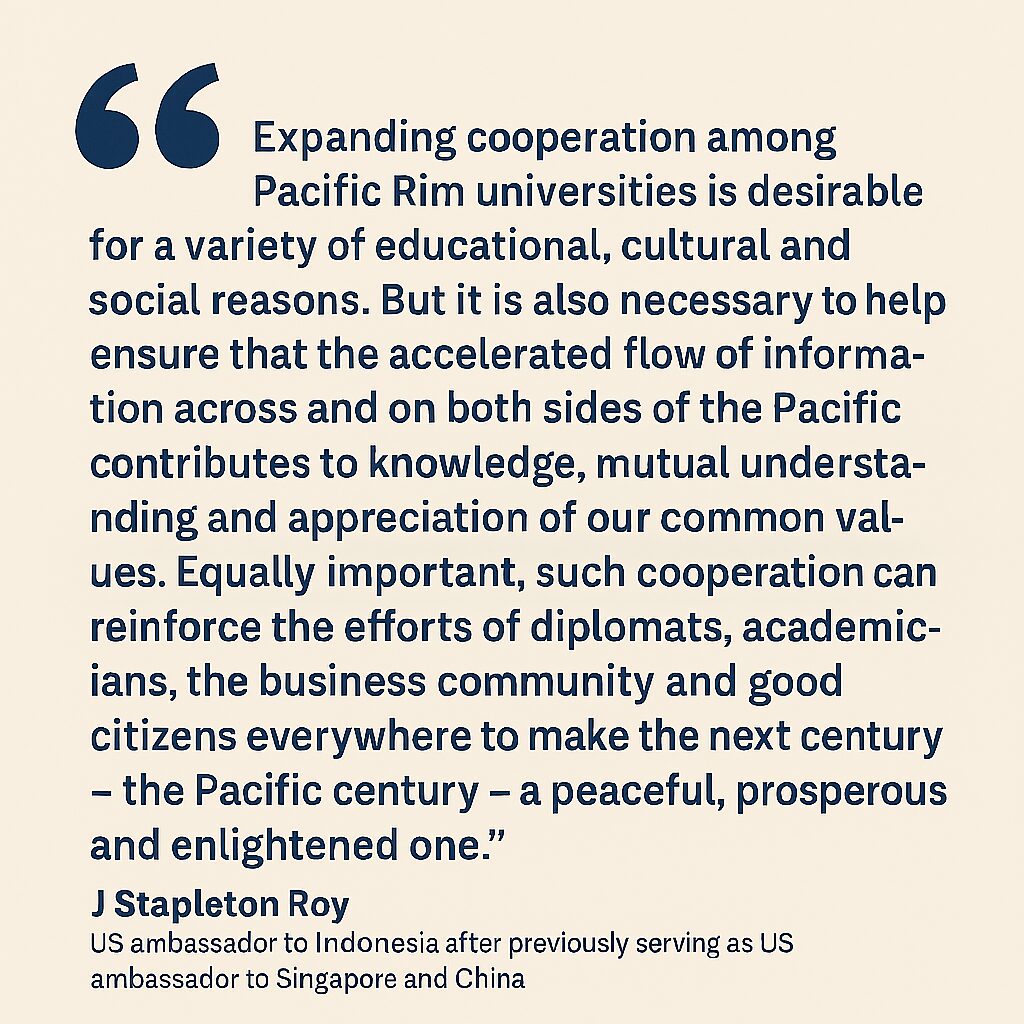
“But it is also necessary to help ensure that the accelerated flow of information across and on both sides of the Pacific contributes to knowledge, mutual understanding and appreciation of our common values.
“Equally important, such cooperation can reinforce the efforts of diplomats, academicians, the business community and good citizens everywhere to make the next century – the Pacific century – a peaceful, prosperous and enlightened one.”
Today, the need for such multilateral diplomacy is even more essential in a world characterised by contrary tendencies of development. On the one hand, the current globe is hyperconnected through trade, finance, modern communication and a mobility of people unseen in earlier phases of history.
The unprecedented and ubiquitous pace of technological development calls into question the very foundations of how life will be lived in the future.
Simultaneously, the globe is politically increasingly fragmented. We have witnessed a global diffusion of power to new national and institutional stakeholders, further exacerbated by demographic shifts, environmental degradation and socio-economic inequality, in addition to political and military conflicts.
In recent months, the enforced termination of joint US-Chinese institutes by the US administration and the request for payments of up to US$1 billion for the release of federal funding – like in the case of Harvard University and UCLA – have been illustrative of political threats to the global mission and the international nature of higher education. APRU’s diplomacy appears thus more urgent in 2025 than before.
A transnational framework apt to overcome political divisions and to build purpose-based trust is offered by the concept of planetarism. It moves beyond the limitations of internationalism by centring on the sustainability of human civilisation and the well-being of the entire planet, rather than the interests of sovereign nations.
Moving beyond the nation-state as the primary political unit, this framework promotes a new understanding of human interdependence with planetary systems, suggesting that a consciousness and collective responsibility for planetary issues is necessary to address the challenges of the Anthropocene.
This past summer, the University of Chile hosted one of our key events featuring educational diplomacy – the APRU Undergraduate Leaders’ Programme. Held for the first time in South America, the event convened 72 students from 13 economies.
The programme’s activities – including an international seminar on the future of democracy (attended by the President of Chile, Gabriel Boric, and featuring world-renowned speakers such as Nobel laureate Joseph Stiglitz and economist Ha-Joon Chang) – are entirely about educating a new generation of global leaders: leaders who will champion a visionary future form of leadership that is ethical, collaborative and transformative.
As University of Chile Rector Rosa Devés emphasised in her opening address: “[The world’s] complex, interconnected challenges… cannot be tackled in isolation. They demand cooperation, empathy and collective intelligence, especially from the new generations who will forge the future…
“It speaks to the ethical responsibility to act in a global context, to recognise the interconnection of our realities and to affirm that the dignity of every person, regardless of origin, is a shared obligation… We need leaders who understand that global citizenship is not about erasing differences but about learning to live with them and to lead through them.”
Macro-communities
Finally, a key purpose of transnational university networks is their power to help form a cohesive global community underpinned by the same values and priorities, a ‘planetary polity’. This is particularly true for university networks with a high degree of density per region of the globe, such as APRU in the Asia-Pacific.
When APRU was established in 1997, this happened purposefully and against the growing profile of the Asia-Pacific as a global economic superpower. The Asia-Pacific Economic Cooperation (APEC) had just been founded in 1989, in response to the growing interdependence of Asia-Pacific economies and the emergence of regional trade blocs in other parts of the world.
The mastermind behind the creation of APRU – Steven B Sample, president of the University of Southern California – intended APRU to be “analogous to, and supportive of, the efforts of the Asia Pacific Economic Cooperation’s (APEC) leaders to stimulate the creation of a community of Pacific nations”.
He invoked the social imaginary of such a community as APRU’s mission, namely “to help these institutions become more effective contributors to an increasingly integrated Pacific Rim community”.
As a purpose-driven model community of scholars, administrators, teachers and students from across the Pacific Ocean numbering close to three million people, APRU is thus a supporting architect of the Asia Pacific macro-community. We mirror the diversity of the Asia Pacific through all our activities, to mention only our network on Indigenous and First Nations Knowledges.
We enhance the representation of female leaders through our Asia Pacific Women in Leadership programme. We pursue the search for scientific truth and the fair and equitable implementation of solutions in our research-informed programmes on the region’s grand challenges – multi-hazards, global health, biodiversity, sustainability, food security and artificial intelligence.
We foster global citizenship – understanding, empathy and respect for the complexity of the globe and the very different local identities and contexts. Like in each community, civic participation is a key responsibility of global citizenship – one that we build through student leadership programmes, summer schools and student competitions.
Considering unprecedented global challenges and persistent global turbulence, it is vital to reaffirm for the mission of university networks – with the words spoken by Pablo Neruda – that “only with a burning patience can we conquer the Splendid City which will give light, justice and dignity to all mankind”.
| Thomas Schneider is the chief executive of the Association of Pacific Rim Universities. This is an abridged version of his recent keynote speech – “The role of transnational university networks in addressing global challenges in times of geopolitical turbulence” – at the opening of the University of Chile’s International Week. |
| This article is a commentary. Commentary articles are the opinion of the author and do not necessarily reflect the views of University World News. |