
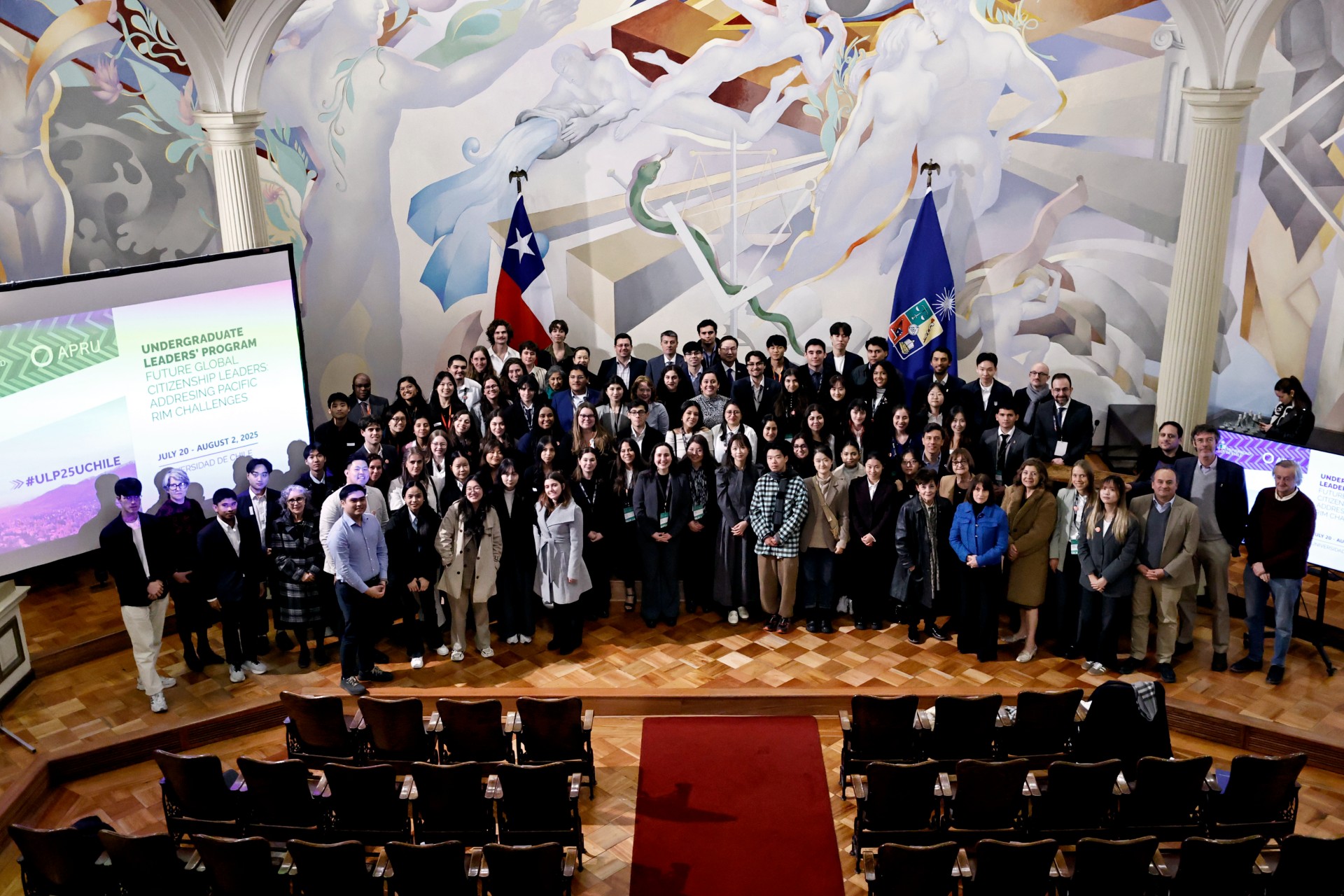
With 72 students representing 13 economies, Universidad de Chile inaugurated the APRU Undergraduate Leaders’ Program (ULP) in South America for the first time, focusing on the shared challenges of the Pacific Rim. During the opening ceremony, which took place at the Salón de Honor of the Casa Central, speakers emphasized the transformative role this program seeks to play for new generations by connecting them with common challenges from a Latin American perspective. Under the theme “Future Global Citizenship Leaders: Addressing Pacific Rim Challenges,” the program runs until August 1, featuring an intensive academic, diplomatic and cultural agenda.
“The Pacific region—as is the world at large—faces complex, interconnected challenges: the climate crisis, cultural tensions, economic inequality and growing threats to democratic values. These challenges cannot be tackled in isolation. They demand cooperation, empathy and collective intelligence, especially from the new generations who will forge the future. Our goal is to offer you a transformative international experience that deepens your sense of global citizenship—beyond international mobility or institutional cooperation. It speaks to the ethical responsibility to act in a global context, to recognize the interconnection of our realities and to affirm that the dignity of every person, regardless of origin, is a shared obligation.
“Your perspectives, questions and life experiences will enrich not only your own understanding but also that of your peers and professors—and, ultimately, our institutions… The world we inhabit urgently needs your voices. We need leaders who understand that global citizenship is not about erasing differences, but about learning to live with them and to lead through them.”
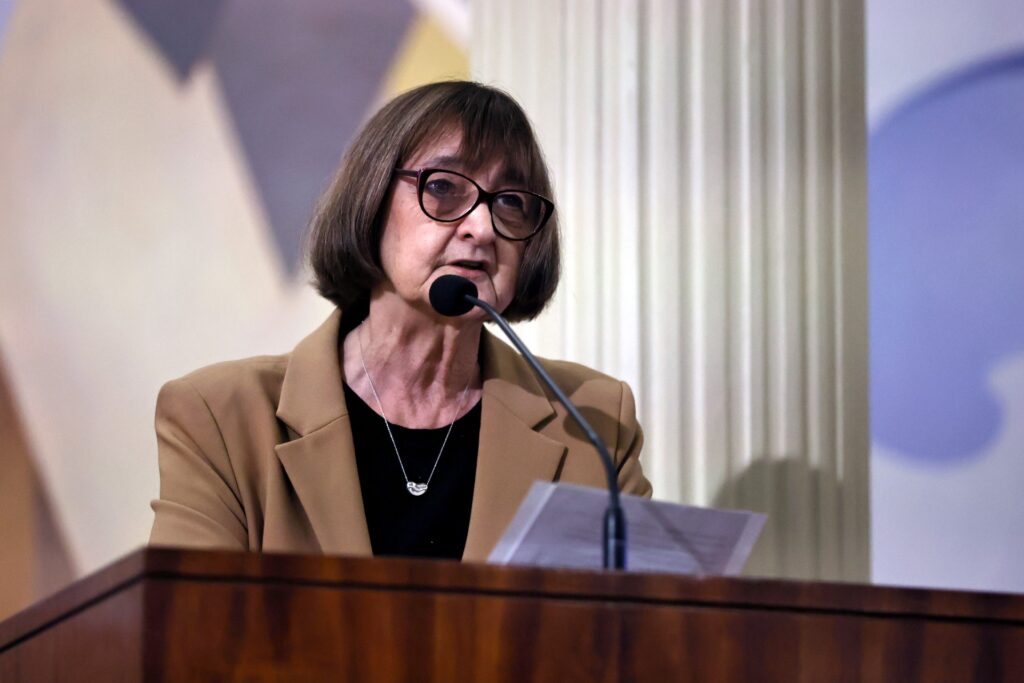
Rector Rosa Devés, Universidad de Chile
With these words, Rector Rosa Devés officially opened the ULP, organized by Universidad de Chile in partnership APRU. The event brings together undergraduates from 25 Pacific Rim universities.
A Milestone for Asia–Pacific Cooperation
Senator Francisco Chahuán, special guest for the day, highlighted Chile’s role as a bridge between cultures—not only because of its strategic location but also due to its commitment to trade openness and international cooperation. “A country like Chile aspires to stand as a bridge. And a bridge is not a bridge until people cross it,” he quoted Julio Cortázar.
The senator provided a thorough analysis of the economic and demographic challenges facing the Asia–Pacific region, underscoring the importance of viewing that bloc from a strategic perspective. “Asia–Pacific concentrates the largest emerging economies and the most innovation, which is why it is so important to focus on that context. We must nurture our relationships with key partners such as China, Japan, India and South Korea,” he said, calling for strengthened multilateral cooperation and economic diversification.
“Integration is not just about treaties or economic indicators: it’s about building community, recognizing ourselves as part of a shared destiny, especially in a world marked by uncertainty and ageing populations,” he added. “We need youth with strategic vision, capable of thinking beyond borders and defending free trade, cooperation and multilateral dialogue.”
Diplomacy, Dialogue and Diverse Knowledge
This year’s program includes open sessions such as the international seminar “The Future of Democracy: Why It Matters?”, featuring speakers like Joseph Stiglitz, Ha-Joon Chang and Susan Neiman. Participants will also meet representatives of public organizations, attend workshops with Latin American women leaders, engage in Indigenous knowledge sessions, participate in diplomatic simulations, visit natural sites and join a collaborative public-policy workshop.
David Quimbayo, APRU’s Program Manager, stressed the event’s historic nature. “This is the first time the ULP is held in South America, and it is a great opportunity to offer a Latin American perspective on our shared challenges. We believe in the transformative power of dialogue, learning through our differences and global citizenship as practice,” he said. He added that the program seeks “to build lasting ties, collaborative projects and friendships that will accompany students into their futures.”
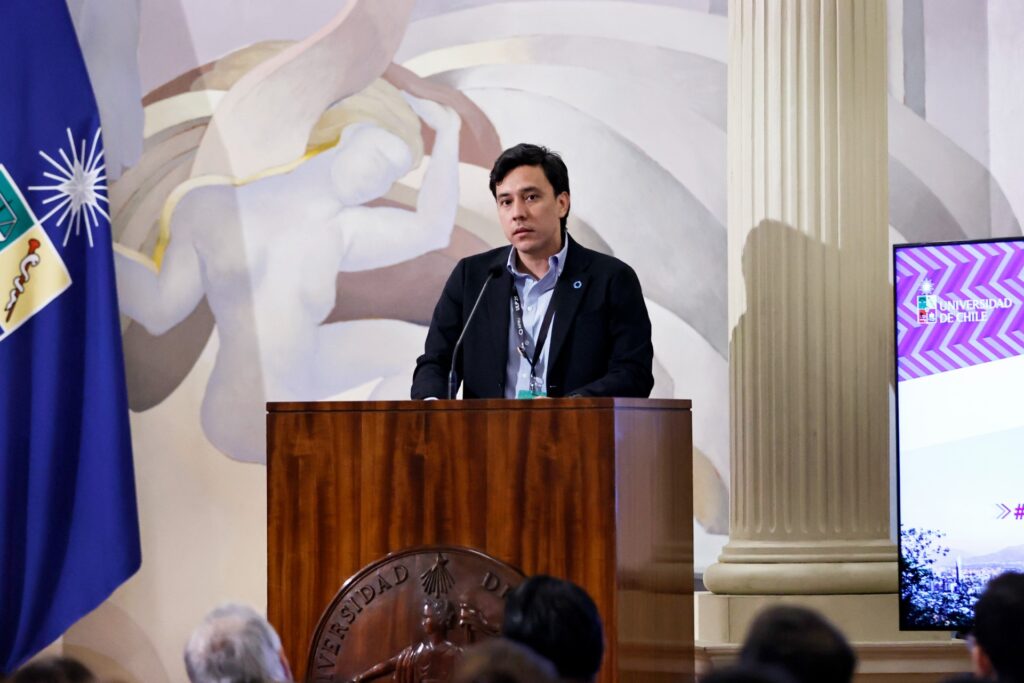
David Quimbayo, Program Manager, APRU
Meanwhile, Professor Andrés Bórquez of the Institute of International Studies emphasized that the program invites participants to develop leadership skills that acknowledge today’s complex world and champion intercultural cooperation. “This program is an immersive experience to think collectively, exercise democratic imagination and act ethically in a world defined by deep interdependence,” he said.
He also praised the collective effort that made this edition possible. “This initiative is the result of collaboration among academic units, management teams and many committed volunteers, opening spaces for the internationalization of knowledge from the global South.”
Carlos Rilling, Executive Director of the Rector’s Office, underscored that “the program’s pedagogical design aims to integrate academic reflection with intercultural empathy, critical thinking with action, and personal growth with collective transformation.”
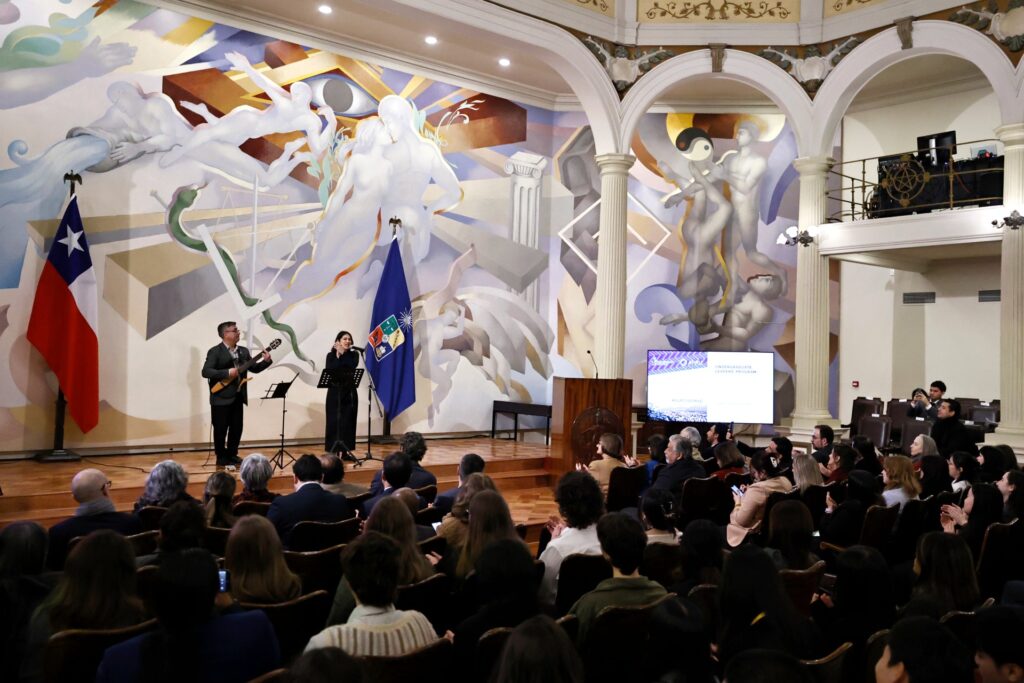
The opening ceremony featured a musical performance by Rocío Rojas Monsalve and Henri Hernández, who performed “Cuando el coyote y el huemul” by Professor Luis Advis and “La jardinera” by Violeta Parra, connecting attendees with the continent’s symbolic and spiritual richness. “Today we gather to imagine a future where deep respect for the past is projected into new ways of inhabiting the world,” Rojas said during her performance.
Thus, Universidad de Chile serves as host and promoter of an educational experience designed to train the future leaders of the Pacific Rim, underpinned by a deep conviction that another form of leadership—ethical, collaborative and transformative—is possible.