
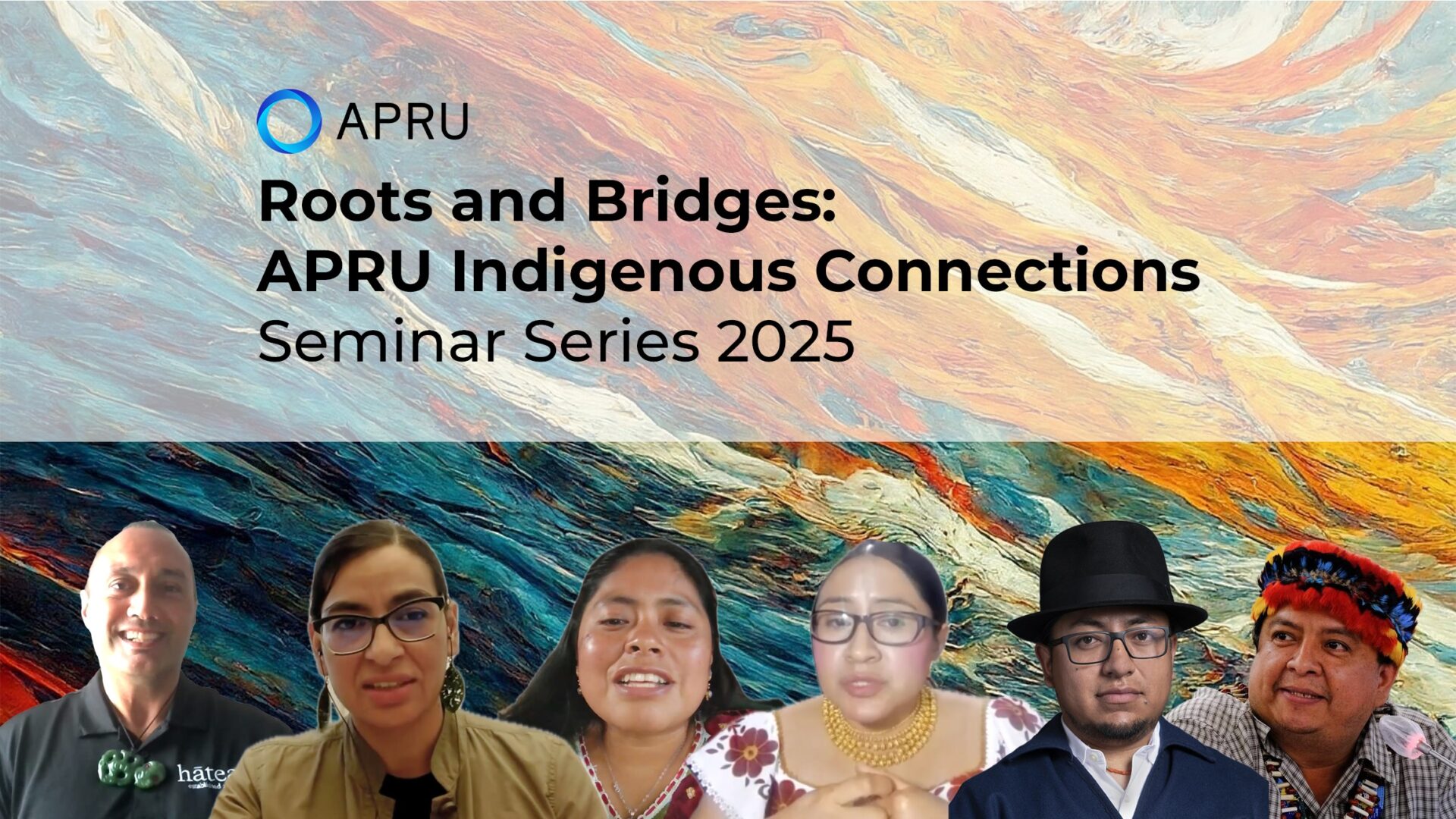
The 2025 edition of Roots and Bridges: APRU Indigenous Connections Seminar Series came to a meaningful close this December, marking the second consecutive year that APRU’s Indigenous and First Nations Knowledges Network brought together students, scholars, community leaders, and practitioners from across the Pacific Rim. Held from May to December, and moderated by Emeritus Prof. David Romo from Universidad San Francisco de Quito, this six-part virtual series created a space for Indigenous voices to lead the conversation on culture, identity, and the future of knowledge-driven collaboration.
This year’s program featured six speakers representing diverse sectors and geographies: universities including The University of Auckland Waipapa Taumata Rau, The University of British Columbia, and Universidad San Francisco de Quito; nonprofit and civil organizations such as Antsetik ts’unun and the Global Alliance of Territorial Communities (GATC); the corporate sector through Movistar; and global governance via the UN Permanent Forum on Indigenous Issues. Together, they spanned four economies: New Zealand, Canada, Mexico, and Ecuador; each contributing perspectives shaped by local experience and global commitment.
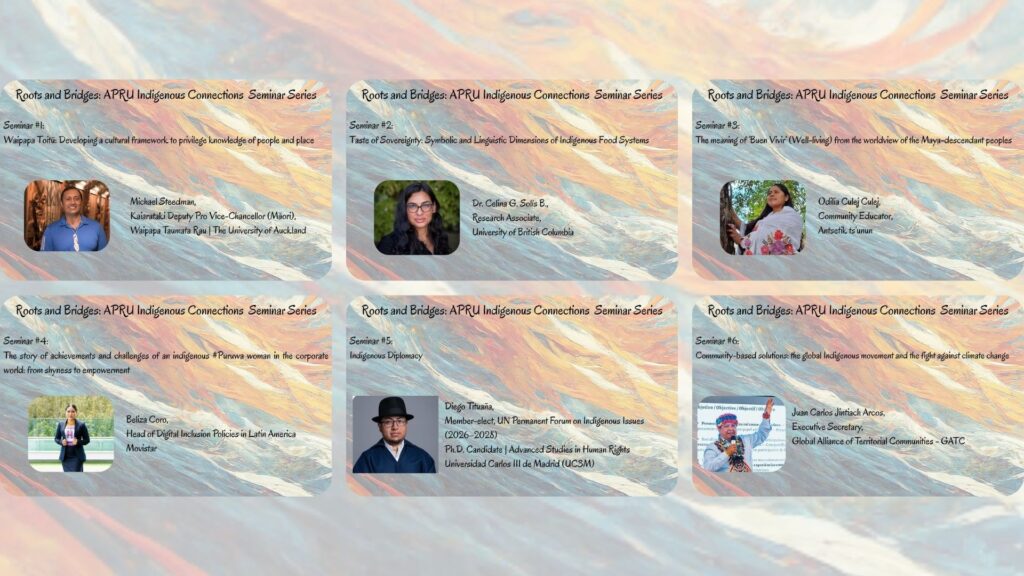
While the 2024 inaugural series focused largely on academic and institutional exchange, the 2025 edition broadens perspectives by highlighting the personal journeys of Indigenous leaders. The sessions explored topics such as building Indigenous cultural frameworks within institutions, the symbolic and linguistic dimensions of Indigenous food systems, the Mayan worldview of “Buen Vivir”, pathways from shyness to empowerment for Indigenous women in corporate spaces, the evolution of Indigenous diplomacy, and community-based solutions to climate change.
“There should be a kind of humility over the supremacy of the lens in which we view other languages and other cultures and try to take the position of the learner instead of taking the position of the one who’s going to either teach or improve things.”
– Dr. Celina G. Solís B.
Across these sessions, participants engaged, not only, with academic insight but with lived experiences: stories of resilience, identity, and the ongoing work of advancing Indigenous rights and knowledges. This personal dimension enriched the learning experience and reinforced the importance of Indigenous-led narratives in shaping more equitable and sustainable futures.
The series also continued to grow its community. With a total audience of more than 600 participants across multiple regions and disciplines, Roots and Bridges has solidified itself as one of APRU’s platforms for exchange, collaboration, and collective reflection.
“I would like to see a lot of girls and a lot of boys from indigenous communities to access to the higher education, to graduate from the best universities. I would like to see a lot of, women writing their own history of life. For that reason, I’m in this space telling my story, telling my experiences in the professional and academic life. I would like to have more indigenous women in this kind of space, sharing their dreams and their objectives. That’s my dream.”
– Beliza Coro
As 2025 concludes, the Indigenous and First Nations Knowledges Network celebrates the connections formed, the knowledge shared, and the momentum generated. The success of this year’s edition reaffirms the value of centering Indigenous worldviews within higher education and global dialogue. With enthusiasm and a renewed sense of purpose, the series will return in 2026 and remains committed to amplifying Indigenous voices and expanding cross-cultural and cross-disciplinary collaboration across the Pacific Rim.