
Artificial intelligence is rapidly reshaping the research landscape. With the ability to analyse vast datasets in a very short time, it promises to accelerate discovery in ways previously unimaginable. However, as we embrace these advances, we must also pause to ask: are we losing the romanticism of science?
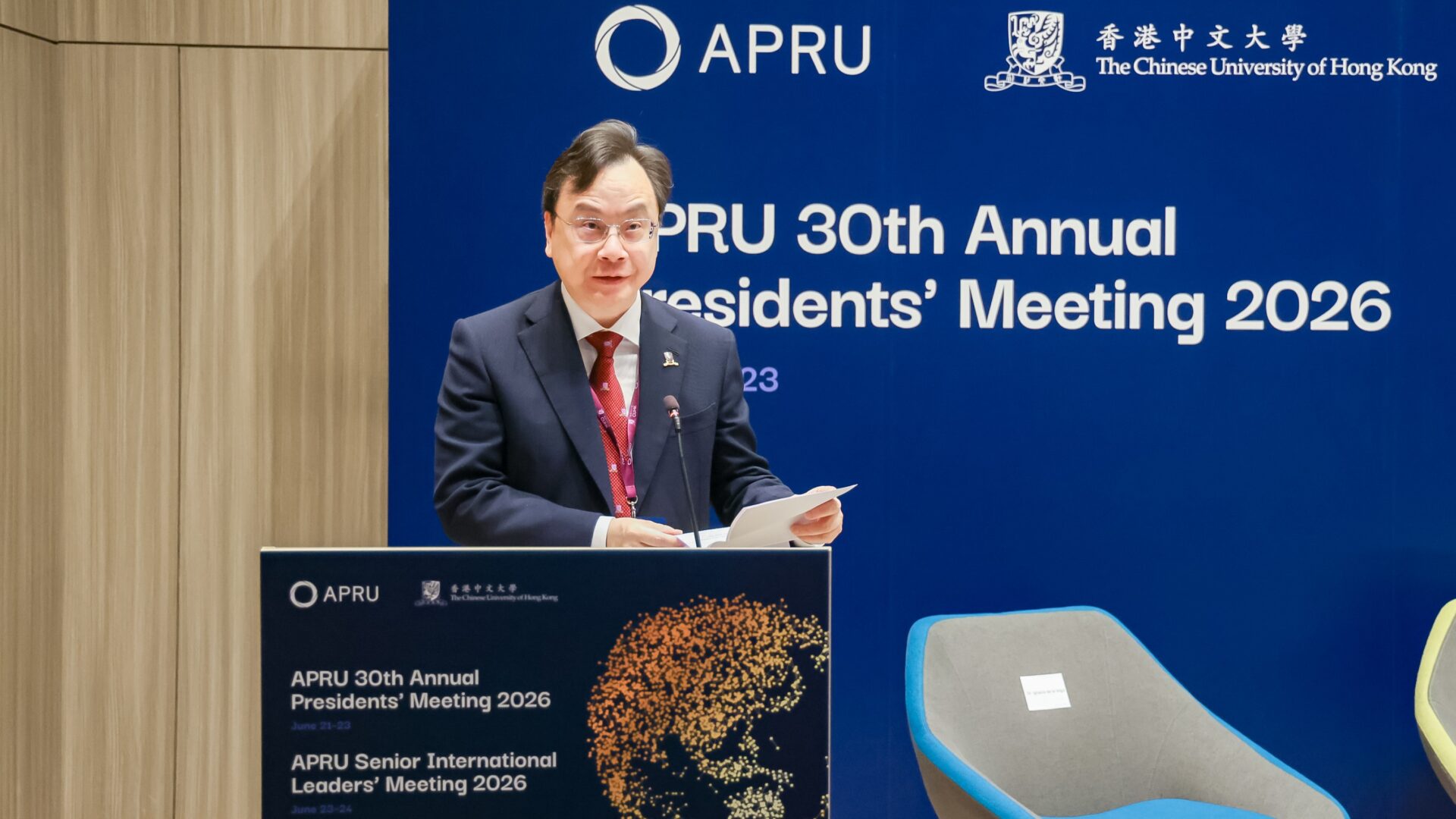
This question was very much on my mind as the Chinese University of Hong Kong recently hosted the Association of Pacific Rim Universities (APRU) Annual Presidents’ Meeting at the end of June, which brought together delegates from 45 institutions across 19 economies.
Among the many issues discussed was the growing impact of artificial intelligence on higher education, particularly how it is transforming the way we teach, learn and conduct research. While we recognise the opportunities AI presents, there was also conversation involving a more fundamental reflection on how the nature of discovery itself may be changing.
In this context, I reflected on a scenario increasingly familiar to researchers. With AI, we input data into a computer, which produces multiple hypotheses. We select a few to test, and, with a bit of luck, eventually one proves correct.
While seemingly efficient, this process makes us wonder: if the machine generates the ideas, then can the scientist truly claim ownership of the discovery? More importantly, does this weaken the very human experience of scientific inquiry – the anticipation, the surprise and the story behind the breakthrough?
| This article is part of a series on Pacific Rim higher education and research issues published by University World News and supported by the Association of Pacific Rim Universities. University World News is solely responsible for the editorial content. |
A personal example
My own research experience shows this human side of science still matters. In the early 1990s, I spent many years searching for foetal cells in maternal blood, believing they would hold the key to non-invasive prenatal diagnosis. That assumption proved wrong.
The breakthrough only came when I shifted perspectives and discovered that fragments of foetal DNA outside cells were present in maternal plasma. This discovery, first reported in 1997, eventually led to non-invasive prenatal testing, which has since benefitted more than 100 million women worldwide.
What is interesting is how the discovery unfolded.
Rather than progressing as a linear path of predictable steps, the journey was shaped by seemingly random measures of promising leads, frustrating missteps, soul-searching and that ‘aha’ moment. I believe these are the elements that make science exciting, fun and beautiful.
We risk losing the discovery process
AI can remove much of the routine and laborious side of research and help us see patterns faster, test ideas more efficiently, and collaborate across disciplines more effectively. However, if we allow AI to dominate the process of idea generation, we may risk losing something fundamental: the discovery process that has long inspired generations of scientists.
Students love to hear inspirational stories such as the one of Sir Isaac Newton who conceived the laws of gravity after an apple fell from a tree and hit him on his head.
These stories give us examples of how scientists, through their interactions with the real (as compared with the virtual) world and perhaps with serendipity, would be inspired to make groundbreaking discoveries.
Food for thought
The increasing dominance of AI in scientific pursuit gives food for thought for educators in universities. They need to balance their focus on equipping students with technical skills required for their future careers and cultivating human qualities and values that students can gain through people-to-people interaction.
Scientific literacy, ethical judgement, creativity and adaptability are skills that we should be developing systematically. By expanding research-led and inquiry-based learning, our students will learn how to think, question and discover for themselves.
In an AI-shaped world, universities must ensure that students learn to use AI as a tool, rather than themselves being research assistants to an AI principal investigator. Universities should be preparing students to be forward-thinking and future-ready, and to be using AI to expand human curiosity and creativity, rather than to substitute human thinking.
We also have to think about what it means to be a scientist at a time when machines are seemingly able to come up with ideas but are unable to experience the sense of wonder and excitement that I experienced in my research journey.
Scientific discovery is a never-ending process of exploration. My journey has been shaped by curiosity, imagination and passion. I believe preserving this human-centric scientific spirit may be one of the most important responsibilities of universities in the age of AI.
Professor Dennis Lo is vice-chancellor and president and Li Ka Shing Professor of Medicine of the Chinese University of Hong Kong. He is internationally renowned for discovering the presence of foetal DNA in maternal plasma, a breakthrough that led to the development of non-invasive prenatal testing used worldwide.
This article is a commentary. Commentary articles are the opinion of the author and do not necessarily reflect the views of University World News.