
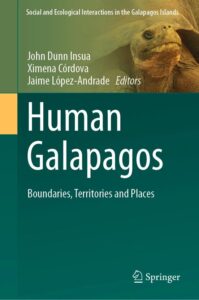
Human Galapagos – Boundaries, Territories and Places, a new book published by Springer in January 2026, stands as a key outcome of collaborations initiated at the 6th APRU Sustainable Cities and Landscapes (SCL) Conference hosted by Universidad San Francisco de Quito (USFQ) in Ecuador in 2023.
Edited by Professors John Dunn Insua, Ximena Córdova, and Jaime López-Andrade of USFQ, the volume features contributions from more than 40 authors engaged in the APRU SCL program, including a number of active working groups’ members who are from the University of Oregon, Simon Fraser University, and Shanghai Jiao Tong University.
The Galápagos Islands, often described as a “living laboratory” of evolution, continue to capture the global imagination. The SCL 2023 conference, held on San Cristóbal Island and Ecuador’s capital, Quito in August, convened Pacific Rim scholars and practitioners to explore place-based solutions to contemporary sustainability challenges. The resulting publication reflects the conference’s transdisciplinary approach, demonstrating how the APRU network fosters collaborative research and knowledge exchange to address pressing issues across the Pacific region.
“This book is more than a scholarly exploration of the Galápagos,” writes the SCL Program Co-Director Yekang Ko in the book’s forward. “It is a call to action—a reminder that the choices we make today, whether in remote islands or bustling urban centers, have profound implications for the future of our planet.”
Human Galapagos builds on this foundation to explore the complex interactions of natural and human systems that define the islands today. Drawing on multidisciplinary perspectives from ecology, architecture, planning, engineering, environmental design, and the social sciences, the book investigates how borders, infrastructure, and cultural imaginaries shape life and governance in the archipelago.
Reframing the Galápagos as a dynamic socio‑ecological system, the volume argues for a more integrated approach to conservation and development. It calls for incorporating human-designed elements—such as settlements, water and energy systems, and coastal infrastructures—into conservation strategies, positioning the Galápagos as a model for sustainable island and coastal communities across the Pacific Rim.