
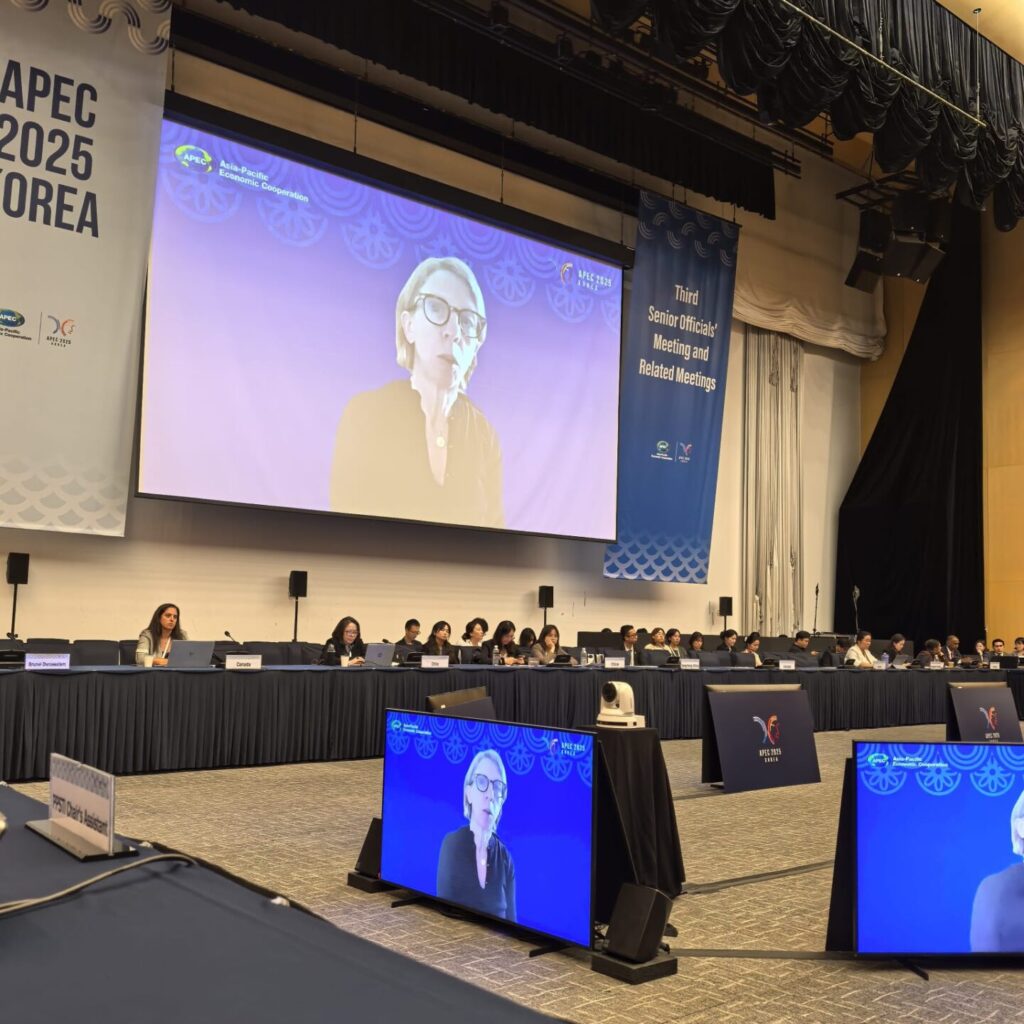
On August 11, Berenice Voets, APEC Liaison at the Association of Pacific Rim Universities (APRU), presented key insights to the APEC Policy Partnership on Science, Technology and Innovation (PPSTI) working group during the Senior Officials Meeting 3 (SOM3). APRU has long partnered with APEC to advance inclusive, ethical, and innovation-driven development. As a guest member of PPSTI, APRU contributes research-based perspectives to support regional collaboration.
The presentation highlighted findings from two recent APRU co-hosted forums focused on AI’s transformative impact on education, workforce development, and social equity. The first, the APEC University Leaders Forum (AULF), held in Jeju Island as an official side meeting of the APEC Education Ministers Meeting, convened over 100 participants from 13 APEC economies. The second, a regional forum on workforce readiness, was held in Bangkok as part of the 3rd UNESCO Global Forum on the Ethics of AI.
Both events underscored the urgency of preparing the Asia-Pacific workforce for rapid AI-driven transformation. With 50–60% of jobs across the region exposed to AI, and nearly a quarter at risk of displacement, the forums emphasized the need for targeted interventions to bridge talent gaps and mitigate inequality. Women and youth were identified as particularly vulnerable, with up to 79% of working women employed in roles highly susceptible to automation.
Participants called for a layered approach to education—pairing universal AI literacy and ethics with sector-specific training and lifelong learning. Examples from economies such as Singapore, Taiwan, and Vietnam showcased innovative models, including micro-credentialing, simulation-based learning, and public–private partnerships that link education to strategic industries like semiconductors, healthcare, and digital services.
The forums also highlighted the importance of inclusive design and local ownership. Linguistic diversity, infrastructure realities, and community engagement were seen as critical to building trust and ensuring equitable access to AI opportunities. SMEs, rural communities, women and youth face unique challenges that require context-aware solutions and adaptive policy frameworks.
To harness AI’s potential for economic growth, participants stressed the need for a fundamental rethink of policy, education, and industrial strategy. This includes reimagining labor protections, investing in modular education ecosystems, and fostering cross-sector collaboration. Strategic partnerships across government, academia, industry, and civil society are essential to co-design locally relevant solutions and deploy ethical, scalable AI models.
In closing, APRU reaffirmed its commitment to supporting PPSTI’s mission and advancing inclusive innovation across the region. By aligning research, policy, and practice, the region can build a resilient, AI-ready workforce that reflects the diversity and dynamism of the Asia-Pacific.