About
About the APEC Education Ministerial Meeting
AULF 2025 Program
Speakers
Event Venue
Accommodation
Partners
Key Contacts
Registration
FAQ
Resources

APRU APEC University Leaders Forum 2025

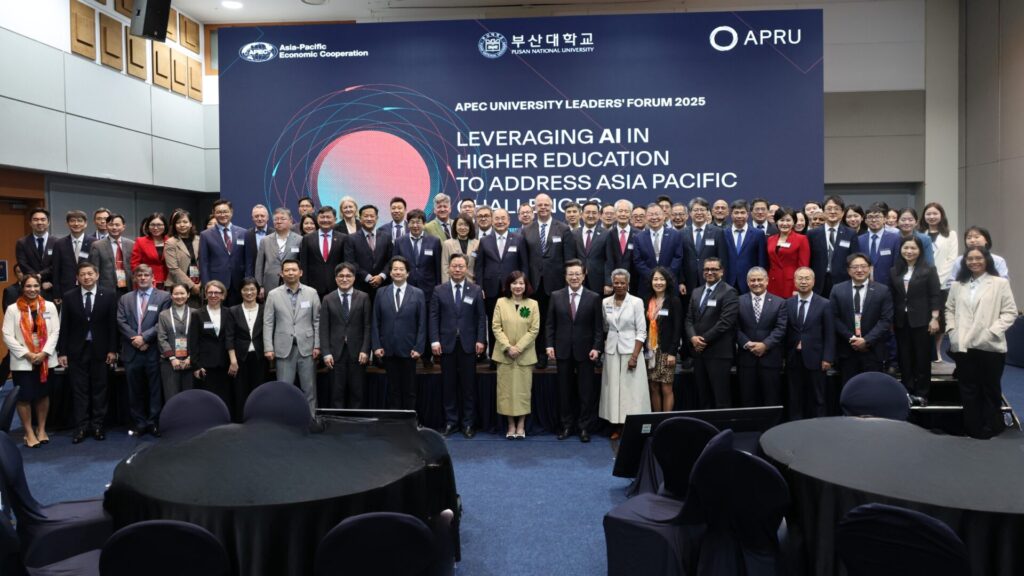
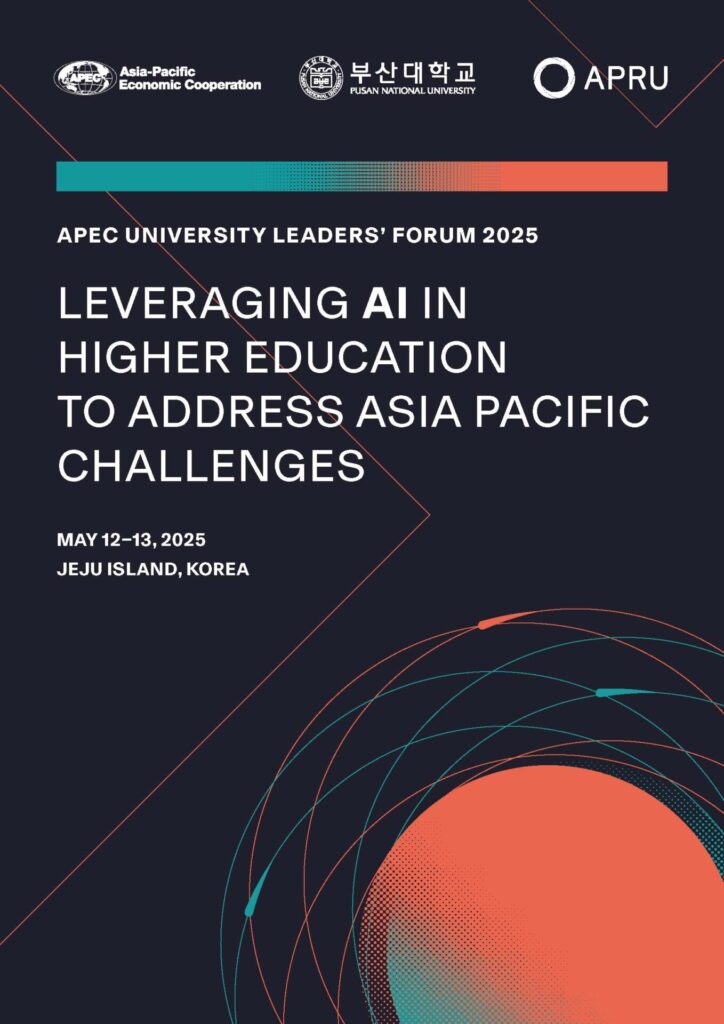
The APRU APEC University Leaders Forum 2025, hosted by Pusan National University, will convene under the theme “Leveraging AI in Higher Education to Address Asia-Pacific Challenges”.

The Forum will explore the multifaceted impact of generative AI on higher education, focusing on its potential to address Asia-Pacific challenges. It will take place alongside the APEC Education Ministers Meeting, providing a unique platform for dialogue on education reform and the integration of AI in solving regional challenges.

The Forum will bring together university leaders, policymakers, and industry experts to discuss meaningful and collaborative strategies for developing a holistic, inclusive, and responsible approach to AI adoption, ensuring equitable access and leveraging AI to its full potential for tackling key challenges in the Asia Pacific region.

Key topics will include:

  1. AI Policy in universities. How do universities keep up with the accelerated pace.
  2. Leveraging AI in higher education to address regional challenges, such as climate change.
  3. Broadening access to education through AI, including expanding access to education, addressing digital divides, and barriers to education.
  4. Building skills and capacity for an AI-driven future to prepare students for future job markets and inform the future of education in the Asia Pacific.
  5. Addressing adaptation challenges and ethical considerations.


Special sessions:

  • Top-level keynote speakers on future trends in AI, risks and opportunities, and policy development.
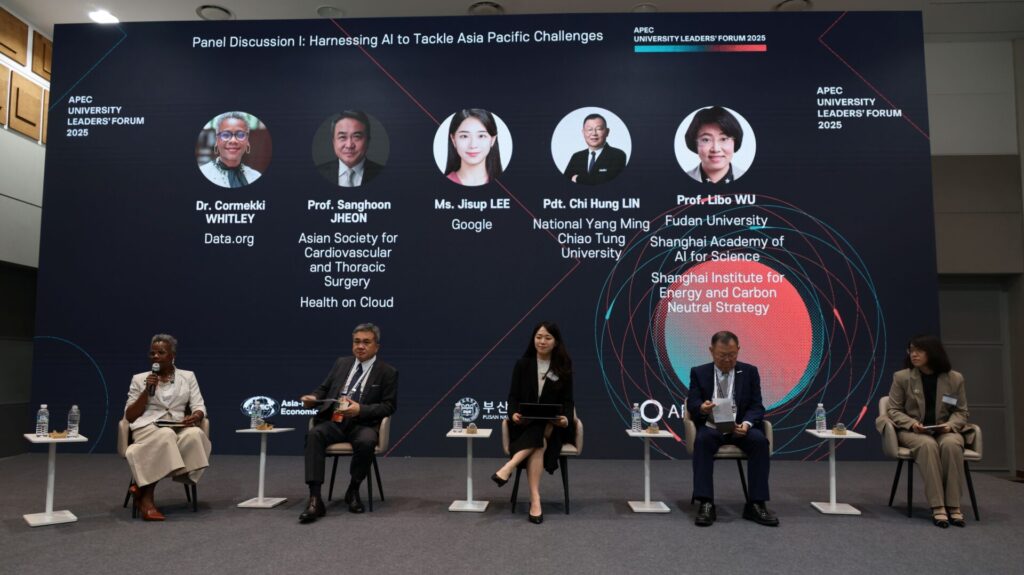
  • Panel discussions: Featuring experts from academia, industry, and government on the ethical implications and societal impacts of AI, and its transformative role in education.
  • Networking opportunities: Facilitating collaborations and partnerships among participants.


The Forum will be graced by the presence of H.E. Lee Ju-ho, Deputy Prime Minister, Ministry of Education of the Republic of Korea who will deliver the keynote address at the opening session.

The outcomes of the Forum discussions will contribute to shaping policies and strategies for the common good.

Attendance to this meeting is by invitation only. If you have received an invitation, join us at the APRU APEC University Leaders Forum 2025 to be part of a transformative conversation on how AI can drive positive change across the Asia Pacific region.

To request an invitation, please contact [email protected]


The APEC Education Ministerial Meeting (AEMM)

The APEC University Leaders’ Forum (AULF) will be held as an official event of The APEC Education Ministerial Meeting (AEMM) and representatives from education ministries and APEC will be invited to attend the AULF meeting. Attendance to the AEMM is by invitation only.

The APEC Education Ministerial Meeting (AEMM) is typically held every four years. The 2025 APEC Education Ministerial Meeting will be held in Jeju, Republic of Korea, in May, concurrently with the AULF. 

At the meeting, education ministers and senior officials review the progress of joint activities, projects and initiatives undertaken by APEC member economies, review the impact of current trends on education within the APEC region and chart future directions for cooperation in education. The preparatory work for the AEMM is coordinated by EDNET (APEC’s Education Network), and the priorities of EDNET are shifted and directed in accordance with corresponding AEMMs.

To learn more about the priorities for the upcoming APEC 2025 meeting in Korea, please visit https://www.apec.org/press/news-releases/2024/korea-sets-ambitious-priorities-for-apec-2025–building-a-sustainable-tomorrow

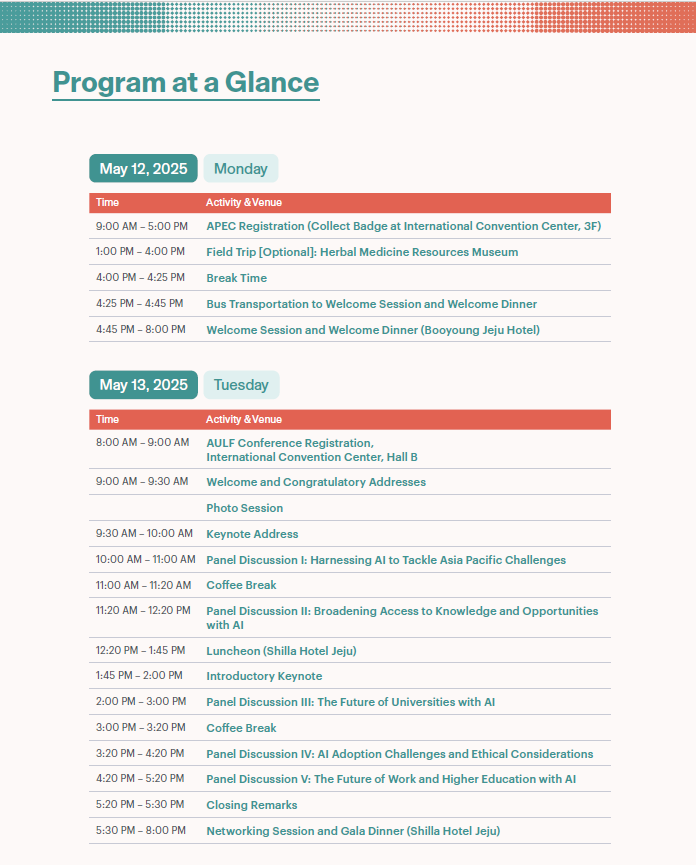
AULF 2025 Program

For the pre-arrival information, please click here.

For the program booklet, please find here.

Please note that the program is tentative and subject to change.


Please note that the program is tentative and subject to change.

Speakers

Event Venue

Jeju International Convention Center  (ICC Jeju)

Website: https://www.iccjeju.co.kr/main/main.php

Location: https://maps.app.goo.gl/WMew9otLpDCZXEHu7

Address: 224, Jungmungwangwang-ro , Seogwipo-si, Jeju-do, South Korea 63547

 (제주특별자치도 서귀포시 중문관광로 224(중문동) )

Phone: +82 64-735-1000 (If you use a Korean SIM card, 064-735-1000)

Accommodation


The Shilla Jeju

Our conference host, Pusan National University, has secured a number of rooms at preferential rates for the conference. Participants can make their own reservations with preferential rates (limited quantity, first-come, first served) through the link below:

http://www.shillahotels.com/jeju/resv/rpm/memSetStep1.do?coporateCd=COMPANY&coporateVal=4151868&lang=en 

For more information about the hotel, see below:

Website: https://www.shilla.net/jeju/index.do

Location: https://maps.app.goo.gl/yLnkA624EJaP2iAs7

Address: 75 Jungmungwangwang-ro 72beon-gil, Seogwipo-si, Jeju-do, South Korea, 63535

(제주도 서귀포시 중문관광로72번길 75) 

Phone: +82 64-735-5114

Getting there:

A public transportation service (Limousine bus No. 600) from Jeju International Airport runs intervals of 20 minutes (fare: KRW 4,500, it takes about an hour(40km))

Taxi rides are expected to take about 30 to 40 minutes and fare around KRW 40,000.

Partners


pusan.ac.kr

About Pusan National University

Pusan National University (PNU), established in 1946, is Korea’s leading national university, located in Busan, the country’s second-largest economy. With 17 colleges, 130 majors, and a student body of 34,000, including 2,000 international students from 90 countries, PNU is renowned for its strengths in STEM, humanities, and marine sciences. It is the only university in Korea offering all marine-related academic disciplines, underscoring its leadership in environmental and marine studies. PNU has adopted five research priorities: defense science, marine climate technology, semiconductors, food technology, and K-culture.

PNU’s global reputation is bolstered by 600 international exchange agreements across 62 countries. It also offers 1,000 English-track courses to accommodate its diverse student population. As a partner in the U.S. Department of State’s Critical Language Scholarship (CLS) Program, PNU is a premier destination for intensive Korean language education and cultural immersion. The university attracts top global talent, hosting the second-largest number of Global Korea Scholarship (GKS) students in Korea.

Additionally, PNU published 5,563 SCI-level articles in 2021 and actively participates in global research as a member of the Association of Pacific Rim Universities (APRU). Two affiliated university hospitals, with a combined 2,500 beds, further enhance its academic and research excellence.

apru.org


About APRU 

As a network of leading universities linking the Americas, Asia, and Australasia, APRU (the Association of Pacific Rim Universities) brings together thought leaders, researchers, and policy-makers to exchange ideas and collaborate on practical solutions to the challenges of the 21st century.

We leverage our members’ collective education and research capabilities into the international public policy process. In the post-pandemic era, our strategic priorities focus on:

  1. Providing a neutral platform for high-level policy dialogue,
  2. Taking action on climate change, and
  3. Supporting diversity, inclusion, and minorities.


APRU’s primary activities support these strategic priorities, focusing on critical areas such as biodiversity, disaster risk reduction, women in leadership, indigenous knowledge, global health, sustainable cities, artificial intelligence, waste management, and more.

APRU collaborates with Asia-Pacific Economic Cooperation (APEC) on initiatives which aim to solve the challenges of the Asia Pacific. APRU has guest membership status with APEC working groups and participates in a number of high-level discussions to ensure that universities have a voice in shaping policy across the region.

apec.org

About APEC

The Asia-Pacific Economic Cooperation (APEC) is a regional economic forum established in 1989 to leverage the growing interdependence of the Asia-Pacific. APEC’s 21 members aim to create greater prosperity for the people of the region by promoting balanced, inclusive, sustainable, innovative and secure growth and by accelerating regional economic integration.

The organization works to ensures that goods, services, investment and people move easily across borders and that all residents of the Asia-Pacific participate in the growing economy. The forum adapts to allow members to deal with important new challenges to the region’s economic well-being. This includes ensuring disaster resilience, planning for pandemics, and addressing terrorism. Recognizing the impacts of climate change, APEC members implement initiatives to increase energy efficiency and promote sustainable management of forest and marine resources.

Capacity building projects play an important role in helping translate APEC’s goals into reality. By enhancing members’ capacity through skills training and technological know-how, APEC-funded projects strengthen members’ readiness to adopt new initiatives from electronic customs processing to regulatory reform. APEC projects also target specific policy areas from enhancing small and medium enterprise competitiveness to facilitating the adoption of renewable energy technologies in the region.

The APEC Education Ministerial Meeting (AEMM) reviews the impact of current trends on education within the APEC region and charts future directions for cooperation in education.

The APEC process is supported by a permanent secretariat based in Singapore.

iace.re.kr

About Institute of APEC Collaborative Education (IACE)

The APEC International Education Cooperation Center (IACE) was established in 2002 with the aim of promoting shared prosperity in APEC and bridging the knowledge information gap among member countries.

As Korea’s dedicated APEC education cooperation agency, the APEC International Education Cooperation Center engages in a range of international collaborative activities, including the APEC Human Network Project, APEC Future Education Consortium, Education Innovation Community, and Educational Diplomacy (APEC Chair Activities), thereby building a regional education community.

Additionally, in partnership with 17 provincial education offices, the Center is leading innovations in e-learning education through projects such as the Educational Information Support Project for Exchange and Cooperation Countries, the Establishment of Model Classrooms Utilizing Advanced ICT, and the APEC e-Learning Training Program.

The IACE has been designated by the Korean Ministry of Education as the dedicated center for e-learning globalization. The Center has launched a specialized support group for e-learning globalization, known as LEAD.

moe.go.kr

About Ministry of Education of the Republic of Korea

The Ministry of Education (MOE) is the central administrative agency of the Republic of Korea. The MOE supports human resource development policies ranging from K-12 to higher education, research, lifelong education, and national academic affairs. The Minister is at the level of Deputy Prime Minister.

It has the National Institute for International Education, the Academy of Sciences, the National Institute of Korean History, the National Institute for Special Education, the Central Educational Training Institute, and the Teachers’ Appeals Review Committee.

35 national universities, including Pusan ​​National University, are affiliated with the Ministry of Education.


Key Contacts

The event team contacts prior to the event and onsite are outlined below for your ready reference.

Team member

Mobile

Email address

Berenice Voets
APRU

+852 9081-8210

[email protected]

Jinju Lee
PNU

+82 10 2569 6355

[email protected]

Soojung Choi
PNU

+82 10 6809 4032

[email protected]


Registration

The event is by invitation only. Please register by April 15, 2025 if you have received an invitation: https://apru.org/event_register_form/apec-university-leaders-forum-2025/

Please contact [email protected] if you wish to receive an invitation.

1. Visa requirements to enter Korea?

All foreign nationals entering Korea must hold a valid international travel document in the form of a national passport (with 6 months of remaining validity from the date of arrival) and a valid visa from the Korea Immigration Service (if required).

As a first step, please check if you need a visa to enter Korea using the ‘Visa Navigator’ section of the Korea Visa Portal (www.visa.go.kr).

If you are exempt from visa requirements, you are still required to apply for a K-ETA before boarding your flights.

Participants with diplomatic or official passports or United Nations laissez-passer, holders of ABTC, or those who are under the age of 17 or over the age of 65, will also be exempt from K-ETA.

Refer to this website [https://www.k-eta.go.kr/portal/apply/index.do?locale=EN] for more information about K-ETA application procedures, or contact your local Korean Embassy or Consulate for visa application.

Please apply for the K-ETA with sufficient time to spare as the assessment alone could take up to 72 hours after the application. The K-ETA application fee is 10,000 KRW/person and applications can be submitted by a proxy. You can apply for the K-ETA for up to 50 persons at once.

If you require visa support from Pusan National University (PNU) with your visa application, please email [email protected].

ABTC holders do not require a visa to enter the Republic of Korea for up to a maximum of 90 days.

2. APEC accreditation requirements

Our host will contact you after you register to provide information if registration is required.

3. Dress code for the Forum?

  • Pre-forum Day (registration and field trip) on May 12: Smart casual, with comfortable walking shoes for the field trip.
  • Welcome Reception on May 12: Business casual (jacket only for men, no tie). There will be a group photo.
  • Forum sessions and dinner on May 13: Business casual (jacket only for men, no tie).


4. Media Participation

The Forum is an invitation-only private event. Only registered participants are permitted to be in the room.
Some media may be invited to attend. To promote free and open discussion, we adopt the Chatham House Rule, which means participants are free to use the information discussed, but neither the identity nor the affiliation of the speaker(s), nor that of any other participant, may be revealed.

While you are encouraged to post personal photos, we would appreciate if you could follow the Chatham House Rules when posting any messages or photos mentioning the Forum on any social media or other platforms. Thank you for your understanding.

5. Can my I transfer my invitation to a colleague?

If you are unable to attend the forum and would like to transfer your invitation to one of your colleagues, please let us know.

6. Local Time

Korea Standard Time (KST) is the Universal Time Coordinated (UTC + 9).

7. Local weather be in Jeju in May?

Spring is the best time to visit Jeju Island because of mild temperatures and blooming landscapes. In May, the temperature would be hovering between 14-22 degree Celsius. In Jeju in May, there’s a moderate chance of rain.

8. Electricity and Drinking Water

The standard electricity supply in Korea is 220V, 60 Hz. Power plugs used in South Korea are round with two circular pins, commonly known as Type C or Type F plugs.

9. Local public transportation

Since Google Map does not provide walking directions, we recommend using Naver map during your stay in Korea. For more information on Naver Map User Guide, please refer to Annex E. https://map.naver.com.

Public Transportation App Features

  • The app service is available in English.
  • Offers public transportation route guidance.
  • Provides a real-time information on bus and subway boarding and exiting, using GPS tracking during travel.
  • To start the navigation: (1) select a public transportation route on the app, and (2) press the guide button.
  • Delivers accurate notification and voice guidance for boarding and exiting during your travel.


Note: * Users must grant the app permission to access location services for full functionality


Resources

AULF 2025 Photos 

Please find photos of the APRU University Leaders’ Forum 2025 on APRU Flickr.

AULF 2025 News


APRU AULF 2025 Program Booklet 

The APEC University Leaders’ Forum (AULF) will be held as an official event of the APEC Education Ministerial Meeting (AEMM). The forum will take place at the International Conference Center (ICC), Jeju, the official APEC venue for the Senior Officials’ Meeting (SOM2), alongside other APEC scheduled activities and meetings. Click here to find the AULF 2025 program booklet.


[Whitepaper] Generative AI in Higher Education: Current Practices and Ways Forward

The Whitepaper is a main outcome of the project “Generative AI in Higher Education”, conducted by the Association of Pacific Rim Universities (APRU) with the generous support of Microsoft. The Whitepaper presents both a framework for action and a call for transformative change in how we prepare students, educators, academics, and administrators for an AI-enabled future. Download the whitepaper here.


APRU Leaflet

A concise and informative document that highlights the mission, vision, and key initiatives of APRU. It serves as a quick reference for understanding the network’s goals and activities.


APRU Video

Share this video with colleagues and partners who wish to know about APRU and the work that we do together. 


Speakers
Deputy Minister PARK Sung-min
Deputy Minister for Planning and Coordination, Ministry of Education, Republic of Korea

Deputy Minister Park strategically steers the nation’s education policy. Since July 2023, Deputy Minister Park has been instrumental in shaping Korea’s education vision and goals through strategic planning and fostering strong internal and external partnerships. He is particularly focused on driving educational innovation to cultivate talent in the field of artificial intelligence.

An accomplished administrative professional with a public administration background from Yonsei University and a doctorate in educational administration from the University of Iowa (USA), Dr. Park brings expensive experience from roles at the Office of the President and the World Bank.

His leadership is pivotal in globalizing the Korean education system and fostering international cooperation. Prior to his current role, Dr. Park served as Secretary-General of the Korean Academy of Sciences from 2017, where he championed academic exchange and engagement both domestically and internationally. In 2022, as Director-General of the Education Autonomy and Safety Policy Bureau of the Ministry of Education, he spearheaded the expansion of educational facilities and the implementation of smart safety systems.

more
Prof. Jae Weon CHOI
President, Pusan National University

Choi Jae-weon is the President of Pusan National University.

He was born in 1965.

He graduated from Dongseong High School in Busan and earned his bachelor’s degree in Control and Instrumentation Engineering from Seoul National University. He also obtained his master’s and doctorate degrees in Control and Instrumentation Engineering from Seoul National University Graduate School.

He was appointed as a professor in the Department of Mechanical Engineering at Pusan National University.

He served as Director of Planning, Director of the Mechanical Technology Research Institute, Director of the Center for Engineering Education Innovation, and Director of the Accreditation Institute for Engineering Education. He later held positions as Dean of the College of Engineering, Dean of the Graduate School of Industry, Dean of the Graduate School of Environment, and Dean of the Graduate School of Technology Entrepreneurship before being appointed President in 2024.

He has also served as Director of the Engineering Education Innovation Leadership Center for the Ministry of Trade, Industry and Energy, an Independent Evaluator for the Ministry of Education, President of the Institute of Control, Robotics, and Systems, and President of the Council of Deans of National Engineering Colleges.

He is a regular member of the National Academy of Engineering of Korea and serves as Co-Executive Director of the Busan Science and Technology Council.

He is particularly focused on establishing a veterinary college and integrating Pusan National University with Busan National University of Education.

more
Prof. Chi Hung LIN
President, National Yang Ming Chiao Tung University

Professor Chi-Hung Lin is the President of National Yang Ming Chiao Tung University (NYCU) in Chinese Taipei. He holds a Ph.D. in Biology from Yale University and an M.D. from the School of Medicine at National Yang Ming University. Professor Lin has an extensive background in medical research and education, having held various positions at National Yang Ming University, including Director of the Institute of Microbiology & Immunology and Vice Dean of the Office of Research and Development. His administrative expertise is highlighted by his roles as Commissioner of the Department of Health for both Taipei City and New Taipei City Governments. Professor Lin has also contributed significantly to academic and healthcare advancements as a professor in multiple institutes at NYMU and as a researcher in national laboratories. His work spans across numerous disciplines including biophotonics, anatomy, clinical medicine, and health risk assessment. 

more
Atty. Angelo A. JIMENEZ
President, University of the Philippines

President Jimenez is a labour lawyer and expert in global worker migration. He has played a key role in shaping labour policies across Asia, Africa, and the Middle East and was instrumental in the creation of the Philippines’ Department of Migrant Workers. His experience includes serving as Deputy Administrator of the Overseas Workers Welfare Administration and as Labor Attaché in Japan, Kuwait, and Iraq, where he worked to protect Filipino workers during crises. 

A lecturer and researcher specializing in migrant protection and labour policies, Jimenez holds a Master in Public Management degree from the National University of Singapore’s Lee Kuan Yew School of Public Policy and was a Lee Kuan Yew Fellow at the Harvard School of Government. A University of the Philippines Diliman graduate, he was Chairperson of the University Student Council then served twice on the UP Board of Regents. He is the first UP President from Mindanao and a proud member of the Manobo tribe. He envisions UP as a globally engaged university dedicated to solving real-world challenges and producing transformative leaders.

more
Dr. Soon-Heung CHANG
President, Busan University of Foreign Studies

Dr.  Chang, has been serving as the President of the Busan University of Foreign Studies (BUFS) since 2022. He has interest in various humanities fields such as history and religion. He is recently focusing his efforts on developing education system combining foreign languages and AI.

Previously he was the President of Handong Global University (2014-2022) and the Vice President of KAIST. As one of the most prominent Korean scientists, he developed the “Chang’s Valve” safety system for Korean nuclear reactors, and collaborated with Bill Gates foundation on next-generation reactor development.

He also developed PSC education system as an education expert, which is a Problem finding and solving, Self learning and Collaboration. This system is an approach where learners independently recognize problems and proactively learn to solve them, collaborating with peers throughout the process.

Dr. Chang graduated in Nuclear Engineering from Seoul National University (1976) and earned Master’s and Doctoral degrees in Nuclear Engineering from MIT. He began his academic career in 1982.

more
Padmanabhan ANANDAN
Former CEO, Wadhwani Institute for Artificial Intelligence

Padmanabhan Anandan is a scientist in the domain of Artificial Intelligence with over 40 years of experience in basic and applied research in AI as well as in leading teams of AI scientists and building multiple applied research institutions. He is the ex-CEO of Wadhwani Institute for Artificial Intelligence, an independent not-for-profit Research institute focused on developing artificial intelligence based applications for social good. He was formerly vice president for research at Adobe Systems and prior to that a distinguished scientist and managing director of Microsoft Research. He was the managing director of Microsoft Research India, which he founded in January 2005 in Bangalore. He joined Microsoft Research in Redmond, Washington in 1997, where he founded and built the Interactive Visual Media group. He was also previously a professor of Computer Science at Yale University and the head of the video information processing group at Sarnoff Corporation.  He is currently serving as free-lance consultant and providing advice to several organizations working in AI for Social Good, including the Bill and Melinda Gates Foundation  (BMGF), the Global Health Labs (GH+ labs), ARTPARK (Bangalore, India), FIND and IPRD Solutions, NY. 

more
Prof. Libo WU
Associate Vice President, Fudan University; Vice President, Shanghai Academy of AI for Science; Dean, Shanghai Institute for Energy and Carbon Neutral Strategy

Professor Wu is Associate Vice President of Fudan University. She is also a full professor at the School of Economics and the School of Data Science at Fudan University, Vice President of Shanghai Academy of AI for Science, Dean of Shanghai Institute for Energy and Carbon Neutral Strategy, Vice Dean of Shanghai Innovation Institute, and Vice Dean of Big Data Research Institute at Fudan University. She is a recipient of the National Outstanding Youth Science Fund (2019) and was named Young Yangtze River Scholar of the Ministry of Education (2017).

Her primary research focuses on Artificial Intelligence for Social Science (AI4SS), applied statistical analysis, coupled modeling of nature-climate-society complex systems, and evaluating the effects of climate and energy policies using econometrics and statistical machine learning. She has published more than 80 papers in prominent academic journals, including Nature Sustainability, PNAS, Journal of the American Statistical Association (JASA), Nature Climate Change, Chinese Social Sciences (in Chinese), Economic Research (in Chinese), as well as six academic monographs.

more
Prof. Wanjiun LIAO
Executive Vice President, National Taiwan University; Chair Professorship of the Ministry of Education (MoE), Chinese Taipei; Adjunct Research Fellow of Research Center for Information Technology Innovation, Academia Sinica

Wanjiun Liao received her PhD degree in Electrical Engineering from the University of Southern California, USA, in 1997. She is a Chair Professor of the Electrical Engineering Department at National Taiwan University and the Executive Vice President at National Taiwan University, Taipei, Chinese Taipei. Previously, she served as the Department Chair of Electrical Engineering of National Taiwan University, the Vice President of Academic Affairs of National Taiwan University, and the Director General of the Engineering and Technologies Department at the Ministry of Science and Technology (MOST), Chinese Taipei. Her research interests include wireless networks, multimedia communications, and edge computing. 

Professor Liao is currently an Associated Editor of IEEE/ACM Transactions on Networking. She previously served on the editorial boards of IEEE Transactions on Wireless Communications, IEEE Transactions on Multimedia, and IEEE Transactions on Mobile Computing. She has been very active in IEEE and IEEE Communications Society (ComSoc), holding several leadership roles, including IEEE ComSoc Distinguished Lecturer, IEEE Vehicular Technology Society (VTS) Distinguished Lecturer, member of the IEEE Fellow Committee and the IEEE ComSoc Fellow Evaluation Committee, IEEE ComSoc Director for Asia Pacific Region, and IEEE ComSoc Board of Governors Member-at-Large. Prof. Liao has received numerous awards and recognitions from various organizations, including the National Chair Professorship from Chinese Taipei’s Ministry of Education, the National Industry Innovation Award from Chinese Taipei’s Ministry of Economic Affairs, Distinguished Research Awards from Chinese Taipei’s National Science Council (NSC). She is a Fellow of the IEEE. 

more
Dr. ZHAO Yuchi
Executive Director, UNESCO International Research and Training Centre for Rural Education; Asia Pacific Economic Cooperation (APEC) Education Network Coordinator (EDNET) 2023-2026

Dr. Zhao is the Executive Director of International Research and Training Centre for Rural Education under the auspices of UNESCO, APEC Education Network Coordinator (2023-2026), and consultant of the National Commission of the People’s Republic of China for UNESCO (2023-2026).  

Previously, he worked as a loaned expert in UNESCO Headquarters from April 2019 to October 2021, in the position as the Coordinator of the UNESCO Prize for Girls’ and Women’s Education and the Coordinator of UNESCO-Hainan Airlines Funds-in-Trust Project. From 2006 to 2011, he served as the Executive Deputy Director of National Project Management Office for China-UK Southwest Basic Project (with a funding of 27 million Pounds).  

In addition to his leadership in IT, Pandit is committed to academia. He currently serves as a graduate faculty member at Oregon Health & Science University (OHSU) and has previously held faculty positions at the University of Oregon, Oregon Tech, and the University of Phoenix.

more
Prof. Noorsaadah Abd. RAHMAN
Secretary General, Academy of Sciences Malaysia; Professor, Department of Chemistry, Universiti Malaya

Dr. Noorsaadah Abd. Rahman FASc obtained her PhD in organic chemistry from Cambridge University and served as a professor in the Department of Chemistry at the University of Malaya.  Administratively, she was the Director for the Institute of Research Management and Monitoring from 2006 till 2014 and the Deputy Vice-Chancellor (Research & Innovation) at the University of Malaya from 2015 till 2021.  She was elected a Fellow of the Malaysian Academy of Sciences (ASM) in 2014 and accorded the Top Research Scientist Award (TRSM) at the same time.  In 2018, she was appointed a Fellow (ChM) of the Institut Kimia Malaysia and in 2024, a Fellow of the World Academy of Science.  Currently she serves as the Secretary General of ASM.

more
Prof. Yi ZENG
Professor at Institute of Automation, Chinese Academy of Sciences; Expert, Ad Hoc Expert Group on AI Ethics, UNESCO; Expert, WHO Expert Group on Ethics and Governance of Artificial Intelligence in Health

Yi ZENG is a Professor from Chinese Academy of Sciences, serving as the Founding Director at the Brain-inspired Cognitive Intelligence Lab, and the International Research Center for AI Ethics and Governance. He is the Founding Director of Beijing Institute of AI Safety and Governance. He is a member of the United Nations High-level Advisory Body on AI, an expert in the UNESCO Ad Hoc Expert Group on AI Ethics, an expert in the WHO Expert Group on the Ethics/Governance of Artificial Intelligence for Health, and a board member of the National Governance Committee of Next Generation Artificial Intelligence in China. His major research interests focus on Brain-inspired Artificial Intelligence, AI Ethics and Governance, AI Safety, and AI for Sustainable Development.

more
Dr. Ravi PENDSE
Vice President for Information Technology and Chief Information Officer, University of Michigan; Special Advisor to the President for India

Dr. Ravi Pendse serves as the Vice President for Information Technology and Chief Information Officer at the University of Michigan. He is an executive officer of the university and provides university-wide leadership and strategic direction for information technology. He is also a Professor in Electrical Engineering and Computer Science and a special advisor to the President of the University of Michigan for India.

Dr. Pendse has secured more than $21 million in external research grants, developed and taught courses in the areas of computer architecture, networking, and cybersecurity, earned several teaching awards, and published numerous scholarly articles co-authored with students. His research interests include the internet of things, cybersecurity, artificial intelligence, and the future of work.

Dr. Pendse holds a B.S. in electronics and communication engineering from Osmania University in Hyderabad (India). He received his M.S. and Ph.D. in electrical engineering from Wichita State University. He serves as a trustee of the Kansas Health Science University.

more
Dr. Cormekki WHITLEY
Chief Operating Officer, Data.org

Cormekki Whitley is a seasoned nonprofit executive with more than two decades of experience leading mission-driven organizations toward sustainable impact and operational excellence. As the Chief Operating Officer (COO) of data.org, Cormekki leads the organization’s financial inclusion capacity building initiatives in the United States and Asia Pacific regions. She also oversees the organization’s strategic operations, financial management, human resources, and program implementation, ensuring efficiency, scalability, and mission alignment. 


Cormekki plays a pivotal role in long-term strategic planning, fostering a culture of collaboration, and driving key initiatives in capacity building, fundraising, inclusion, and impact measurement. Her expertise in financial oversight, organizational development, fundraising and change management has been instrumental in strengthening operational infrastructure and expanding the organizational reach. 


Committed to advancing financial inclusion and innovative solutions, Cormekki champions data-driven decision-making, community impact, process improvement, and leadership development within the nonprofit sector. She holds a Bachelor’s degree in accounting from NC State University and advanced degrees from Meredith College and Northcentral University.

more
Prof. Yike GUO
Provost and Chair Professor in the Department of Computer Science and Engineering, The Hong Kong University of Science and Technology

Professor Yike Guo is the Provost of The Hong Kong University of Science and Technology (HKUST) and Chair Professor in the Department of Computer Science and Engineering. He is a world-renowned computer scientist who has led several large-scale AI and data science research projects in Hong Kong, UK and other European countries. He was the Vice-President (Research and Development) at Hong Kong Baptist University and the Founding Director of the Institute of Data Science at Imperial College London’s six global institutes. He is also a Fellow of the Royal Academy of Engineering (FREng), a Fellow of the European Academy of Sciences (MAE), a Fellow of the Hong Kong Academy of Engineering Sciences (FHKEng), a Fellow of the Institute of Electrical and Electronics Engineers (FIEEE), a Fellow of the British Computer Society (FBCS), and a Fellow of the Chinese Institute for Engineering Intelligence (FCAAI).  


Professor Yike Guo won the 2022 Wu Wenjun Artificial Intelligence Science and Technology Award for Outstanding Contribution Award, which is considered to be the highest honor in the field of intelligent science and technology in China. 

more
Prof. Dong-il CHO
Emeritus Professor of Seoul National University; President of International Federation of Automatic Control (IFAC)

Prof.  Cho received the B.S.M.E degree from CMU (1980), the M.S. degrees MIT (1984), and the Ph.D. degree from MIT (1988). From 1987 to 1993, he was a professor at Princeton University, and from 1993-2023, he was a professor at Seoul National University. He is currently the Chief Scientific Officer at RA Automation Company. 

He has authored and co-authored more than 150 international journal articles. He is also active in technology transfer and is the holder or co-holder of more than 150 US and Korean patents. He was a Founder and Co-Founder of 3 startup companies and served on the Board of Directors for several listed companies in Korean stock markets.  

He served as the President of ICROS, BOG Member of IEEE and EDS. He is currently the President of IFAC (International Federation of Automatic Control), which has 50 national members.  

Major Awards he has received include the ICROS Award (2015), the Doyeon Award (2021). the Minister of Information and Communication of Korea Commendation (2006), the Prime Minister of Korea Commendation (2018), and Korean Government Service Merit Medal (2023). He was elected to Ordinary Member (2010-2012) and Senior Member (2013-2017, 2018- ) of the National Academy of Engineering of Korea. 

more
Prof. San LING
Deputy President and Provost, Nanyang Technological University, Singapore, and member of the Committee of Government Scientific Advisors, Singapore

Professor Ling is Deputy President and Provost at Nanyang Technological University (NTU), Singapore. Currently the Presidents Chair in Mathematical Sciences, he joined NTU Singapore in 2005 as the Founding Head of Division of Mathematical Sciences in the School of Physical & Mathematical Sciences (SPMS), after 13 years at the National University of Singapore. He has previously been Chair of SPMS and Dean, College of Science, at NTU Singapore. Between August 2022 and July 2024, Professor Ling also served concurrently as the Chief Scientific Advisor for the National Research Foundation, Singapore. He is also a member of the Committee of Government Scientific Advisors, Singapore. 


Professor Ling obtained his BA and MA in Mathematics from the University of Cambridge, and PhD in Mathematics from the University of California, Berkeley. The honours he has received include: the Singapore National Science Award (Team) in 2003, Public Administration Medal (Silver) by the President of the Republic of Singapore (2013), Fellowship of the Singapore National Academy of Science (2014), and Public Administration Medal (Gold) by the President of the Republic of Singapore (2024). He has also been a visiting scholar at institutions such as UC Berkeley, INRIA, the Technion and Hanyang University. 


Professor Lings research interests are in applications of algebra and number theory to coding theory and cryptography. He has published more than 250 papers, 2 textbooks and edited several conference proceedings. Professor Ling has also served on several professional bodies, and as a reviewer for research funding agencies in several countries. 

more
Dr. Michael FUNG
Executive Director, Institute for the Future of Education, Tecnologico de Monterrey

Dr. Michael Fung is the Executive Director of the Institute for the Future of Education (IFE) at Tecnologico de Monterrey, leading the University’s efforts to create, disseminate, and apply research-based educational innovation, to transform higher education and lifelong learning around the world and improve the lives of millions of people. 


He was formerly Deputy Chief Executive at SkillsFuture Singapore, where he led the development of a comprehensive education and training ecosystem under the national SkillsFuture movement, which has become a global benchmark and reference for workforce skills development and lifelong learning. 


He was the Founding President of the Higher Education Planning in Asia Association, and serves on various global boards and committees. He is an alumnus of the University of Southern California and Carnegie Mellon University in the US, and Tsinghua University in China. 

more
Prof. So Young KIM
Vice President of International Office, KAIST

Professor So Young Kim is the Vice President of International Office of KAIST and a former head of the Graduate School of S&T of KAIST. Specializing in R&D policy, she is has led large S&T policy projects on research funding, basic science, S&T workforce, science ODA, and technology governance. At KAIST, she has held various positions including director of the Korea Policy Center for the Fourth Industrial Revolution, project manager of the Establishment of Kenya-AIST Project, president of the Women Faculty Council, and chair of the 50th History Publication Committee.  

As a public intellectual, she has chaired several governmental committees including Special S&T Committee of the Presidential Commission on National Integration and the Spent Nuclear Fuel Policy Review Committee. Her honors include: Minister Award for National Strategic Technology from the Ministry of Science and ICT and the National Assembly Award for Service in S&T. Professor Kim has also provided consulting and advisory services for international organizations such as World Bank, AfDB, WHO, UNDP, UNEP, UNIDO, OECD, WEF. Elected to the Korea Academy of Science and Technology, Prof. Kim received her B.A. and M.A. from Seoul National University and her Ph.D. and M.S. from Northwestern University with Fulbright Scholarship. 

more
Mr. Abhijit PANDIT
Vice President and Chief Information Officer, University of Oregon

Mr. Pandit  leads the University of Oregon’s strategic vision for information technology. As Chief Information Officer (CIO), he is responsible for driving university-wide IT innovation, optimizing technology infrastructure, and ensuring the seamless delivery of IT systems and services that support the university’s mission of teaching, learning, and research.

Mr. Pandit’s leadership extends beyond the university. He serves as Vice Chair of the Board for Link Oregon, the state’s Research and Education Network (REN) that supports the public and nonprofit sectors. Additionally, he is a Board Member of the Northwest Academic Computing Consortium (NWACC) and contributes to industry thought leadership as a member of the Microsoft Higher Education Customer Advisory Board. He previously served on the AWS Higher Education Enterprise CIO Council.

more
Prof. Sanghoon JHEON
President, Asian Society for Cardiovascular and Thoracic Surgery; Founder and CEO, Health on Cloud

Professor Jheon is a renowned thoracic surgeon who graduated from Kyungpook National University School of Medicine in 1984 and earned his Ph.D. in 1994. He began his professional medical career in 1993 and went on to receive additional training in Tokyo and at Harvard. Over the years, he served as a professor at Seoul National University College of Medicine and held key leadership roles—including CFO and CEO—at Seoul National University Bundang Hospital. He now serves as professor emeritus and director of the SNUBH-VERIGRAFT Organ Regeneration Center at Seoul National University Bundang Hospital.

A pioneer in thoracoscopic surgery, Professor Jheon has led multiple multicenter studies in Korea and published around 250 papers. He also launched a training program for young surgeons across Asia, which has educated more than 500 participants. He remains actively involved in various medical societies and currently serving as president of the Asian Society for Cardiovascular and Thoracic Surgery. In 2011, he founded the Asian Thoracoscopic Surgery Education Platform, which later evolved into the Asian Thoracic Academy. Since 2010, Professor Jheon has been at the forefront of innovation at SNUBH, and in 2019, he was honored with Korea’s Most Respected Hospital CEO Award.

Recently, his focus has shifted toward the integration of cutting-edge technologies like ICT, XR, and the Metaverse into healthcare. He founded Health-on-Cloud and the Smart Hospital Alliance, leading projects such as the Metaversity/Cloud Hospital Platform and the Medi-Tech Exchange Platform, which are currently being piloted in Asia and Latin America. With a forward-thinking mindset, Professor Jheon continues to drive meaningful change in the healthcare space.

more
Ms. Jisup LEE
Head of Government Affairs and Public Policy, Korea, Platforms & Devices, Google

With a strong background in regulatory policy, Jisup Lee has been a key member of Google’s Government Affairs and Public Policy team in Korea for the last three and half years.

Prior to joining Google, she served over six years as a Deputy Director at the National Economic Advisory Council, and as Deputy Director at the Korea Fair Trade Commission a, focusing on competition policies and regulations.

Her expertise is underpinned by degrees in Economics from Seoul National University and Law from Korea National Open University.

more
Prof. Julie CAIRNEY, B.Met.Eng. UNSW, PhD UNSW
Deputy Vice-Chancellor, Research, The University of Sydney

As Deputy Vice-Chancellor, Research, Professor Cairney is responsible for helping to develop and deliver the University’s strategic research priorities and support the pursuit of outstanding fundamental and applied research across the institution. 

A highly influential figure in the Australian research sector, she serves on the boards of Cicada Innovations, Uniseed, and Kinoxis Therapeutics and CAD Frontiers. She was previously on the ARC College of Experts and the New Zealand Marsden Fund. Professor Cairney has also worked as Pro-Vice Chancellor (Research Enterprise), and she was formerly the Director of the Australian Centre for Microscopy and Microanalysis and the CEO of Microscopy Australia, a national facility that is supported by the National Collaborative Research Infrastructure Strategy. 

A Professor of Engineering, she is also a leading researcher specialising in using advanced microscopy to study the three-dimensional structure of materials at the atomic scale. Her work is published in the top international journals, including Science and the Nature series. 

more
Mr. Larry NELSON
Asia Regional Business Leader, Education; General Manager, Microsoft Corporation

Mr. Nelson leads Microsoft’s  education business unit for primary, secondary, and higher education institutions and drives digital transformation projects in educational organizations across India, China, South Korea, Japan, New Zealand, Australia and all other countries in Southeast Asia. Together with the Asia Industry Team, he brings Microsoft’s mission of empowerment—and cutting-edge technology—to life, working side by-side with education customers  and partners on the front lines of innovation, to drive value across  their full digital transformation journey.

Before joining Microsoft in 2009, Mr. Nelson led strategic planning of telecom services at Stanford University. He was also the principal at Global Educational Technology Knowledge, LLC, where he provided strategic planning, marketing, operations, market research and business development expertise to corporations, schools, universities and Ministries of Education.

With more than three decades of experience, he has held a series of executive positions in multinational technology corporations, including Director of Global Citizenship and Acting- Executive Director of the Global Education and Learning Community (GELC) at Sun Microsystems which he converted  to an independent non-profit now known as Curriki.org, Vice President of Sales, Marketing, and Finance at SchoolCity.com, CEO of the Decision Development Corporation , a privately held educational software publisher.  Prior to that, he worked at General Foods, Procter & Gamble, and Bloomingdale’s.

Mr. Nelson graduated from Vassar College, United States of America, with a Bachelor of Arts degree in Political Science/Legal Theory. He also received a Master of Business Administration in Marketing and Finance from Cornell University, United States of America.

more
Prof. Sunmee CHOI
Vice Provost of Academic Affairs, VinUniversity

Ms. Choi, Professor of Service Operations is the Vice Provost of Academic Affairs at VinUniversity. Prior to her current appointment, she was the Founding Dean of College of Business and Management at VinUniversity (2020-2022), Associate Vice President of International Affairs at Yonsei University, Director of Graduate Studies for School of Business at Yonsei University; and Associate Dean for School of Business at Yonsei University.

Her areas of research and expertise include services operations management, revenue management and customer experience management. She published her work in prestigious journals such as Journal of Business Research, Journal of Service Management, Journal of Services Marketing and Journal of Brand Management, to name a few.

She received best teaching awards and best paper awards numerous times. She holds a Ph.D. and an M.S. from Cornell University and a B.A. from Yonsei University in Seoul, Korea.

more
Prof. Gil-Tae SONG
Director of the AI Graduate School; Associate Vice President for Educational Innovation, Pusan National University

Professor Song is the Director of the AI Graduate School, Associate Vice President for Educational Innovation, and a professor in the School of Computer Science and Engineering at Pusan National University (PNU). Before joining PNU, he was a postdoctoral scholar at Stanford University. Professor Song also currently plays a role as Vice President of the Korean Institute of Information Scientists and Engineers (KIISE), a Board Member of the AI Graduate Schools Council under the Ministry of Science and ICT, and Chair of the AIEDAP (AI Education Alliance and Policy lab) Steering Committee under the Ministry of Education of South Korea. 

His research focuses on the automatic analysis of large-scale, heterogeneous biomedical data—including genome sequencing data, drug discovery experiments, and clinical data—by leveraging advanced machine learning techniques. His work aims to bridge the gap between raw biomedical datasets and practical clinical applications, such as disease diagnosis, drug discovery, and patient outcome prediction.

In 2022, Professor Song received a Ministerial Commendation from the Ministry of Science and ICT of South Korea, followed by another in 2023 from the Deputy Prime Minister and Minister of Education. Dr. Song earned his Ph.D. in Computer Science and Engineering from Pennsylvania State University, and both his bachelor’s and master’s degrees in Computer Science and Engineering from Seoul National University.

more
Dr. Anders KARLSSON
Vice President, Global Strategic Networks, Elsevier

Dr. Karlsson, PhD, joined Elsevier in 2012 as Vice President, Global Strategic Networks in charge of the Asia Pacific Region. Before Elsevier he was Counsellor for Science and Innovation at the Embassy of Sweden in Tokyo, Japan for five years. In March 2023 he became a member of the Board of the Swedish Foundation for the Internationalization of Higher Education and Research (STINT). He is a steering committee member of the International Network for Government Science Advice (INGSA) Asia Chapter. Since June 2024 he is further member of the board of Toyo Solar Inc. (NASDAQ). He was until Nov. 2024 the Japan chapter chair of the International Association of Scientific, Technical and Medical Publishers (STM).

Dr. Karlsson was a professor in Quantum Photonics at the Royal Institute of Technology – KTH, Stockholm, Sweden, and his work leading a consortium on quantum information technology was awarded the EU René Descartes Research Prize in 2004. He has been Visiting Scientist at NTT Basic Research Labs, a Fulbright Fellow at Stanford University, École Polytechnique Paris, Zhejiang University and Senior Advisor at Osaka University.

Dr. Karlsson has a Ph.D. in Electrical Engineering and a M.Sc. in Engineering Physics, both from KTH, Stockholm, Sweden.

more
Prof. Thomas SCHNEIDER
Chief Executive, APRU

Professor Schneider was elected as APRU’s 5th Chief Executive and took up the role from January 2023.  

A native of Germany, Professor Schneider studied at the University of Zurich, the University of Basel and the École Pratique des Hautes Études in Paris. He earned his degrees in Egyptology from the University of Basel. Throughout his career, he has held academic and administrative positions in four global regions – North America; Asia; Europe; the Middle East.  

Throughout the years, Professor Schneider has acquired significant leadership experience at the departmental level (Acting Department Chair; Director of Graduate Studies; Chair of Egyptology) and university level (Senator on the UBC Senate, 2014 8). He oversaw specific strategic projects and initiatives as Special Advisor to the Vice-Provost and Dean, Graduate & Postdoctoral Studies, at UBC (2015-7) and as Advisor to the President at Quest University Canada (2016-17).  

From 2018-20, Professor Schneider served the Southern University of Science and Technology in Shenzhen, China’s fastest-rising new STEM university, as Associate Vice President (International), spearheading its internationalization efforts. Recently, Professor Schneider has founded PALAC – a new consortium of liberal arts colleges focused on experimental learning in the liberal arts across multiple economies in Asia and North America.  

Professor Schneider has acquired a broad knowledge of the spectrum of disciplines. He has been a consultant, adjudicator and reviewer for universities, funding agencies and publishers in North America, China, Europe, Israel, and Australia, as well as an executive editor of academic periodicals. His own scholarship focuses on cultural and linguistic interconnections in the Near East, the environmental history of Egypt, and the history of the humanities in Nazi Germany. 

more
more
Contact
Us

For inquiries, please contact Ms. Berenice Voets at [email protected].

Enquiry
×
Speaker