
This article was featured on University World News on June 26, 2025 and written by Kalinga Seneviratne.
For more details about the event, download the official event summary report here.
A multidimensional approach is needed to equitably address education, training and cultural issues when it comes to implementing artificial intelligence (AI) in educational and workplace settings, experts, academics and policy-makers heard this week at a side event of the Third UNESCO Global Forum on the Ethics of AI held in Bangkok.
“[When] talking about an AI-ready workforce of the future, we must keep in mind that it’s not something abstract, but it’s really [about] the students in our schools, the employees in our offices, the factories, and even the entrepreneurs in our markets”, said Rafael Torquato Cruz, project coordinator and community manager at the United Nations Economic and Social Commission for Asia and the Pacific (ESCAP), Bangkok.
“Education for the area of AI is not just about training top AI engineers; we need to think about upskilling an entire workforce,” he added. That workforce “includes factory workers, farmers, teachers, doctors [and] people in all professions who can acquire digital tools for AI and know how relevant they are for work.”
| This article is part of a series on Pacific Rim higher education and research issues published by University World News and supported by the Association of Pacific Rim Universities. University World News is solely responsible for the editorial content. |
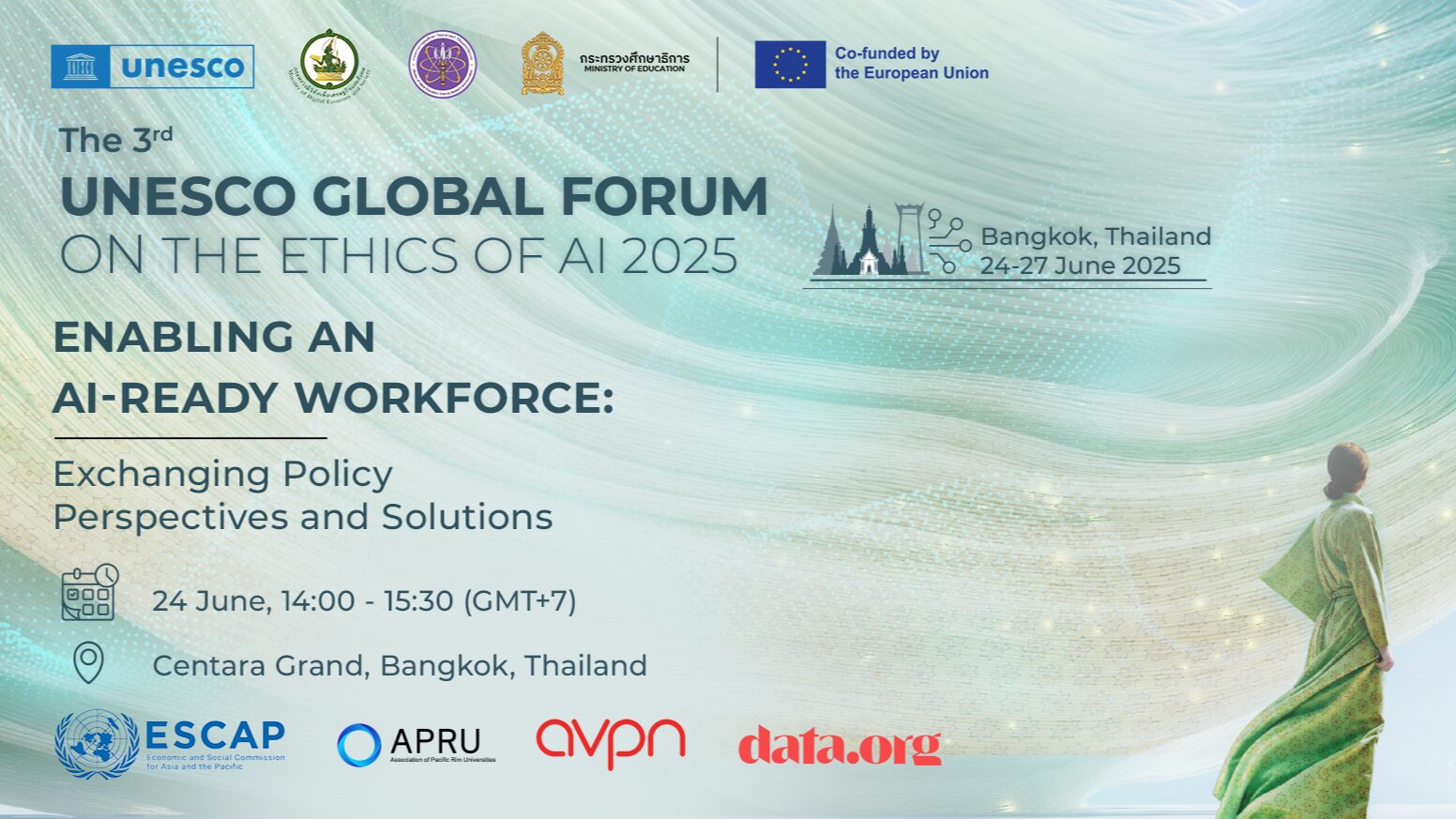
Cruz, who manages a community of practice on AI, was speaking at a UNESCO forum side event, “Enabling an AI-ready Workforce”, organised by the Association of Pacific Rim Universities (APRU) and UNESCAP in partnership with AVPN (Asian Venture Philanthropy Network) and non-profit Data.org, to address, among other things, the most pressing capacity and policy gaps related to AI skills.
A panel of academics and AI specialists and policy experts from major technology companies in Asia stressed the importance of ensuring the world does not become even more fractured, divided into nations that have the computing power for cutting-edge AI systems and those that do not.
“AI education must be ethical, inclusive, interdisciplinary and locally grounded – bridging technical fluency with critical thinking and cultural relevance,” Christina Schönleber, APRU’s chief strategy officer, told University World News.
“Universities play an important role as conveners of knowledge and catalysts for innovation, ensuring that AI readiness is rolled out equitably and contextually, so no community is left behind,” she said.
But collaboration needs “to go beyond academia”, and bringing together the main groups involved in AI application along with policymakers and civil society was an important task that would contribute to a multidimensional approach to AI,” she said.
The pace of trust
Trisha Suresh, LinkedIn’s head of public policy for Southeast Asia, based in Singapore, said: “Skills for jobs are changing very rapidly. So even if you’re not changing jobs, we know that our jobs are changing.”
Citing analysis of LinkedIn data of members’ skills from 2016 to 2023, she said: “Even if you had not changed jobs, the skills needed for that job have changed by about 40% [over that period]. So our jobs have already been changing quite rapidly.”
Suresh said jobs such as customer service representatives and legal assistants – where women are disproportionately represented – are most vulnerable to disruption from AI applications. “Those individuals would switch into jobs that would still have quite a high risk of AI disruption,” she noted. “That’s what the data is telling us”.
Moderating the panel, Bangalore-based Priyank Hirani, director of capacity building at Data.org, said training students, upskilling working professionals, and supporting government leaders by creating open-source resources and learning content was imperative for local leaders seeking to support talent creation, working together with global experts.
He emphasised the need to go beyond broad guidelines on AI to reimagine sector-specific AI training and human-first AI transformation to ensure inclusive growth in the Asia-Pacific.
“We have to break down barriers, move from duplicative efforts, and adopt a long-term ecosystems approach to make inclusive AI workforce development possible at scale, keeping ethics and responsible use principles at the forefront,” he said in a post-conference blog.
“We need to move fast to leverage data and AI for good – but we must move at the speed of trust [and] scale of human interactions and not the speed or scale of technology.
“For solutions and capacity building to be sustainable and scalable, we need to build that trust through authentic partnerships with mission-aligned organisations and really ground our thinking in local cultural contexts,” he added.
Associate Professor Wongkot Wongsapai, vice-president of Thailand’s office of the National Higher Education, Science, Research and Innovation Policy Council, said AI was being introduced in three phases in Thailand: first to “internalise” AI in universities’ curricula; secondly, to introduce lifelong learning of AI skills in the workplace; and thirdly, to use AI to drive innovation, focusing on AI research and development.
“We are rapidly embracing and adopting the technology and innovation,” said Wongsapai, noting that Thailand’s 154 universities and higher education institutions and 65 training centres have already trained about 31,000 people in the use of digital AI in the workplace.
Emerging risks
Yinghui Tng, head of government affairs and public policy at Google Southeast Asia, said YouTube, owned by Google, was a great “supplementary educational tool” that trains and educates people around the world. With AI added to the mix, it becomes a “bold” educational tool.
“We do believe that innovation needs to push the boundaries to create cutting-edge research that will address the most challenging problems. But in order to do that, we need to do it responsibly … with an eye towards the new risks emerging as a result of the deployment of AI.”
Tng pointed to financial fraud as a by-product of AI applications, with criminal syndicates operating in cyberspace across borders. “We didn’t look at it as a law enforcement problem. We thought of it as a technology problem,” she explained.
“Criminal organisations … don’t just operate within the confines of a single platform or within a country or borders or within a single tactic. And [as a result] it requires a whole-of-society kind of approach to solve financial fraud. This is definitely one of the emerging risks that we see as a result of technology,” she noted.
The AI divide
The session also pointed to the computer access divide, in addition to the digital divide, especially with the need to spread AI technology to rural areas in Southeast Asia. Another crucial barrier highlighted by participants was language and the need for AI technology to be able to adapt to different languages.
Given the hundreds of languages and dialects that exist across the region, Ekapol Chuangsuwanich, deputy director of the AI Centre at Bangkok’s Chulalongkorn University, referred to “different levels of readiness for AI”.
Saiman Pokhrel, AI trainer at Bagmati UNESCO Club in Bagmati, Nepal, told University World News the club has been teaching AI skills to over 60,000 students per year in 3,300 schools in rural areas of Nepal.
But, with some 128 native languages, AI use is limited unless it can be adopted into indigenous languages. “Big tech houses like Google, Microsoft, and Amazon need to make tools so that indigenous languages can be much more effectively used in AI,” he said.
“It’s important to have customised learning based on AI technologies, allowing people to be able to learn in a localised culture, context-specific way,” Hirani told University World News.
Some professors in India may be resistant to using AI in teaching because of “concerns about technology taking over jobs, but AI could be a companion to make you more effective at delivering what you do,” he added.
“We are basically developing the dialogue going forward and also getting academics to engage with these stakeholders to provide insights and knowledge on some of those challenges, to help address them and provide solutions,” Schönleber said in conclusion.