

[Bangkok, Thailand, October 8, 2025]
The Association of Pacific Rim Universities (APRU), in partnership with Google, data.org, and National University of Singapore Fintech Lab have launched an innovative Tech Policy Hackathon. The hackathon drew remarkable interest from students across the globe, with 299 participants from 40 universities spanning 15 economies—including the USA, Canada, Australia, Japan, and Korea—submitting a total of 70 innovative entries. From this impressive pool, 12 standout teams comprising 56 students from 14 universities across nine economies were selected to compete in the final round held in Bangkok. This vibrant mix of participants highlights the global enthusiasm for collaborative problem-solving and the rich diversity of talent driving innovation forward.
The hackathon engaged students in interdisciplinary teams to address real-world issues including:
- Digital poverty and minority inclusion
- Online security and scam prevention
- Support for SMEs in the digital economy
- Workforce development and education access
- Financial inclusion for the underserved communities
- Disaster resilience through technology
Participating institutions include Nanyang Technological University (Singapore), Universiti Malaya (Malaysia), Chulalongkorn University (Thailand), Universitas Indonesia, Hong Kong University of Science and Technology, Far East Federal University (Russia), University of the Philippines, VinUniversity (Vietnam), CamTech (Cambodia), and others.
“This initiative is about building bridges,” said Christina Schönleber, Chief Strategy Officer at APRU. “At APRU, we see our role as a super connector—linking academia, underserved communities, civil society organizations, and the technology sector to advance digital literacy and address policy challenges. In a region where AI and data strategies are still fragmented, empowering students with the tools, mentorship, and cross-sector collaboration they need is essential to shaping a more inclusive and resilient digital future.”
The urgency of this initiative is underscored by the uneven adoption of AI and data literacy across ASEAN. Singapore, for example, leads with advanced infrastructure and national AI strategies, others are still grappling with limited access, disjointed policies, and low digital literacy—especially in rural and underserved communities. For example:
- Indonesia and Vietnam have AI adoption rates around 42%, driven by necessity and grassroots innovation.
- Thailand and Malaysia are investing heavily in infrastructure but face gaps in workforce readiness.
- The Philippines, despite strong academic talent, struggles with practical AI deployment due to infrastructure and investment gaps.
This fragmented landscape risks deepening inequality. As AI and data-driven technologies reshape economies, communities without access to digital skills and infrastructure risk being left behind, while others surge ahead. According to the Asia Foundation, micro and small enterprises across ASEAN often lack the digital skills to benefit from the digital economy, and underserved groups, such as women and rural entrepreneurs, face the steepest barriers.
Supported by Google in partnership with data.org and NUS Fintech Lab, the hackathon provided access to global mentors, policy frameworks, and data resources. Winning proposals will be shared with university experts and leaders and civil society organizations in the region to inform solutions development to policy challenges across the region.
“At Google, we believe technology must be a force for inclusion. That’s why we’re committed to ensuring that underserved communities across Southeast Asia have access to vital digital tools and skills. In partnership with organizations in the region, we aim to close the gap in AI and data literacy needed to thrive in today’s society,” said Yinghui Tng, Head of Government Affairs and Public Policy, Southeast Asia, Platforms & Devices, Google.
As a global platform for partnerships committed to building a workforce of one million purpose-driven data and AI practitioners by 2032, data.org connects people with tools and training to drive action. Through globally informed, locally led capacity building, data.org empowers communities to use data and AI to solve real-world social impact challenges.
“Data and AI can unlock new ways to tackle urgent challenges, but only if people closest to the issues shape the solutions,” said Shivam Shukla, Coordinator, Programs and Capacity Building at data.org. “Through mentorship and cross-sector guidance, the Hackathon equips emerging data and AI innovators in Southeast Asia to craft evidence-driven ideas for inclusive growth — from financial access to digital trust — and bring them into policy dialogues.”
As a regional leader in financial technology education, the NUS FinTech Lab played a pivotal role in the hackathon by equipping students with the skills and insights needed to explore data-driven solutions for financial inclusion and digital resilience. Their involvement helped ensure that the next generation of innovators is not only tech-savvy, but also aware of the policy challenges and ready to lead in shaping Southeast Asia’s digital economy.
“This initiative reflects the growing need for international education to prepare students not just for jobs, but for leadership in shaping digital futures,” said Nicholas Garcia, Deputy Director, National University of Singapore FinTech Lab. “By engaging students in real-world policy design, we’re building a generation of thinkers who can navigate and influence the global tech landscape.”
“The most powerful part of this hackathon is seeing students connect innovation with responsibility — Principled Innovation. By tackling issues like digital safety for vulnerable groups, financial access for underserved communities, and equitable support for women-led enterprises, they’re modeling what it means to design AI and data systems that balance technical strength with social impact,” said Michelle Banawan, Assistant Director of Intelligent Systems, Learning Engineering Institute, Office of the Provost, Arizona State University.
The Tech Policy Hackathon reflects APRU’s commitment to fostering inclusive cross-border collaboration and equipping students with the skills to lead in an increasingly complex digital world.
Congratulations to the winning teams:
1st Place: SIGAP UMKM
Universitas Indonesia (UI), Nanyang Technological University, Singapore (NTU), and Singapore Management University (SMU)

- Peter Gospel Ho, Chemical and Biomolecular Engineering, NTU
- Kyara Hafiza Saliha, Finance and Sustainability, SMU
- Samuel Yudhistira Susanto, Computer Science, SMU
- Phoebe Ivana, Computer Engineering, UI
- Faiz Assabil Firdaus, Computer Science, UI
“Don’t focus too much on whether we’re winning or not, but think about the impact of our application — is it really making a difference? And if it is, then I think whether we’re winning or not doesn’t really matter. As long as we’re making impact, that’s enough,” said Phoebe Ivana, Computer Engineering.
“Throughout the process, our top priority was ensuring that our solution truly works and is feasible. That commitment drove us to go the extra mile. We even reached out to experts outside of the competition in this short amount of time, to refine and validate our approach,” said Kyara Hafiza Saliha, Finance and Sustainability.
2nd Place: 40by40
Nanyang Technological University, Singapore
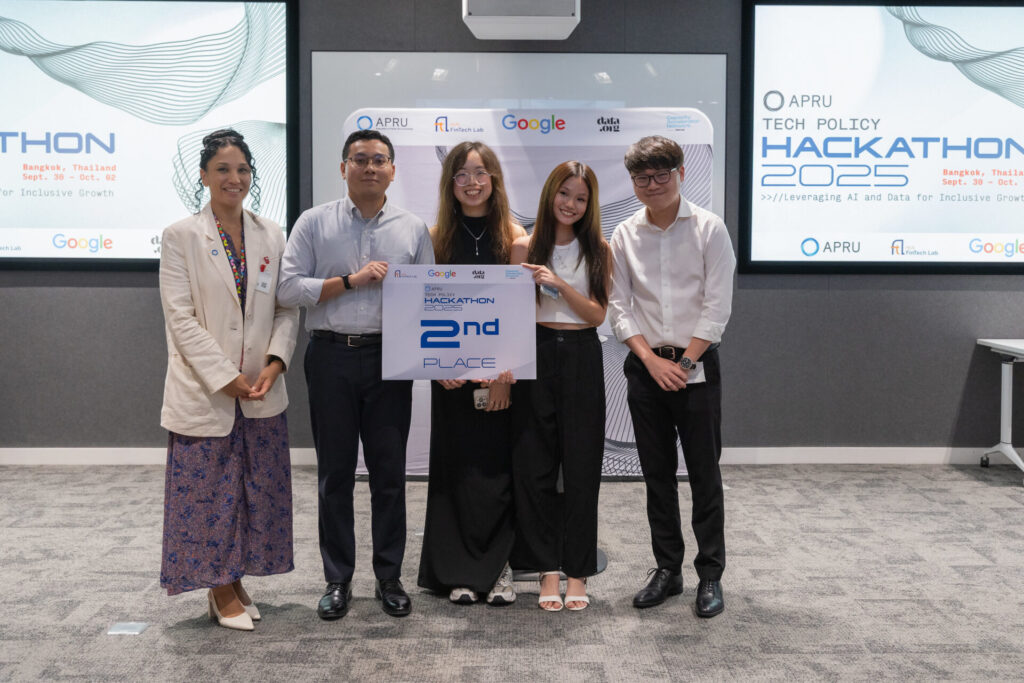
- Mohammad Fahmy Bin Fadzil, School of Social Sciences, Public Policy & Global Affairs
- Tang Yan Lin, School of Social Sciences, Public Policy & Global Affairs
- Aaron Ng Kaicheng, School of Biological Sciences
- Alison Yeo, School of Biological Sciences
“One thing that we have learned is the interdisciplinary approach in all the solutions presented here at this hackathon. As you know, it is not a one-size-fits-all or uni-dimensional approach that we are proposing, we are examining very complex issues that we are facing globally, so we need the people with the technical experience, social experience, and everybody working together to improve social well-being in our communities.”
3rd Place: AgriAccess
The Hong Kong University of Science and Technology

- Chung Ho Man, Computer Science and Economics
- YAU Ho Lun, Global China Studies
- YIN Xinshu, Quantitative Social Analysis
- Chau Long Hei, Mathematics
- Chin Chi Lon, Computer Engineering
“This milestone is less about a single achievement and more about the shared conviction that fueled it: that by bridging technology and finance, we can make the invisible, investable. We are acutely aware that we could not have even begun to approach this challenge without a constellation of support.” Owen Chung, Student, The Hong Kong University of Science and Technology
Honorable Mentions:
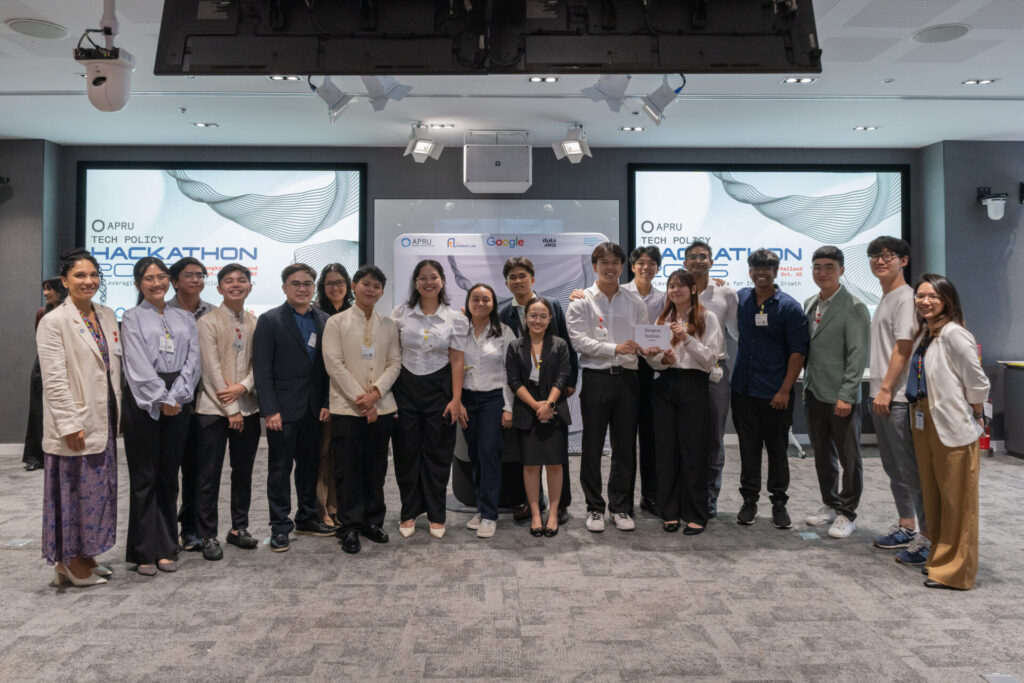
Credit Pass
University of the Philippines (UP), Asian Institute of Management (AIM), University of San Carlos (USC)
- Darmae M Tan, Master of Information Systems, UP
- Francis Tallo, MS in Data Science, AIM
- Wince B Dela Fuente, Law, USC
- Atasha Nicole G. Bahande, BS Management Minor in Finance, UP Cebu
- James Gabriel Elijah P. Ty, BS Computer Science, UP Cebu
Project AiGRI
University of the Philippines, Tacloban
- Angela Denise Z. Almazan, Computer Science
- Desirre Bless I. Barbosa, Computer Science
- Honey Joy B. Mora, Political Science
- Norman Enrico C. Eulin, Computer Science
- Rolf Genree L. Garces, Computer Science
“We are honored to have placed among the top teams, but we know that this is only the beginning. We’re determined to push AiGRI beyond the walls of the hackathon, to keep improving it with the goal to seeing it make a real-world impact for the farmers who feed our nation,” said Rolf Genree, student at the University of the Philippines, Tacloban.
Bangkok Baddies
Nanyang Technological University (NTU)
- Loo Yi Cong, Business
- Sanjeyan Chrysharnthan, Computer Engineering
- Ong Xin Chun, Computer Engineering
- Isaac Lee Jiajun, Information Engineering and Media
- Kumaravel Yashpreethu, Computer Engineering
APRU Tech Policy Hackathon Website
https://www.apru.org/event/apru-tech-policy-hackathon-2025/
Photos
Photos are available for download: https://flic.kr/s/aHBqjCsLJk