Key Partners
About the series
Seminar #1: Mar 27 (HKT)
Seminar #2: Apr 24 (HKT)
Seminar #3: May 29 (HKT)
Seminar #4: Aug 28 (HKT)
Seminar #5: Sep 25 (HKT)
Seminar #6: Oct 30 (HKT)
Seminar #7: Dec 4 (HKT)
After the success of the seminar series in 2024 and 2025, Roots and Bridges: APRU Indigenous Connections will continue in 2026, offering academics and students from APRU member universities and partner institutions a platform to share works‑in‑progress, exchange insights, and explore key topics related to Indigenous Peoples and communities across the Asia‑Pacific region.
 
This year, the series will also evolve to include panel sessions for selected presentations, providing deeper engagement and dialogue among participants.
 
Network researchers from a broad range of academic fields will present their fieldwork, research, methodologies, insights, and findings during seven virtual events. The series aims to present, explore, and extend the possibilities of international collaborations among the participants. They will highlight Indigenous-led methodologies, Indigenous and First Nations knowledges, languages place-based research, leadership programs, teaching and learning, and related topics.
 

Seminar series aims:

  1. Share knowledge among APRU member universities, staff and students
  2. Connect researchers, educators, professional staff, students and community members
  3. Encourage collaboration across countries, universities and disciplines
  4. Amplify Indigenous voices and visions

Course Format and Delivery

This series will be conducted on a virtual platform (Zoom) synchronously.


More information about future seminars coming soon.
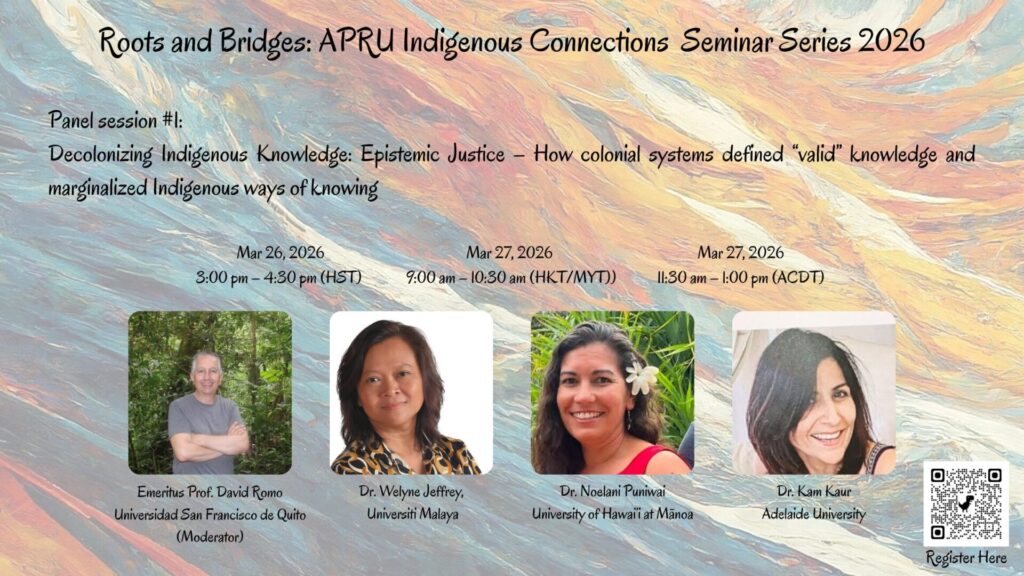
Panel session#1:

Decolonizing Indigenous Knowledge: Epistemic Justice – How colonial systems defined “valid” knowledge and marginalized Indigenous ways of knowing

Date:

Mar 26, 2026, 3:00 pm – 4:30 pm (Hawai’i Time: UTC/GMT -10 hours)
Mar 27, 2026, 9:00 am – 10:30 am (Malaysia Time: UTC/GMT +8 hours)
Mar 27, 2026, 11:30 am – 1:00 pm (Adelaide Time: UTC/GMT +10:30 hours)

Check your local time and date here

Speakers:

Dr. Welyne Jeffrey, Universiti Malaya

Dr. Noelani Puniwai, University of Hawai’i at Mānoa

Dr. Kam Kaur, Adelaide University

Seminar host:

Emeritus Prof. David Romo, Universidad San Francisco de Quito

Video:

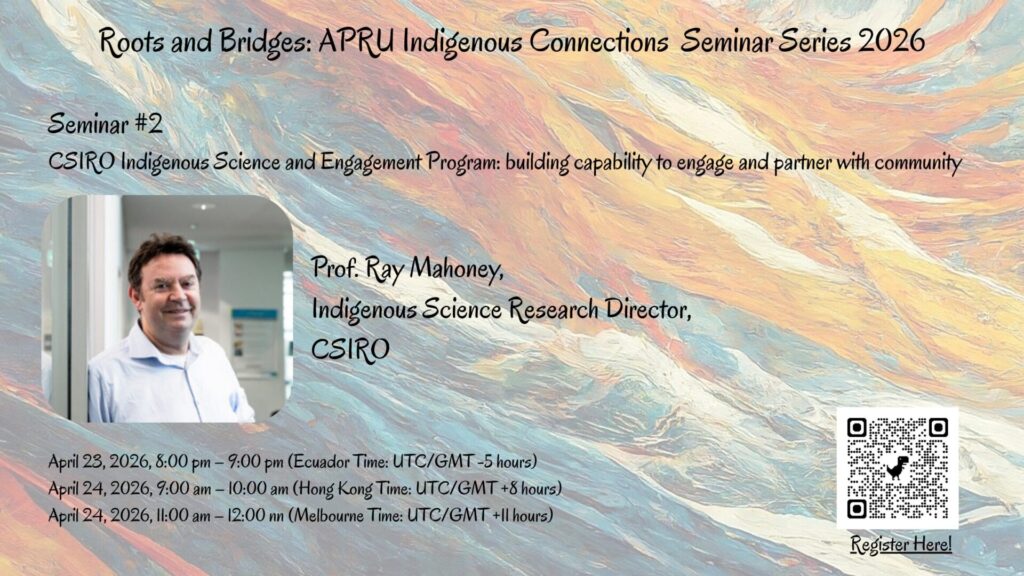
Seminar #2: 

CSIRO Indigenous Science and Engagement Program: building capability to engage and partner with community

Date:

April 23, 2026, 8:00 pm – 9:00 pm (Ecuador Time: UTC/GMT -5 hours)
April 24, 2026, 9:00 am – 10:00 am (Hong Kong Time: UTC/GMT +8 hours)
April 24, 2026, 11:00 am – 12:00 nn (Melbourne Time: UTC/GMT +11:00 hours)

Check your local time and date here

Speaker:

Prof. Ray Mahoney, Indigenous Science Research Director, CSIRO

Abstract:

The National Science and Research Priorities, centres “elevating Aboriginal and Torres Strait Islander knowledge systems”. This requires embedding Aboriginal and Torres Strait Islander knowledges and perspectives across Australia’s science and research system. The CSIRO is changing its ways of working to centre the knowledge and priorities of Aboriginal and Torres Strait Islander people, communities and organisations. Professor Mahoney will showcase science and research examples of how CSIRO, in alignment with the National Agreement on Closing the Gap, can value and support Aboriginal and Torres Strait Islander science and scientists.

Seminar host:

Emeritus Prof. David Romo, Universidad San Francisco de Quito

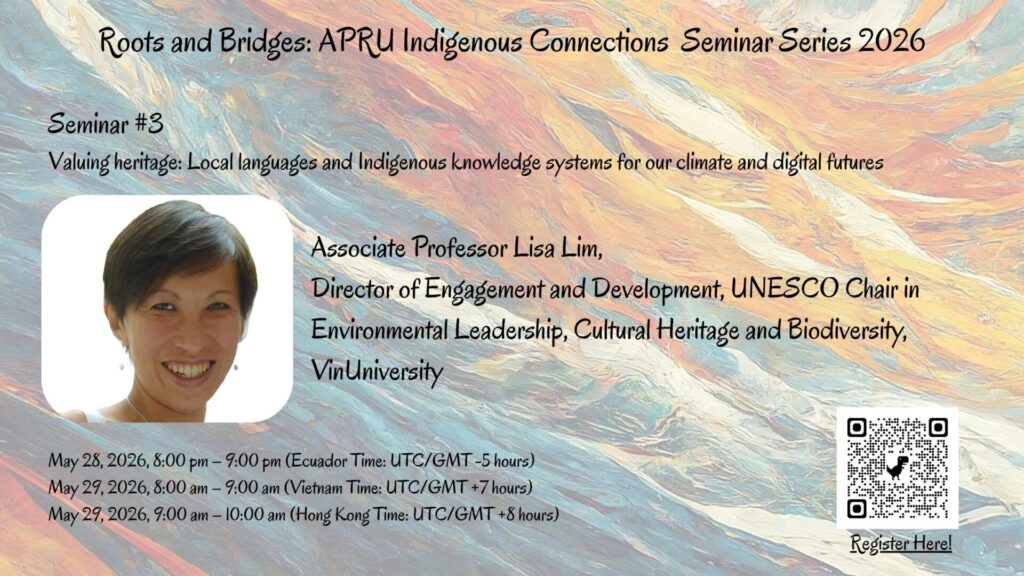
Seminar #3:

Valuing heritage: Local languages and Indigenous knowledge systems for our climate and digital futures

Date:

May 28, 2026, 8:00 pm – 9:00 pm (Ecuador Time: UTC/GMT -5 hours)
May 29, 2026, 8:00 am – 9:00 am (Hanoi Time: UTC/GMT +7 hours)
May 29, 2026, 9:00 am – 10:00 am (Hong Kong Time: UTC/GMT +8 hours)

Check your local time and date here

Speaker:

Associate Professor Lisa Lim, Director of Engagement and Development, UNESCO Chair in Environmental Leadership, Cultural Heritage and Biodiversity, VinUniversity

Abstract:

This seminar discusses heritage literacy in education and development: a) Cultural heritage as encompassing both tangible and intangible dimensions, with language playing a critical role, at intersections with identity, environment, and Indigenous knowledge systems; b) Heritage as arena for negotiating cultural memory, where processes foreground community inclusivity but transform how traditions are archived and circulated; c) Digital platforms as archives that should encode ecological knowledge, linking language to environmental practices, resource management, cultural resilience. Examples illustrate work in the UNESCO Chair in Environmental Leadership, Cultural Heritage, and Biodiversity.

Seminar host:

Emeritus Prof. David Romo, Universidad San Francisco de Quito

Video

Panel session #4:

Indigenous Research Through Latin American Lenses

Date:

August 27, 2026, 8:00 pm – 9:30 pm (Ecuador Time: UTC/GMT -5 hours)
August 27, 2026, 7:00 pm – 8:30 pm (Mexico Time: UTC/GMT -6 hours)
August 28, 2026, 9:00 am – 10:30 am (Hong Kong Time: UTC/GMT +8 hours)

Check your local time and date here

Speakers:

Prof. Luz Maria Stella Moreno-Medrano, Tecnológico de Monterrey

Assoc. Prof. Maria Patricia Ordóñez, Universidad San Francisco de Quito


Seminar host:

Emeritus Prof. David Romo, Universidad San Francisco de Quito

Register here

Session #5: 

Truth Telling and Dialogue

Date:

September 24, 2026, 8:00 pm – 9:00 pm (Ecuador Time: UTC/GMT -5 hours)
September 25, 2026, 9:00 am – 10:00 am (Hong Kong Time: UTC/GMT +8 hours)
September 25, 2026, 11:00 am – 12:00 nn (Melbourne Time: UTC/GMT +11:00 hours)

Check your local time and date here

Speaker:

Mr. Travis Lovett, Executive Director, Centre for Truth-telling and Dialogue, The University of Melbourne

Seminar host:

Emeritus Prof. David Romo, Universidad San Francisco de Quito

Session #6:

Being a Good Ancestor

Date:

October 29, 2026, 8:00 pm – 9:00 pm (Ecuador Time: UTC/GMT -5 hours)
October 30, 2026, 9:00 am – 10:00 am (Hong Kong Time: UTC/GMT +8 hours)
October 30, 2026, 1:00 pm  – 2:00 pm (New Zealand Time: UTC/GMT +13 hours)

Check your local time and date here

Speaker:

Associate Professor Dan Hikuroa, Assistant Dean Research Māori, Faculty of Arts & Education, Waipapa Taumata Rau/University of Auckland

Abstract:

Being a good ancestor exemplifies what it means to be indigenous – simultaneously thinking about the past, present and future, and making decisions based on reliable knowledge passed down and tested through generations, with an inter-generational mindset. In te ao Māori, humans are not separate from nature but part of it, bound by whakapapa to everything, and are guided by the fundamental, intertwined concepts of tika (truth), pono (honesty), and aroha (love). Together, they represent a relational, holistic understanding of the world, where one acts with truthfulness, integrity, and love towards others and the natural environment, fostering responsible and respectful relationships.

Seminar host:

Emeritus Prof. David Romo, Universidad San Francisco de Quito

Panel session #7: 


Date:

December 3, 2026, 8:00 pm – 9:30 pm (Ecuador Time: UTC/GMT -5 hours)
December 4, 2026, 9:00 am – 10:30 am (Hong Kong Time: UTC/GMT +8 hours)

Check your local time and date here

Speakers:

Coming soon

Seminar host:

Emeritus Prof. David Romo, Universidad San Francisco de Quito

Speakers
David Romo
Seminar Host - Universidad San Francisco de Quito

David Romo, Ph.D. Emeritus professor from Universidad San Francisco de Quito.  Emeritus Director Tiputini Biodiversity Station. Prof. Romo directed the Program of Ethnic Diversity and was responsible for including over 700 indigenous and Afroecuadorian students to USFQ.

more
Welyne Jeffrey
Universiti Malaya

Dr. Welyne Jeffrey Jehom is a Senior Lecturer in Anthropology and Sociology at the Faculty of Arts and Social Sciences, University Malaya. She has been a part of the university since 2016, previously contributing her expertise to the Gender Studies Program within the same faculty from 2008 to 2016. She spearheaded the Center for Malaysian Indigenous Studies as its head from 2018 to 2021 and currently serves as the Coordinator for the Master of Human Development program at Universiti Malaya, commencing in 2022. She is also recognized as a board member Asian Human Development Organisation (AHDO) Malaysia. Throughout her career, she has dedicated herself to impactful research, collaborating with various groups and Indigenous communities, and focusing on critical issues of development, decolonisation and empowerment. In addition to her academic responsibilities at Universiti Malaya, she plays a pivotal role in managing the Community Engagement Section for Enggang (Pekan), a conservation company under Enggang Holdings. Her multifaceted contributions in academia and community engagement underscore her commitment to fostering positive change and development within diverse spheres of influence.

more
Noelani Puniwai
University of Hawai'i at Mānoa

Dr. Noelani Puniwai is a mother of three. She works with communities to restore the health of people and ʻaina/kai (places that raise you) as an Associate Professor at Kamakakūokalani Center for Hawaiian Studies at the University of Hawaiʻi at Mānoa. A professional conservation scientist, native Hawaiian community member, and science educator, Noelani tries to facilitate the communication of knowledge between scientists, local communities, and management agencies with a focus on seascapes, fisheries, and ocean health. Her research interests include coastal ecosystems, indigenous and ethical science, knowledge co-production for an abundant future, understanding and recognizing climate change, and cultural seascapes. She loves learning about her heritage, her coastlines, her akua, and dreaming about abundant futures.

more
Kameljeet Kaur
Adelaide University

Dr. Kameljeet Kaur’s work at The University of Adelaide, specifically within Wirltu Yarlu, represents a significant contribution to the field of Indigenous Knowledge and education. Her role as a course coordinator and lecturer, focusing on Indigenous Knowledge, showcases a deep commitment to integrating First Nation pedagogies, decolonial methods, and critical theory into academia. By collaborating with local and global First Nation communities’ Elders, cultural leaders, and scholars, Dr. Kaur is at the forefront of constructing courses that are not only informed by Indigenous methodologies but also aim at decolonizing the educational framework.

The development of a virtual reality storytelling course, in partnership with Anangu Elders from the Anangu Pitjantjatjara situated in the far north west corner of South Australia and Kaurna Elders of the Adelaide Plains, is particularly noteworthy. This innovative approach seeks to leverage digital technologies to record and present Indigenous knowledge in a manner that is both accessible and immersive for students. Such initiatives are crucial for promoting understanding and respect for Indigenous ways of knowing, doing, and being among both Indigenous and non-Indigenous students.

Dr. Kaur’s research interests further highlight her dedication to addressing complex societal issues such as ‘race’ and gender inequalities, cultural diversity, and decolonization.

more
Ray Mahoney
CSIRO

Ray Mahoney is a Bidjara man with family ties to Central West Queensland. Ray has worked extensively to codesign, develop, implement and evaluate best practice public health and prevention programs to close the gap in health and wellbeing between Indigenous and non-Indigenous people. Ray currently leads a range of research projects with Indigenous community-controlled organisation partners. Ray has led Indigenous health research and science projects that demonstrate CSIRO’s commitment to deliver on Australia’s National Science and Research Priorities, including the central priority: elevating Aboriginal and Torres Strait Islander knowledge systems. Ray has established trusted relationships and partnerships with Indigenous communities across Australia delivering on community identified research and science priorities. Current science and research projects include; Clean energy transition for remote communities; Housing and impacts of climate change; AI in Indigenous health care; Supporting primordial prevention, screening and treatment for ARF and RHD initiatives that are led by Aboriginal and Torres Strait Islander communities.

more
Lisa Lim
VinUniversity
Lisa Lim is Director of Engagement and Development for the UNESCO Chair in Environmental Leadership, Cultural Heritage and Biodiversity, at VinUniversity in Hanoi, Vietnam, having held professoriate positions at top universities in Singapore, Hong Kong, Amsterdam, Sydney, and Perth. She is widely recognised for her scholarship in the fields of language contact and evolution, in particular in World Englishes and in Asian multicultural ecologies; issues of language shift, endangerment, revitalisation, postvernacular vitality, and intangible cultural heritage of minority and endangered language communities; the sociolinguistics of globalisation; environmental linguistics; and migration linguistics. She is co-author of Languages in Contact (Cambridge University Press, 2015), and co-editor of several Special Issues and volumes, including The Multilingual Citizen: Towards a Politics of Language for Agency and Change (Multilingual Matters, 2018), shortlisted for the BAAL Book Prize, and a Languages special issue on Innovative Methods in Endangered Language Documentation (MDPI, in prep). Passionate about engagement and impact, she is a consultant for the Oxford English Dictionary, has pitched at a TEDxWanChaiWomen Open Mic event, and has been writing a fortnightly ‘Language Matters’ column in Hong Kong’s South China Morning Post since 2016.
more
Luz Maria Stella Moreno-Medrano
Tecnológico de Monterrey

Luz María Moreno Medrano is a Mexican researcher and educator with more than 25 years of experience dedicated to transforming education from critical and intercultural perspectives. She began her career as a rural teacher in the Sierra Tarahumara in an indigenous community in 1994, an experience that defined her commitment to social justice, the dignity of peoples, and the ethics of care. She holds a PhD in Education from the University of Cambridge and a Master’s in Educational Policy from Harvard, and from 2021 to 2025 she directed the Institute for Research on Educational Development (INIDE) at the Ibero-American University. She is currently National Dean of Research at the School of Humanities and Education at Tecnológico de Monterrey, where she promotes critical thinking, socially committed research, and dialogue between diverse fields of knowledge for the construction of democratic and inclusive learning communities.

more
Maria Patricia Ordóñez
Universidad San Francisco de Quito

María Patricia Ordóñez is associate professor of Anthropology at Universodad San Francisco de Quito (Ecuador); holds a PhD and MA in Archaeology from Leiden University (Netherlands) and an MSc in Forensic Anthropology and Archaeology from Cranfield University (UK). She currently teaches and leads research on ethics, material culture, and museum practice. Her work focuses on the formation, use, and ethical challenges of human remains collections in the Andes and Western Europe, with a particular interest in collaborative curation with Indigenous peoples and nationalities in Ecuador.

She previously served as Director of Research and Innovation at the Instituto Nacional de Patrimonio Cultural (INPC) and was curator at the Museo Casa del Alabado, a museum dedicated to Pre-Columbian art. She has acted as a consultant for archaeological and heritage management projects and has been an invited curator for several institutions, including the Museo Nacional del Ecuador (MUNA). Her research and curatorial practice aim to bridge academic archaeology with community-based approaches, promoting ethical stewardship and inclusive narratives in museums. She is also involved in international collaborations addressing decolonial heritage practices and the repatriation of cultural and human remains.

more
Dan Hikuroa
Waipapa Taumata Rau/University of Auckland

Dan Hikuroa (Ngāti Maniapoto, Ngaati Whanaunga, Ngāti Mahuta, Pākehā) is a father, surfer, paddle-boarder, gardener, loves the taiao and an Associate Professor in Māori Studies, Waipapa Taumata Rau-University of Auckland. Dan is an established world expert on weaving indigenous knowledge and science to realise the dreams and solve challenges of the communities he works with. Dan has been spearheading alternative ways of undertaking development and assessing sustainability, including braiding indigenous knowledge and epistemologies with science and into policies, assessment frameworks and decision-support tools. Dan is UNESCO New Zealand Commissioner for Culture, member of Pou Herenga, Māori Advisory to the Climate Change Commission, had key roles within New Zealand’s Centres of Research Excellence, advises national and regional government, communities and philanthropic trusts, member of several significant international research teams and formerly AGU Council.

more
more
Contact
Us

Enquiries

David Quimbayo

Program Manager

Email: [email protected]

Enquiry
×
Speaker