
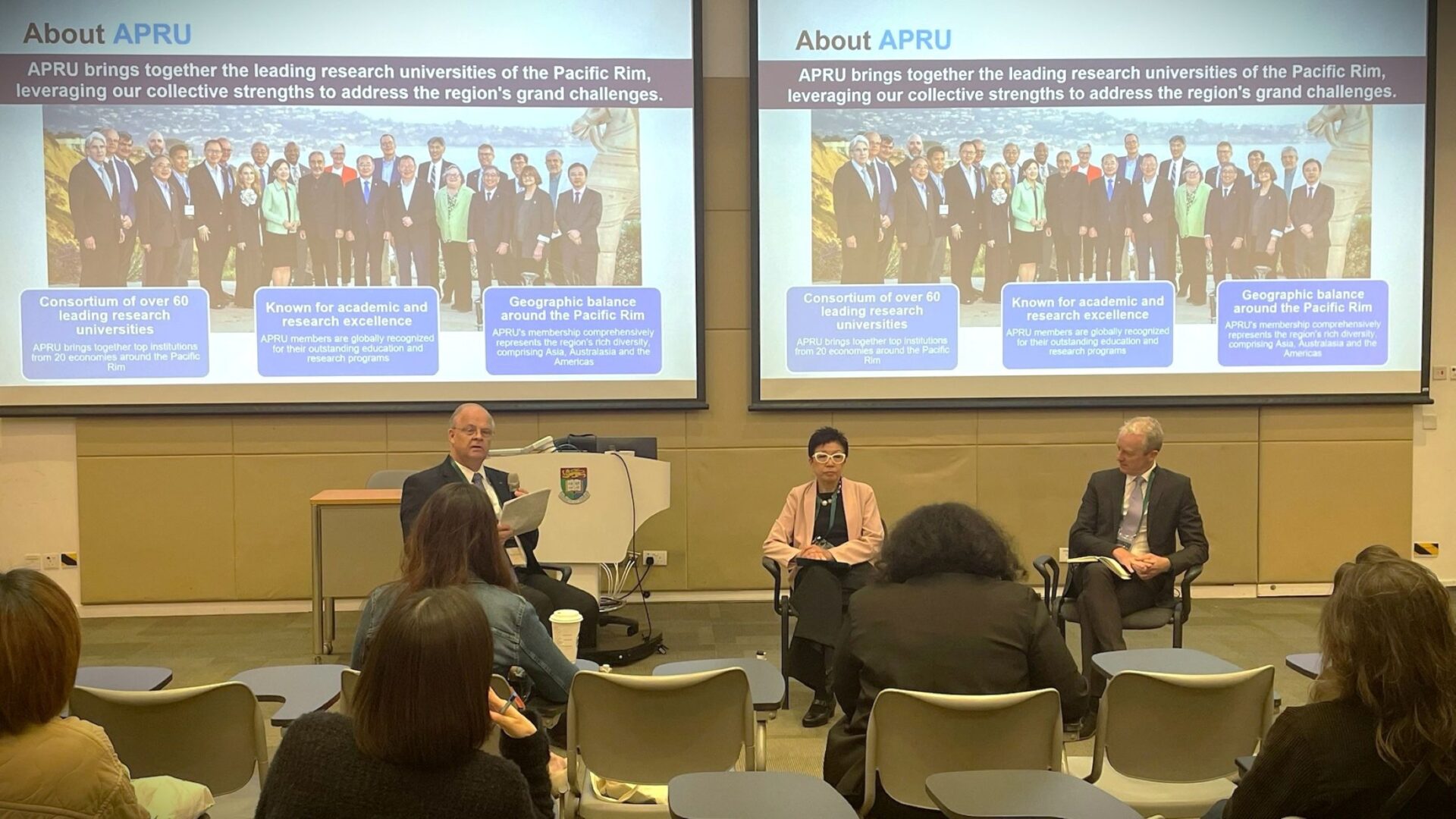
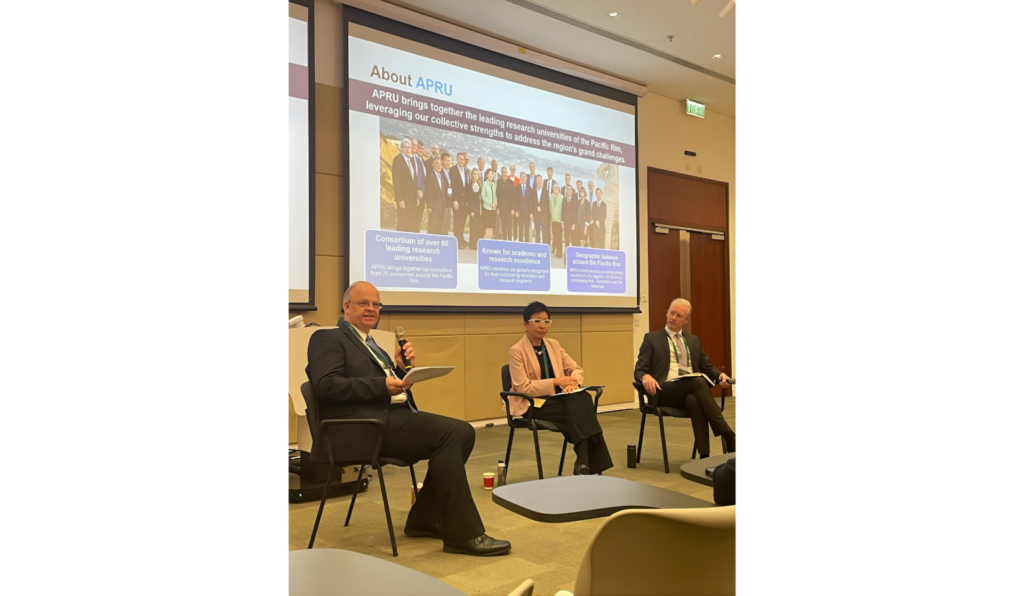
The University of Hong Kong (HKU) hosted HKU Partner Day 2026 on February 22–23, a dynamic two-day event serving as a prelude to the Asia-Pacific Association for International Education (APAIE) 2026 Conference. The event brought together over 400 higher education leaders, institutional partners, and scholars from around the world to strengthen global collaboration and explore emerging trends shaping the future of education. APRU contributed to the success of the two-day event by preparing an in-depth discussion titled, “Building Resilient and Inclusive Higher Education Systems” featuring Professor Cindy Fan, Vice Provost for International Studies and Global Engagement, University of California, Los Angeles (UCLA) and Prof. Erik Lithander, Deputy Vice-Chancellor (Strategic Engagement), The University of Auckland.
Opening the session, Professor Thomas Schneider, APRU Chief Executive, placed APRU in a long arc of cross‑border collaboration, emphasizing how a 64‑member network can operate as a “super connector” between universities, governments, industry and civil society, particularly when geopolitical or technological shocks test campus systems. He challenged participants to interrogate what “resilience” and “inclusion” actually mean across different Asia-Pacific contexts and argued that diversity of perspectives, such as biodiversity in nature, strengthens institutional ecosystems: “Nature is always a good example… hubs of biodiversity are more beneficial than monocultures; diversity is always beneficial.”
The discussion would treat resilience not simply as “weathering a storm,” but as responsiveness grounded in mission; and inclusion not as a set of siloed equity programs, but as a whole‑of‑institution orientation supported by transparent leadership and international partnerships.
What Resilience Looks Like on Campus
Professor Cindy Fan, UCLA described resilience in practice as pursuing two concurrent goals during crises: (1) academic continuity (keeping teaching and research going despite disruptions) and (2) strengthening community (using crises to rebuild trust and connection). She shared UCLA initiatives such as Dialogue Across Difference and targeted efforts to combat antisemitism, designed to “reset the table” for listening across profound disagreements. Her metaphor: resilient universities are like palm trees, “You might see branches coming down, but they don’t really break… universities that have deep roots, in mission clarity, bend with the winds but don’t snap.” She later tied inclusivity to the concept of inclusive excellence: diversity and excellence are “two sides of the same coin.” Resilience must be built before the next crisis through trust, transparency, and connectivity (e.g., frequent senior‑leadership briefings; open communication about decisions and budgets). Fan shared a new framing of DEI as inclusive excellence, embedding it into academic standards rather than treating it as an add‑on.
Resilience Without Responsiveness Is Stubbornness
Professor Erik Lithander, University of Auckland cautioned against the “dark side of resilience”: “When you have resilience without responsiveness, that’s stubbornness.” He argued that while universities admirably protect core missions during shocks, the sector has been slow to adapt a centuries‑old instructional model and has “lost social licence” with publics, media and governments by failing to articulate value beyond teaching and research headlines. The task ahead is to “recapture the imagination and the support of our constituents” through consistent engagement, diversified revenue, and coalitions of external partners, including international associations like APRU. He also emphasized that resilience is not only internal capacity; it also depends on external legitimacy. Universities need systematic outreach to rebuild relationships with government, media, business and alumni, to communicate tangible societal contributions, not just institutional needs.
Inclusivity: Holistic Vision, Practical Delivery
The panel contrasted holistic inclusion with group‑by‑group approaches. Lithander noted Auckland’s Māori‑informed values (relationship‑building, kinship, generosity) as a compass for creating a campus climate that is inclusive for everyone, while acknowledging the continued need for targeted services (e.g., disability support) in the near term. Fan offered LA‑grounded metaphors (“salad bowl” over “melting pot”) and examples (heritage graduations that are open to all), underscoring that inclusion honors difference without reverting to silos: “The only way to achieve excellence is to encourage and embrace diverse viewpoints.” A model which builds a pervasive culture of inclusive excellence and maintains practical supports for groups with specific needs is necessary so the philosophy and the infrastructure reinforce each other.
AI, Futures, and the Skills That Endure
In audience Q&A, speakers explored AI’s uncertain effects on student demand, disciplinary enrollment, and academic integrity. Lithander flagged the strategic risk to programs if careers are perceived as “in the firing line.” Fan argued universities should focus on foundational competencies, such as critical thinking, analysis, communication, teamwork, and mindset development so graduates can navigate job markets that don’t yet exist: “How do we help students acquire skills and resilience to be competitive in a job market that is always changing?”
While the technology trajectory is unclear, a mission‑anchored skills core remains the most reliable hedge. Institutions should also collaborate through APRU on shared AI challenges (policy, pedagogy, integrity).
Lessons on Building Resilient and Inclusive Higher Education Systems
- Anchor in mission; design for responsiveness. Resilience equals continuity and the capacity to adapt, not a return to the status quo.
- Rebuild social licence. Proactive, long‑horizon engagement with external stakeholders is essential to sustain support.
- Make inclusion systemic. Treat inclusive excellence as core to academic quality while retaining targeted services that meet concrete needs.
- Leverage the network. Use APRU as a platform for coalitions and co‑design (e.g., APWiL, Indigenous Knowledges, AI in Higher Education initiatives) that translate principles into scalable practice.