

Transnational HE Networks Can be Catalysts of Change
October 17, 2025
01

This article was featured on University World News on October 17, 2025 and written by Thomas Schneider, Chief Executive of APRU.

There are currently 15 active war zones on our planet and approximately 25 other regions of civil unrest or violence, highlighting the failure of political crisis-solving. Many other forms of geopolitical turbulence are widespread; society is highly politicised and divided. Higher education is not exempt from such turbulence, with assaults on science and internationalisation multiplying, not the least in the United States.

I wish to call to my rescue – and inspiration – Pablo Neruda, Chile’s poetic beacon and humanitarian advocate. The poet’s work, as a literary scholar has stated, is “at once a chronicle of tumultuous times and the intimate diary of a nomad”, “the voyage of awakening to the responsibility of the intellectual to society and to history”.

After relating this arduous voyage in his Nobel lecture of 13 December 1971, under the title “Towards the Splendid City”, Neruda evokes the vision of the splendid city – a future of humanity in justice, dignity and equality.

He concludes: “Lastly, I wish to say to the people of good will, to the workers, to the poets, that the whole future has been expressed in this line by Rimbaud: ‘only with a burning patience can we conquer the Splendid City which will give light, justice and dignity to all mankind. In this way the poetry will not be sung in vain’.”

How can university networks pursue the same goal, to conquer the splendid city with a burning patience? How can we make sure that our poetry – the poetry of higher education – will not be sung in vain?

This article is part of a series on Pacific Rim higher education and research issues published by University World News and supported by the Association of Pacific Rim UniversitiesUniversity World News is solely responsible for the editorial content.

Transnational networks

At a time when most geopolitical turbulence occurs among nation states and their claims to territory and resources, focusing on universities’ ‘transnational’ networks emphasises their capability to operate outside, be effective beyond the limitations of nation states or interstate relations and prioritise broader humanitarian and planetary issues.

Developments such as the massification of higher education, human-driven climate change, the Fourth Industrial Revolution and Industry 5.0, the shift to virtual communications, the rise of social media and financial and health crises have brought a lot of change.

Higher education, too, has undergone significant structural transformations, including increasing professionalisation, the emergence of more market-driven models, the questioning of its role in society and a focus on sustainability. This has been mirrored by the establishment of a new type of specialised university alliance which prioritises social and environmental issues, marking a new kind of global university engagement.

In contrast with conventional partnerships that tend to be defined by geographical and political terms, we are seeing the emergence of transnational partnerships, and maybe at some point in the future, transnational universities.

The power of transnational networks

The broad shift of higher education towards civic engagement has also reshaped comprehensive global networks such as the Association of Pacific Rim Universities (APRU). Established in 1997, APRU today comprises 63 member universities across 18 economies of the Asia-Pacific. Using this example, I will demonstrate how university consortia can address global challenges in times of geopolitical turbulence.

They can do so through a threefold ability: the ability to amplify the creation of knowledge in research and education; transnational connectivity as an agent of multilateral diplomacy; and cohesion within a value-based, planetary community.

I designate the three areas by the terms ‘meta-university’, ‘multi-connector’ and ‘macro-community’; you may imagine them as the three vertices of one triangle.

‘Meta-universities’

In 2007, former Massachusetts Institute of Technology president Charles Vest coined the term ‘meta-university’ for distributed and decentralised university networks. Such meta-universities would share scholarship, increase access to education and create societal impact.

Recent assessments of the concept have described meta-universities through the lens of a ‘value net’, picturing market relationships between the centre of a network (the meta-university) and other stakeholders. They have emphasised their role as a catalyst for new systems thinking – integrating different perspectives into a higher, general level of understanding of complex systems.

APRU presents the key characteristics of a meta-university thus: “The combined research power of our 63 member universities translates into 12% of the annual global research output. If we were treated as a country, APRU would rank third globally – after China and the United States – in terms of research production.

“As a transnational platform of collaboration, we co-create knowledge and advance technological innovation in all fields of human inquiry.

“Our signature research-informed programmes focus on the big challenges of the Pacific in the areas of health, hazards, sustainability, food, biodiversity and technology. We facilitate research, train students, and create policy frameworks through our annual research summits, workshops and competitions.

“Through our member institutions, APRU has a combined enrolment of 2.5 million students and employs more than 200,000 professors, offering through its institutions an estimated 10,000 degree programmes and 300,000 annual courses.

“On a network level, APRU offers a comprehensive range of programmes (some of them for credit or as a certificate), informed by multiple academic disciplines, including health sciences, natural sciences, the social sciences and cultural studies. APRU expands access to education through a wide variety of programmes, builds professional capacity and enhances student engagement and the development of global citizenship.”

In summary, APRU has the capacity to leverage the vast collective research power, the extensive resources in education and culture, and the profound socio-economic impact of its member institutions towards the further development of higher education and the solution of planetary challenges.

Multi-connectors

Transnational university networks fulfil a crucial second objective – by functioning as a multi-connector among universities and between universities and other segments of society (the government, NGOs and the corporate sector), they pursue educational diplomacy as a deliberate means to bypass geopolitical tensions.

Beyond its past, rather narrow political definition and the sphere of interstate relations, diplomacy is nowadays a preserve of multiple actors. It has extended to specialised fields of diplomatic engagement such as trade diplomacy or climate diplomacy.

Over the past three decades, APRU has established itself as an important multilateral actor of educational diplomacy, a role embedded in APRU’s constitutional mission.

At APRU’s inaugural meeting in 1997, J Stapleton Roy, US ambassador to Indonesia after previously serving as US ambassador to Singapore and China, made the following remarks of unabated relevance: “Expanding cooperation among Pacific Rim universities is desirable for a variety of educational, cultural and social reasons.
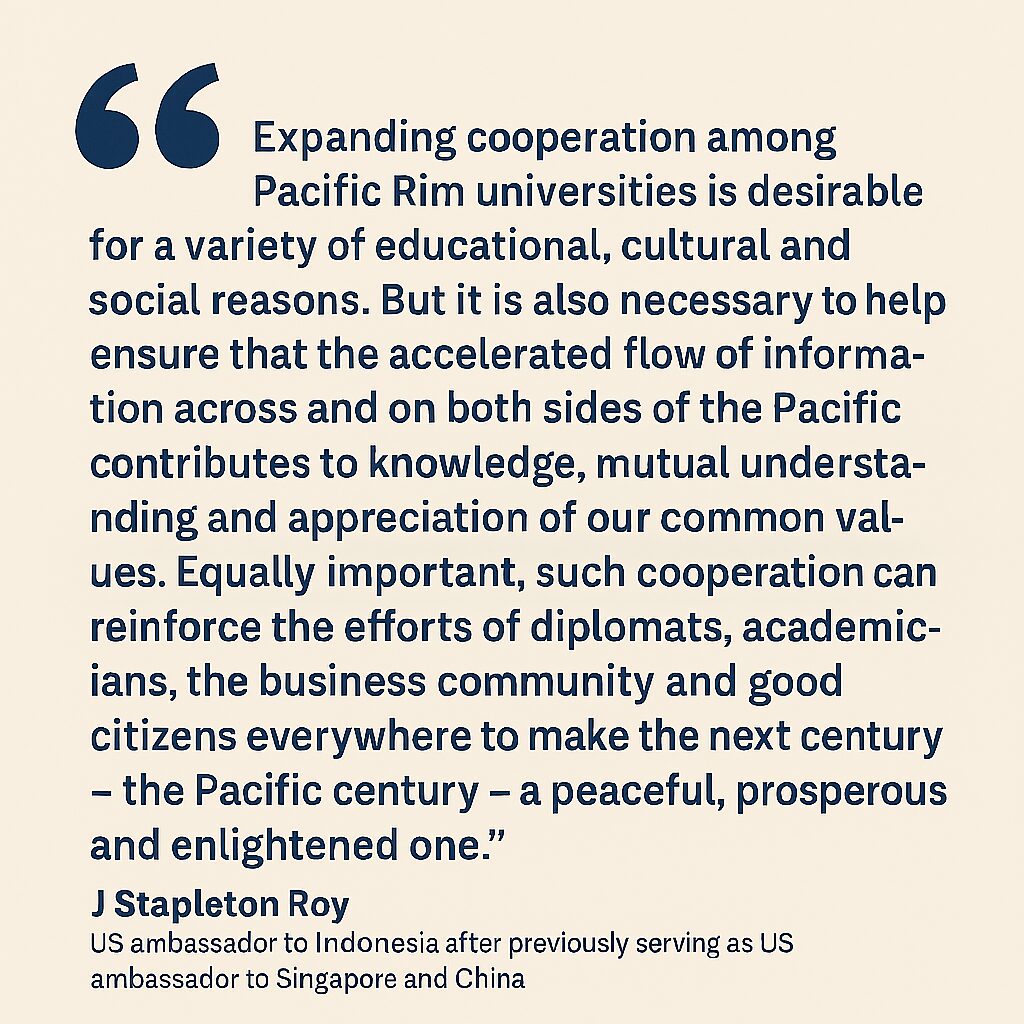
“But it is also necessary to help ensure that the accelerated flow of information across and on both sides of the Pacific contributes to knowledge, mutual understanding and appreciation of our common values.

“Equally important, such cooperation can reinforce the efforts of diplomats, academicians, the business community and good citizens everywhere to make the next century – the Pacific century – a peaceful, prosperous and enlightened one.”

Today, the need for such multilateral diplomacy is even more essential in a world characterised by contrary tendencies of development. On the one hand, the current globe is hyperconnected through trade, finance, modern communication and a mobility of people unseen in earlier phases of history.

The unprecedented and ubiquitous pace of technological development calls into question the very foundations of how life will be lived in the future.

Simultaneously, the globe is politically increasingly fragmented. We have witnessed a global diffusion of power to new national and institutional stakeholders, further exacerbated by demographic shifts, environmental degradation and socio-economic inequality, in addition to political and military conflicts.

In recent months, the enforced termination of joint US-Chinese institutes by the US administration and the request for payments of up to US$1 billion for the release of federal funding – like in the case of Harvard University and UCLA – have been illustrative of political threats to the global mission and the international nature of higher education. APRU’s diplomacy appears thus more urgent in 2025 than before.

A transnational framework apt to overcome political divisions and to build purpose-based trust is offered by the concept of planetarism. It moves beyond the limitations of internationalism by centring on the sustainability of human civilisation and the well-being of the entire planet, rather than the interests of sovereign nations.

Moving beyond the nation-state as the primary political unit, this framework promotes a new understanding of human interdependence with planetary systems, suggesting that a consciousness and collective responsibility for planetary issues is necessary to address the challenges of the Anthropocene.

This past summer, the University of Chile hosted one of our key events featuring educational diplomacy – the APRU Undergraduate Leaders’ Programme. Held for the first time in South America, the event convened 72 students from 13 economies.

The programme’s activities – including an international seminar on the future of democracy (attended by the President of Chile, Gabriel Boric, and featuring world-renowned speakers such as Nobel laureate Joseph Stiglitz and economist Ha-Joon Chang) – are entirely about educating a new generation of global leaders: leaders who will champion a visionary future form of leadership that is ethical, collaborative and transformative.

As University of Chile Rector Rosa Devés emphasised in her opening address: “[The world’s] complex, interconnected challenges… cannot be tackled in isolation. They demand cooperation, empathy and collective intelligence, especially from the new generations who will forge the future…

“It speaks to the ethical responsibility to act in a global context, to recognise the interconnection of our realities and to affirm that the dignity of every person, regardless of origin, is a shared obligation… We need leaders who understand that global citizenship is not about erasing differences but about learning to live with them and to lead through them.”

Macro-communities

Finally, a key purpose of transnational university networks is their power to help form a cohesive global community underpinned by the same values and priorities, a ‘planetary polity’. This is particularly true for university networks with a high degree of density per region of the globe, such as APRU in the Asia-Pacific.

When APRU was established in 1997, this happened purposefully and against the growing profile of the Asia-Pacific as a global economic superpower. The Asia-Pacific Economic Cooperation (APEC) had just been founded in 1989, in response to the growing interdependence of Asia-Pacific economies and the emergence of regional trade blocs in other parts of the world.

The mastermind behind the creation of APRU – Steven B Sample, president of the University of Southern California – intended APRU to be “analogous to, and supportive of, the efforts of the Asia Pacific Economic Cooperation’s (APEC) leaders to stimulate the creation of a community of Pacific nations”.

He invoked the social imaginary of such a community as APRU’s mission, namely “to help these institutions become more effective contributors to an increasingly integrated Pacific Rim community”.

As a purpose-driven model community of scholars, administrators, teachers and students from across the Pacific Ocean numbering close to three million people, APRU is thus a supporting architect of the Asia Pacific macro-community. We mirror the diversity of the Asia Pacific through all our activities, to mention only our network on Indigenous and First Nations Knowledges.

We enhance the representation of female leaders through our Asia Pacific Women in Leadership programme. We pursue the search for scientific truth and the fair and equitable implementation of solutions in our research-informed programmes on the region’s grand challenges – multi-hazards, global health, biodiversity, sustainability, food security and artificial intelligence.

We foster global citizenship – understanding, empathy and respect for the complexity of the globe and the very different local identities and contexts. Like in each community, civic participation is a key responsibility of global citizenship – one that we build through student leadership programmes, summer schools and student competitions.

Considering unprecedented global challenges and persistent global turbulence, it is vital to reaffirm for the mission of university networks – with the words spoken by Pablo Neruda – that “only with a burning patience can we conquer the Splendid City which will give light, justice and dignity to all mankind”.

Thomas Schneider is the chief executive of the Association of Pacific Rim Universities. This is an abridged version of his recent keynote speech – “The role of transnational university networks in addressing global challenges in times of geopolitical turbulence” – at the opening of the University of Chile’s International Week.
This article is a commentary. Commentary articles are the opinion of the author and do not necessarily reflect the views of University World News.

Related Articles
APRU Delegation Visits Shanghai Jiao Tong University and Tongji University
more
In Memoriam: Dr Yong Zulina Zubairi
more
Deepening APRU Connections Across Southeast Asia
more
The Association of Pacific Rim Universities and the Digital Education Council Announce Collaboration
more
APRU Welcomes Three New Members: Universidad Nacional Autónoma de México, Universiti Brunei Darussalam, and VinUniversity
more
Voices of Inclusion: Partnerships for Global Advocacy
more
APAIE 2026: Asia Pacific Partnerships in Mentoring Aspiring Women Leaders
more
Programs with Purpose: Collaborative Pathways for the Global Good
more
Building Resilient and Inclusive Higher Education Systems
more
APRU Strengthens Strategic Partnerships Across the United States
more
In Memory of Professor Emma Johnston AO
more
Roots and Bridges 2025: A Year of Connection, Reflection, and Indigenous-Led Knowledge Sharing
more
Breaking Stereotypes and Building Intercultural Skills
more
Redefining the Global Classroom: How the APRU Virtual Student Exchange Program Makes Global Learning Accessible to All
more
Sailing in the Wake of Neruda: APRU Strengthens Partnerships in Chile
more
Global Range, Local Change: APRU Senior International Leaders Unite at Universidad San Francisco de Quito
more
APRU Welcomes SUSTech: Celebrating Excellence Across the Pacific Rim
more
APRU SDG4GC 2025 Program Concludes with Innovative and Collaborative Social Impact Proposals
more
Strengthening Regional Collaboration: APRU Visits Six Leading Australian Universities
more
APRU Undergraduate Leaders’ Program 2025: Building Bridges for Future Global Citizenship
more
Universidad de Chile Inaugurates, for the First Time in South America, the APRU Undergraduate Leaders' Program
more
Biomedical research enters new era amid global shifts
more
Diversity, Inclusivity, and Action: APRU SDG4GC Sets the Stage for its 3rd edition
more
AI and Human Longevity: Universities’ Role Beyond Research
more
APRU’s 2025 Roots and Bridges Series opens with a deep dive into Waipapa Toitū
more
APRU Certificate in Global Climate Change Leadership 2025: Fostering Future Climate Leaders
more
APRU Open Dialogues 4th Cohort: Students Reflect on Stereotypes in a Globalized World
more
APRU Certificate in Global Climate Change Leadership Launches, Empowering the Next Generation of Climate Leaders
more
Breaking Boundaries in Education: Instructors Reflect on the APRU Virtual Student Exchange Program
more
APRU Announces Indigenous and First Nations Knowledges Network Presidential Champions
more
[APRU Member Visits] APRU Chief Executive Visits Waseda University and Keio University to Strengthen Collaboration
more
APRU Member Visit to University of Michigan Highlights Progress on Global Engagement
more
Setting the Stage for Forest Innovation: APRU FELLI's Inaugural Meeting
more
New Member Visit to University of Alberta Helped Identify Opportunities for Collaboration
more
Professor Rocky Tuan Leads the Way as APRU's Newest Ambassador
more
APRU and Universiti Malaya Discuss Current and Future Partnership
more
Universidad de Chile Celebrated the 3rd In-person International Workshop of the APRU Indigenous Knowledges Network
more
Greater Bay Area Science Forum highlights Hong Kong’s super-connector role
more
APRU Has Fruitful Discussions with Chulalongkorn University in Bangkok
more
APRU Visits Top Universities in China
more
APRU Prepares Onboarding Session for National Yang Ming Chiao Tung University’s Top Leaders
more
Asia Pacific Open Dialogues: Uniting University Voices Against Partner Violence
more
Student Global Climate Change Simulation 2024 equips students with climate negotiation skills
more
Empowering Global Citizenship: Highlights from the APRU SDG4GC 2024
more
Undergraduate Leaders’ Program Celebrates its Decade Anniversary Exploring Sustainable Development in Shanghai
more
Expanding horizons with the APRU Virtual Student Exchange Program
more
Connecting the Indigenous Knowledges: Roots and Bridges Seminar Series 2024
more
APRU welcomes three exceptional members to the network: National Yang Ming Chiao Tung University, University of Alberta, and University of Michigan
more
APRU Open Dialogues 2nd Cohort brings together students to dialogue about what is the right to Higher Education
more
Building Bridges: Universidad de Chile's Inclusive Education Initiatives Through APRU Virtual Student Exchange at APEC HRDWG Meeting
more
Fruitful Visits to APRU members in China
more
APWiL webinar highlights the many roles women academics juggle while gaining ground in leadership
more
AI in maternal health – how research and policy intertwine
more
APRU At APEC Policy Partnership on Science, Technology, and Innovation in Lima, Perú
more
Gathering views, exploring new ways: APRU delegation meets Latin American members
more
“Staff training” core to online int’lisation
more
Researchers identify gaps in implementing AI in healthcare
more
Delegation of the Association of Pacific Rim Universities (APRU) visited the Central House
more
IESGA's 6th Global Conference Forges Pathways to Empowering Sustainability
more
APRU SWM Forum 2023: Advancing UN SDGs and ESG for a Sustainable Future
more
Indigenous Knowledge Has the Power to Help Address the Climate Crisis
more
APWiL Mentoring Program keeps growing, 4th Cohort takes off
more
APRU Indigenous Knowledges Network meets in Melbourne
more
SDG4GC - How a growth mindset can open a world of opportunity
more
APRU Open Dialogues tackles Gender-Based Violence Prevention in Learning Environments
more
APRU APEC University Leaders' Forum 2023 on KTVU FOX 2, CCTV+, Xinhua and China Daily
more
Innovative Approaches to Addressing Biodiversity Challenges: Thought Leaders Convene at the APEC University Leaders’ Forum 2023
more
President Gao Song Met with the Chief Executive of APRU
more
Visits to Korean, Taiwanese APRU-members bode well for the network in 2024
more
APWiL Mentoring Program 3rd Cohort concludes, having promoted teaching and learning in both directions
more
Routes Towards a Sustainable Society: Forum with Springer Nature Editor-in-Chief
more
Towards a Sustainable Biochar Market in Korea
more
APRU Supports Frontiers Planet Prize 2024: Call for Submission
more
APRU Members Shine at Healthy Women Healthy Economies Prize
more
Invitation to APRU Members to Join CUPP 2024-2025 Tender
more
APRU inspired by visits to UC Davis and UC Santa Cruz
more
AI for Social Good Summit Gathered Academics and Gov’t Representatives to Showcase Joint Research Outcomes Enhancing Wellbeing in Southeast Asia
more
APRU Steering Committee 2023-2024
more
Public Agencies from Thailand Participated in AI for Social Good Summit
more
2023 Global ESG Forum in Singapore Underscores Biodiversity and ESG Reporting as Key Drivers to Sustainable Development
more
CUHK Hosts APRU Undergraduate Leaders’ Program on Sustainable Cities Development
more
The University of Hong Kong hosts APRU Presidents’ Meeting on Sustainable Future Solutions
more
Keio University News: Keio University Launches 2023 Mentoring Program to Promote Female Faculty Member Empowerment and Leadership
more
APWiL Third Cohort & Professor Freshwater as new APWiL Presidential Champion
more
Country Workshop Aims to Turn AI Research Results into Actionable Public Policy
more
Global Climate Change Simulation Offers USC Students New Perspectives on Worldwide Fight
more
UO Students Co-host APRU Global Climate Change Simulation
more
World BOSAI Forum 2023 facilitates forward-looking visits to Japanese APRU members
more
APAIE 2023: APRU universities showcase successful student programs for social impact
more
Workshop Reveals Impressive Progress on AI for Social Good Project
more
New APRU Member – The University of Adelaide
more
UP News: UP participates in APWiL Mentoring Program 2022
more
APRU on Bloomberg: The next stage: APRU-Google-UN ESCAP AI for Social Good Project now working directly with government agencies
more
APRU APEC University Leaders’ Forum 2022 Successfully Concludes with High-level Discussions on Preparing for the Next Pandemic
more
UMelbourne News: An international focus on Indigenous knowledge
more
Tec News: APRU universities meet in San Cristóbal de las Casas to hold dialog on indigenous knowledge in the Pacific Rim
more
The APRU Climate Change Simulation- Preparing Students to Lobby Leaders for Vital Actions
more
APRU and Government Partners Organize Workshop to Strengthen AI policy in the Asia-Pacific Region
more
APRU MetaGame Conference 2022 Successfully Concludes in Hong Kong With Academics Pushing New Ideas on the Application of Esports in Education
more
Students from Tongji School of Medicine Enrolled in the Top 10 Entries of the APRU Global Health Virtual Case Competition 2022
more
APRU Brings Universities into the World of Esports with MetaGame Conference 2022
more
CUHK Biologists Unveil the Genetic Histories of Centipedes and Millipedes to Contribute to Studies of Biodiversity and Ecology
more
APRU Steering Committee 2022-2023
more
APRU ends pandemic hiatus with first physical meeting at NTU Singapore and highlights urgency to collaborate through international university networks
more
APRU Readies for Looming Book Launch with Springer on Safety and Resilience of Higher Educational Institutions
more
APRU on Bloomberg: APRU Readies for Looming Book Launch with Springer on Safety and Resilience of Higher Educational Institutions
more
No Easy Answers on Protection of AI Data Rights, Webinar by HBS and APRU Shows
more
APRU on The Fiji Times: FNU Students Join Global Climate Change Simulation
more
Webinar by Heinrich Böll Stiftung and APRU takes deep dive into Explainable AI
more
Heinrich Böll Stiftung and APRU Discuss Risk-based Governance of AI in First Joint Webinar
more
Tec News: Tec Professors, in a Global Mentoring Project for Women
more
UBC News: 2 UBC Esports undergrads win industry research scholarships
more
APEC Healthy Women Healthy Economy Prize Accepting Applications 2022
more
APRU on UNESCO News: New report “Moving minds: Opportunities and challenges for virtual student mobility in a post-pandemic world”
more
APRU on SCMP: Covid-19 wrecks exchange programme plans, as record low number of Hong Kong university students went overseas in last academic year
more
APRU on HKMB: Digital games exercise minds
more
UCLA News: Building the foundation — and networks — needed to diversify university leadership
more
UC Davis News: APRU, UC Davis and Hong Kong University of Science and Technology Launch Second Cohort of Asia-Pacific Women in Leadership Mentoring Program
more
APRU on Nikkei: COVID has made a bad situation worse for women academics
more
APRU on SCMP: Virtual foreign exchange allowing students to ‘study abroad’ without leaving home will outlast Covid-19
more
UH News: Esports fellowship creates global opportunities for UH students
more
APRU Metagame Conference 2021 Returns at Cyberport’s Annual Digital Entertainment Leadership Forum
more
Times Higher Education Awards Asia 2021: winners announced
more
APRU Steering Committee 2021-22
more
The 16TH APRU Multi-Hazards Symposium 2021: Transdisciplinary Collaboration for Disaster Resilience
more
APRU Celebrates Successful Completion of Its APWiL Mentoring Program’s First Cohort
more
APRU on The Jakarta Post: A Mounting Battle that Starts at Home
more
New APRU Member – Tongji University
more
New APRU member - Simon Fraser University
more
APRU on UWN: Long way to go for parity for women in HE leadership
more
APRU on World Economic Forum: Universities can be 'living labs' for sustainability
more
APRU on Associated Press: APRU partners with United Nations ESCAP on The Asia Pacific Mayors Academy to Empower Mayors as Regional Leaders for Sustainability with Training Tailored to Unique Urban Challenges for a More Resilient Future
more
Asia Summit: ‘penalty systems’ and ‘male allies’ address gender gap
more
Cyberport Brings Together Hong Kong and Pacific Rim Youth for Esports Exchange
more
YESPORTS ESPORTS APPRENTICESHIP Recipient Announced
more
APRU on The Business Times: Safeguarding Our Future With AI Will Need More Regulations
more
Winners of the 2021 APEC Healthy Women Research Prize
more
APRU on South China Morning Post: Governments, business and academia must join hands to build trust in AI’s potential for good
more
APRU on JUMPSTART: How Esports Fellowships Can Pave the Way for A Stable, Ethical, Diverse Industry
more
Good-bye 2020, Welcome 2021!
more
APRU Launches the First Global Inter-University Esports Conference and Fellowship Program
more
APRU Quarantunes Competition Connects and Uplifts Student Communities through Music, Boosting Spirits during Ongoing Pandemic
more
APRU on Times Higher Education: ‘Oversight needed’ so AI can be used for good in Asia-Pacific
more
APRU releases AI for Social Good report in partnership with UN ESCAP and Google: Report calls for AI innovation to aid post-COVID recovery
more
Civic Resilience and the COVID-19 Crisis (Part 2 of 2)
more
AI for Social Good network releases new report
more
TEC News: Song of Tec students wins 1st place among universities worldwide
more
Quarantunes Student Music Competition
more
Collaboration, technology and global health policy
more
Asia-Pacific Mayors Academy concludes first cohort
more
New Member Spotlight: Shanghai Jiao Tong University
more
New Member Spotlight: Universidad San Francisco de Quito
more
AI For Everyone: New Open Access Book
more
University of Malaya takes the lead on the APEC University Leaders’ Forum 2020
more
Upgrade needed for universities’ workplace wellness programs, new APRU survey shows
more
UNU-IAS and Partners Launch Asia-Pacific Mayors Academy
more
Cities and Refugees – 2019 Global Student Design Ideas Competition
more
What are the co-benefits to SDG14 when making progress toward other SDGs? Initial findings reported at APEC SOM3 from the APRU Pacific Ocean Program
more
AI Policy for the Future: Can we trust AI?
more
Sustainable Urban Development Mayors Fellowship
more
APRU Partners to Close the Digital Skills Gap at APEC
more
Kick-off for AI for Social Good―A United Nations ESCAP-APRU-Google Collaborative Network and Project
more
APEC Project DARE (Data Analytics Raising Employment)
more
APRU Inaugural Sustainable Cities and Landscapes Design Field School
more
APRU Contributes Insights on Innovation Networks and Latest Research Partnerships to Policymakers at APEC Meetings
more
APEC Health Meetings in PNG enriched by APRU insights
more
The APEC 2018 Workshop on Innovative Marine Debris Solutions, July 26-27, 2018, Beijing
more
Experts Welcome Framework for Developing APEC Skills
more
APEC University Leaders’ Forum Featured in University World News
more
Invitation to the 6th APEC Conference on Cooperation in Higher Education
more
APRU Research Experts say APEC Economies Must Build Educated and Mobile Workforces to Offset the Negative Impact of Aging Populations
more
APRU at the UN World Conference on Disaster Risk Reduction
more
APRU-IRIDeS Multi-Hazards Summer School 2014 Report is out now
more
2nd Multi-Hazards Summer School 2014
more
9th Multi-Hazards Symposium 2013
more
Partnering for a less hazardous planet: Interview with Professor John Rundle
more
1
176