
APRU at APAIE 2026
APRU was delighted to contribute to APAIE 2026 with a series of panel sessions showcasing how our network’s collective expertise is shaping the future of international higher education across the Asia Pacific. This article is one of four in a special APRU series sharing insights from our conversations at APAIE 2026. APAIE 2026—the premier gathering of international higher‑education leaders, policy makers, and industry professionals—hosted by The Chinese University of Hong Kong convened from February 23–27 under the theme Asia‑Pacific Partnerships for the Global Good. This year’s conference brought together 3,592 participants from 72 regions, featured 600+ organisations in the exhibition, welcomed 570 delegates to pre‑conference workshops, delivered 120 presentations and 3 plenaries.
Session Report
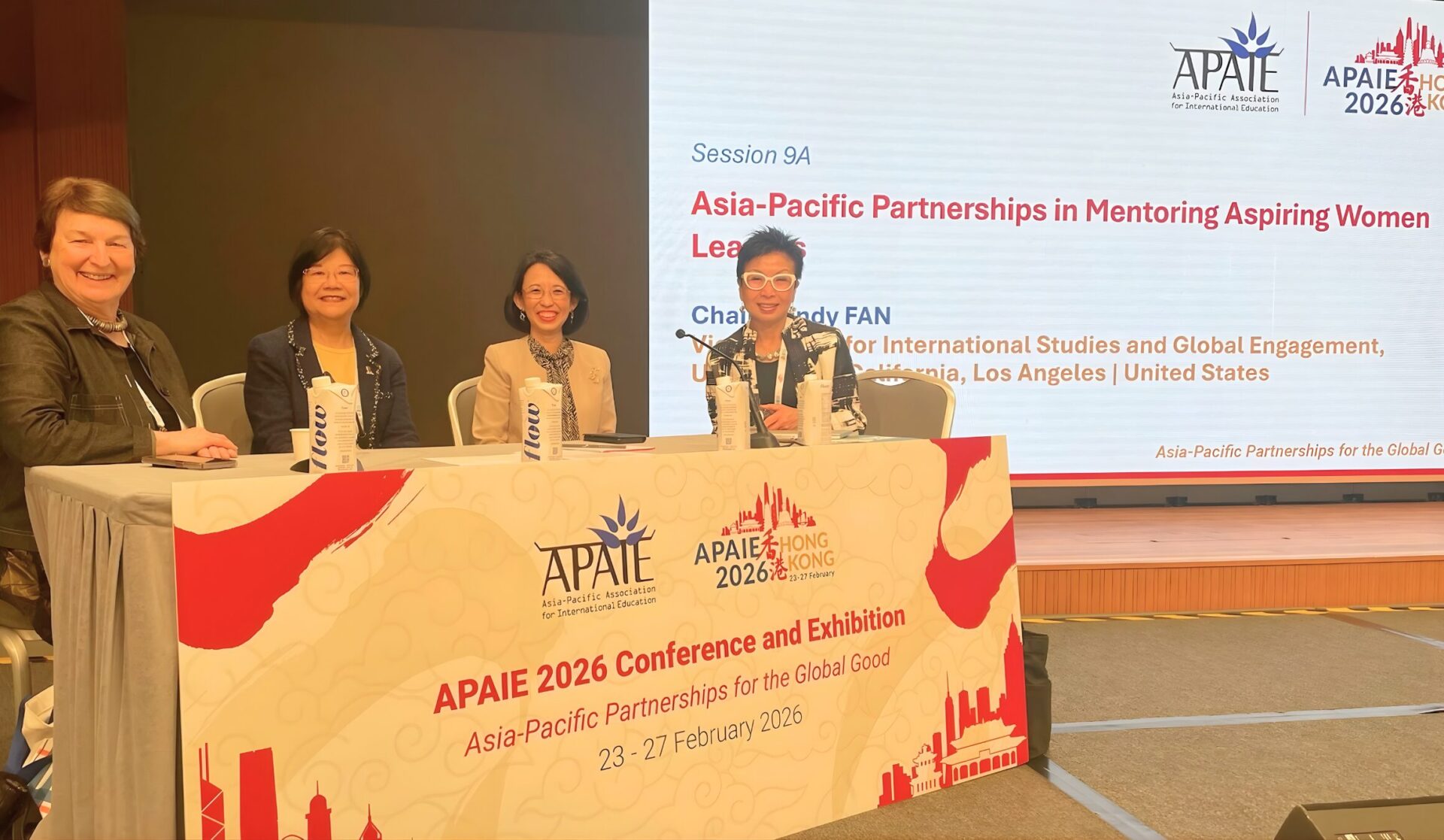
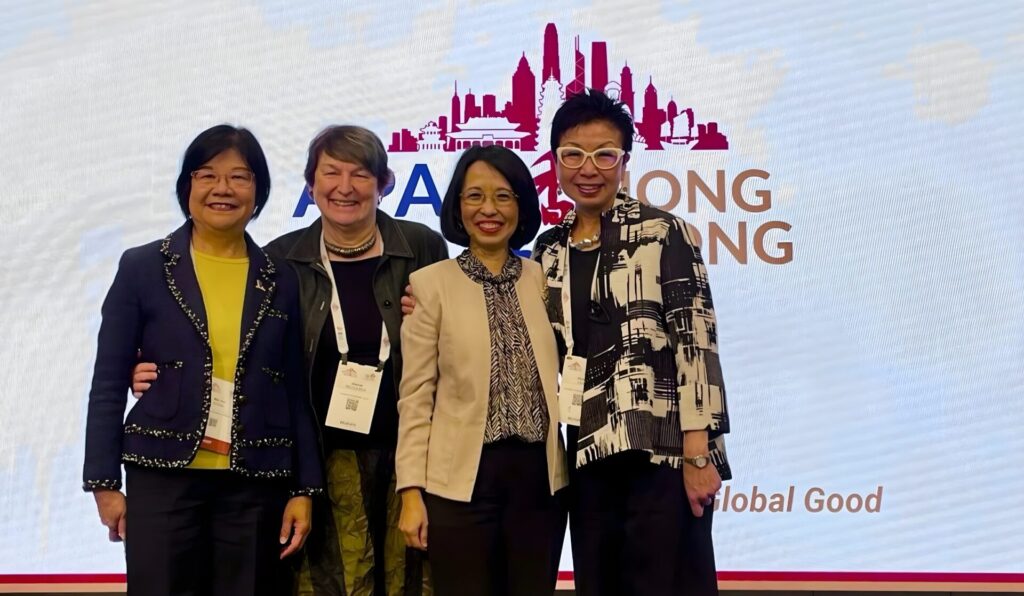
Chaired by Professor Cindy Fan, Vice Provost for International Studies and Global Engagement University of California, Los Angeles (UCLA), the session explored how mentorship (formal and informal) accelerates women’s leadership and how institutions can embed supportive structures. Panelists traced personal journeys that evolved into campus‑wide and national initiatives, drawing on the APWiL (Asia‑Pacific Women in Leadership) Mentoring Program as a catalyst for change across the region.
Mentoring as Both Practice and Mindset
Professor Cindy Fan described how mentorship, especially when it starts early and unexpectedly, becomes a lifelong accelerator for leadership. Throughout her career, mentors pushed her into roles she did not initially feel ready for, such as organizing professional conference sessions as a graduate student, chairing a department as a junior faculty member, and contributing to senior leadership councils where she learned to speak with confidence. Public sponsorship, such as nominations for competitive opportunities, coupled with repeated “practice moments” cultivated visibility, resilience, and a habit of stepping forward even amid uncertainty. Fan underscored that effective mentorship is more than skills transfer; it’s structured exposure to decision‑making spaces where leadership must be exercised again and again. As she put it, “Practice makes perfect… mentors pushed me to practice, organize sessions, chair departments and find my voice.”
Collective Networks Transform Individuals into Leaders
Professor Joanna Regulska, Vice Provost and Dean, Global Affairs University of California, Davis (UC Davis) offered a reflective narrative on how her leadership was shaped by the “collective power” of many mentors across life stages. Early experiences cultivated empathy and a readiness to take risks; later, learning flowed reciprocally with students, colleagues, and even family members, reminding her that mentorship is rarely linear and never one‑way. Regulska emphasized the empowering force of solidarity, from intimate scholarly communities to large‑scale civic mobilization such as the Polish Women’s Congress, which transforms individuals into confident leaders. Her message: sustainable leadership pathways for women depend on shared strength, intentional practice, and the courage to give back as others did for us. She said, “There was a collective power of many, many, many people over my life… taking risks is scary, but we rely on others, and later we must give back to those who come after us.”
APWiL: From Personal Growth to Institutional Change
Professor Yvonne Lim, Associate Deputy Vice Chancellor (Academic and International), Universiti Malaya showed how participation in APWiL can evolve from individual mentor–mentee growth to institution‑wide infrastructure and even national‑level impact. At Universiti Malaya (UM), sustained engagement created a “critical pool” of mentors and mentees spanning 11 faculties (23 participants across five cohorts). UM then formalized that momentum into YouMentor, a campus program housed under the Registrar to ensure governance, continuity, and scale. The same network energy enabled UM to host its first university‑wide International Women’s Day event with senior leadership visibility and to co‑create She Leads, a national women’s leadership initiative in partnership with Malaysia’s Higher Education Leadership Academy. The through‑line: use APWiL to seed cross‑faculty communities, formalize ownership within the institution, and leverage that platform to co‑create policy‑aligned programs beyond campus.
Mentorship Through Opportunity, Service, and Shared Growth
Professor Mai Har Sham, Pro-Vice-Chancellor and Vice-President (Research), The Chinese University of Hong Kong reflected on how mentors encouraged her to seize opportunities that did not always map neatly onto traditional reward systems but proved foundational for leadership. Early in her career, senior colleagues invited her to take on medical curriculum reform, student well‑being initiatives, and admissions leadership through high‑effort roles that deepened her understanding of institutional change. She stressed that mentoring is multidirectional: she has learned as much from research students and postdoctoral fellows as they have from her, and their scientific curiosity has strengthened her resolve to lead with humility and openness. Sham’s guidance to emerging leaders is to embrace unplanned opportunities and build leadership through service and shared learning, she said, “Opportunities are always there, but you have to step up and grab them… even when they don’t seem comfortable at first.”
Key Insights
Across four perspectives, the session underscored a common insight: mentorship is both personal and structural. Personal stories of risk‑taking and reciprocity intersect with institutional scaffolding, just like APWiL‑inspired programs, that convert individual growth into community capacity and national pipelines. Partnerships across borders help members translate lessons into campus policies and scalable initiatives, strengthening leadership ecosystems across the Asia Pacific.